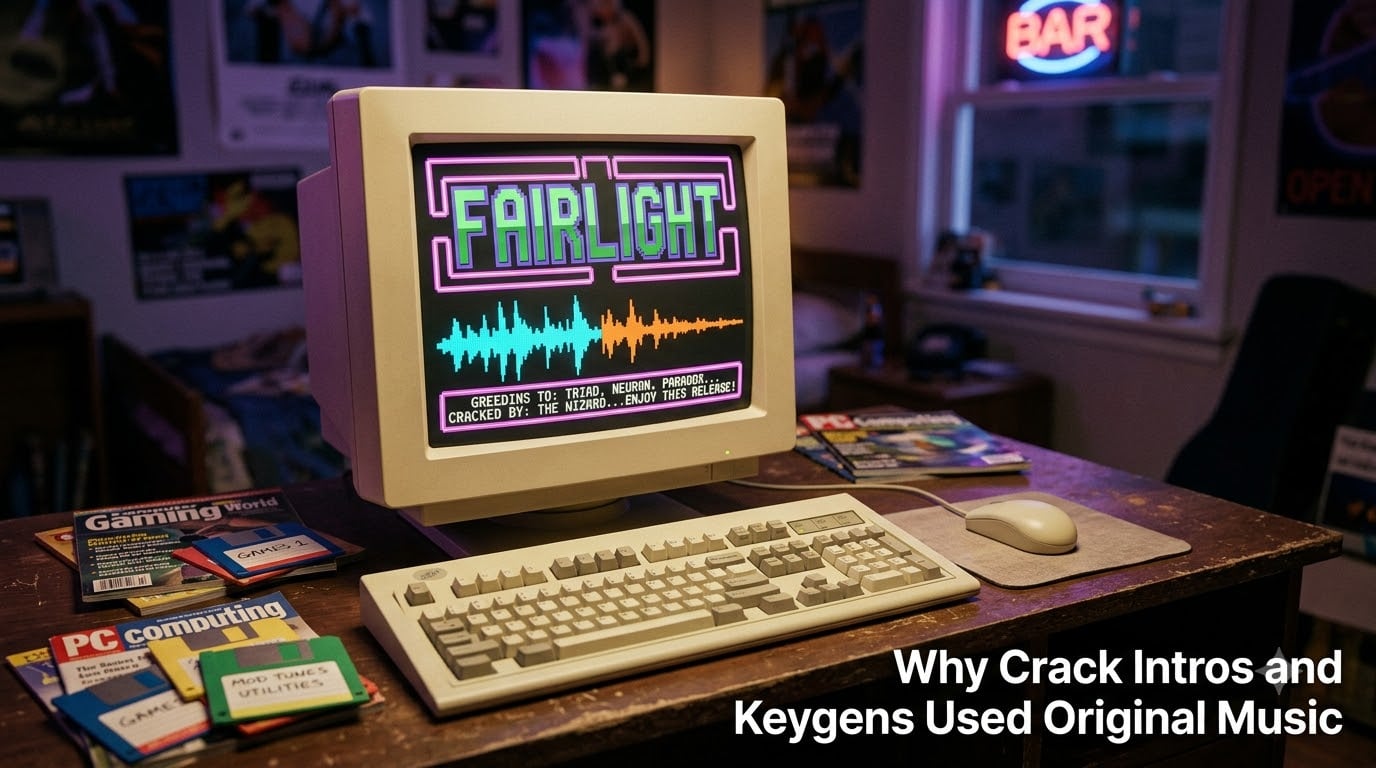
Crack intros and keygens used original music because the cracker groups behind them came directly from the demoscene, where self-made chiptune tracks were a badge of skill and identity. With floppy disks and dial-up transfers limiting every kilobyte, hand-crafted tracker tunes packed impressive sound into files small enough to ride along inside a cracked program.
I grew up hearing these strange looping tracks every time I downloaded something off a BBS or a friend’s CD. Years later I learned what I was actually listening to, and it rewrote how I thought about computer music entirely. Let me walk you through the story.
IN THIS ENTRYTable of Contents
- 1What is a Crack Intro / Cracktro?
- 2The Demoscene Connection
- 3Why Chiptunes Were Perfect for Crack Intros
- 4The Rise of Tracker Music in the Warez Scene
- 5Famous Scene Groups and Their Soundtracks
- 6The Modern Chiptune Revival
- 7The Legal Gray Area
- 8Frequently Asked Questions
- 9Why does keygen have music?
- 10What is keygen music?
- 11Why does chiptune sound so good?
- 12Is chiptune music copyrighted?
- 13What does keygen mean?
- 14The Legacy Lives On
What is a Crack Intro / Cracktro?
A crack intro, usually shortened to cracktro, is the small animation and audio sequence that plays when you launch a cracked or pirated program. Before the software itself runs, you see a group logo, scrolling text crediting the release, and a piece of original music that lasts anywhere from 30 seconds to a few minutes.
The first cracktros appeared on the Commodore 64 in the early 1980s. When a cracker broke the copy protection on a game, they patched in their own intro screen so the user would know who to thank. This was the birth of what we now call keygen music.
The format mattered as much as the function. Cracktros were tiny. On a C64, a whole intro had to fit in less than 4 KB of memory. On the Amiga, you got a little more room, but every byte still mattered because releases traveled over phone lines at blistering speeds of around 1,200 to 2,400 baud.
The Demoscene Connection
To understand why crack intros and keygens used original music, you have to understand the demoscene. The demoscene was a European underground subculture that started in the 1980s, where programmers and artists competed to squeeze the most impressive visuals and music out of limited hardware.
Demosceners were not criminals. They were hobbyists obsessed with pushing the limits of sound chips like the SID in the C64 and the Paula chip in the Amiga. They held competitions at LAN parties called demo parties, and they traded their work on bulletin board systems across Europe.
Cracker groups and demo groups shared the same talent pool. The same kid who wrote a stunning Amiga demo on Saturday night might crack a game on Sunday morning. Many legendary groups started as demo crews and pivoted into software cracking because it paid better and reached more users. Groups like Fairlight, Razor1911, and 2000ad all had roots in this crossover scene.
Music was central to demo culture. A great demo without a great soundtrack was incomplete. When these artists moved into cracking, they brought their musicians with them. That is why nearly every cracktro shipped with an original score. It was identity, advertising, and artistry rolled into one file.
Why Chiptunes Were Perfect for Crack Intros
Chiptune music is sound built directly from old computer hardware. The Commodore 64’s SID chip could only play three voices at once. The Amiga’s Paula chip could handle four channels of 8-bit samples. These limits forced composers to be extremely creative with arrangement and melody.
That constraint turned out to be a gift. Chiptune tracks are catchy by necessity. With only a handful of voices, every note has to earn its place. A great chiptune melody will loop in your head for days, which is exactly the kind of earworm a cracking group wanted associated with their work.
There were also very practical reasons to favor chiptune and tracker formats. An MP3 file from the late 1990s was 3 to 5 MB per minute. A tracker MOD file of the same length could fit in 200 to 500 KB, sometimes less. When you are uploading a cracked game over a 56k modem, that difference is the gap between a 30-minute transfer and an all-night transfer.
Then there is the legal angle. Using a copyrighted pop song in your cracktro would expose the group to lawsuits from record labels. Writing original music eliminated that risk entirely while letting the group’s in-house musicians showcase their skills.
The Rise of Tracker Music in the Warez Scene
Tracker music changed everything. A tracker is a type of music software that plays back small audio samples on a grid, allowing composers to build full songs by arranging patterns of notes rather than recording audio directly. The most famous tracker formats were MOD, S3M, and XM.
MOD files originated on the Amiga in 1987 with Ultimate Soundtracker. They could hold four channels of sampled audio plus sequencing data, all in a single compact file. By the early 1990s, FastTracker 2 and Scream Tracker 3 popularized the XM and S3M formats on the PC, giving composers more channels, better effects, and crisper sound.
Cracker groups embraced tracker formats because the files were tiny, the quality was surprisingly good, and the tools were free. Programs like FastTracker 2 and ProTracker let a single musician produce a professional-sounding track without expensive studio gear. For a cracking crew working out of a bedroom, this was perfect.
The result was an explosion of original music. By the mid-1990s, the top scene groups had dedicated musicians who produced dozens of tracks per year. A single cracking crew might release 50 to 100 intros in a year, each with its own soundtrack. That is a lot of music, and a lot of it was genuinely excellent.
Famous Scene Groups and Their Soundtracks
A few cracker groups became legendary partly because of their music. Fairlight, founded in 1987 in Sweden, was one of the earliest demo-turned-cracking groups. Their intros often featured moody, atmospheric chiptunes that set them apart from competitors.
Razor1911, founded in 1985 in Norway, became one of the most respected cracking groups of all time. Their intros were known for high production values, polished graphics, and memorable music. Razor1911’s soundtrack work is still studied by chiptune fans today, and you can explore legendary Razor1911 crack intro tracks in dedicated archives.
The 2000ad group was another major player, active from 1988 into the 2000s. Their intros leaned heavily on Amiga-style tracker music and helped define what a classic cracktro should sound like. Many of these classic keygen music from the 2000ad team tracks are still circulating on preservation sites today.
Other notable groups include Skid Row, who specialized in cracking educational software, and Class, who were famous for their clean coding style. Each had a sonic signature. If you heard a track with a certain mood or melody style, you could often guess which group made it.
The Modern Chiptune Revival
The cracking scene shrank dramatically after the late 2000s. Broadband internet, always-online DRM, and shifting user habits made old-style piracy releases less relevant. But the music did not disappear.
A whole modern chiptune revival grew directly out of keygen culture. Artists like Anamanaguchi, Chipzel, and Bit Shifter cite cracktros and demoscene music as major influences. Independent game developers now commission chiptune tracks to evoke nostalgia for that era.
Preservation efforts have kept the originals alive. Sites like Pouet, SceneSat, and dedicated keygen music archives have collected thousands of original tracker files from defunct scene groups. If you want to hear what made the warez scene sound so distinctive, these archives are the place to start.
You can also hear this influence in modern horror games, indie titles, and synthwave tracks. The sound of the Commodore 64 and the Amiga has become shorthand for retro computing, and it all traces back to those tiny intros hiding inside pirated software in the 1980s and 1990s.
The Legal Gray Area
One common question is whether cracktro music itself is legal to download and listen to today. The honest answer is that it sits in a gray area. The music was original and created by identifiable artists, so the compositions are copyrighted by those musicians or the groups they belonged to.
Many groups have explicitly released their old tracks into the public domain or under Creative Commons licenses after disbanding. Others never made a formal statement, which means the legal status depends on who owns the rights and whether they have chosen to enforce them.
Practically speaking, preservation archives host this music for historical and educational purposes. Downloading a tracker file for personal listening is rarely prosecuted. Distributing it commercially without permission would be a different matter, but listening and studying is generally accepted in retro computing and demoscene communities.
Frequently Asked Questions
Why does keygen have music?
Keygens have original music because the cracking groups behind them came from the demoscene, where composing original tracks was part of the culture. The music served as group branding, a technical showcase, and a way to avoid copyright problems with commercial songs.
What is keygen music?
Keygen music refers to the original chiptune and tracker compositions embedded in crack intros, key generators, and pirated software releases. It is a subgenre of electronic music that emerged from the warez scene and demoscene in the late 1980s and 1990s.
Why does chiptune sound so good?
Chiptune sounds good because it is built from simple waveforms on vintage sound chips, which forces composers to focus on melody, rhythm, and arrangement. The hardware limits create a distinctive lo-fi character that many listeners find catchy and nostalgic.
Is chiptune music copyrighted?
Chiptune music is copyrighted when the composer or their group owns the rights. Many old scene groups released their tracks freely, but newer chiptune artists typically hold standard copyrights on their work.
What does keygen mean?
A keygen, short for key generator, is a small program that produces valid serial numbers or activation codes for commercial software. Cracking groups often paired keygens with intro animations and original music, which is where the keygen music genre gets its name.
The Legacy Lives On
Crack intros and keygens used original music because that music carried the identity of the demoscene into the warez world. It was technically practical, legally safe, and culturally meaningful. Every floppy and CD that traded hands in the 1990s carried a tiny piece of underground art alongside the pirated software.
Today, that music lives on through preservation archives, modern chiptune bands, and a generation of listeners who still get those old tracker loops stuck in their heads. If you want to explore the sound yourself, keygenmusic.net hosts an extensive collection of original tracks from the groups that defined the era.
The next time you hear a chiptune melody in a retro-styled indie game, you are hearing the direct descendant of a cracktro from 1994. That is the kind of cultural staying power that few underground movements ever achieve.