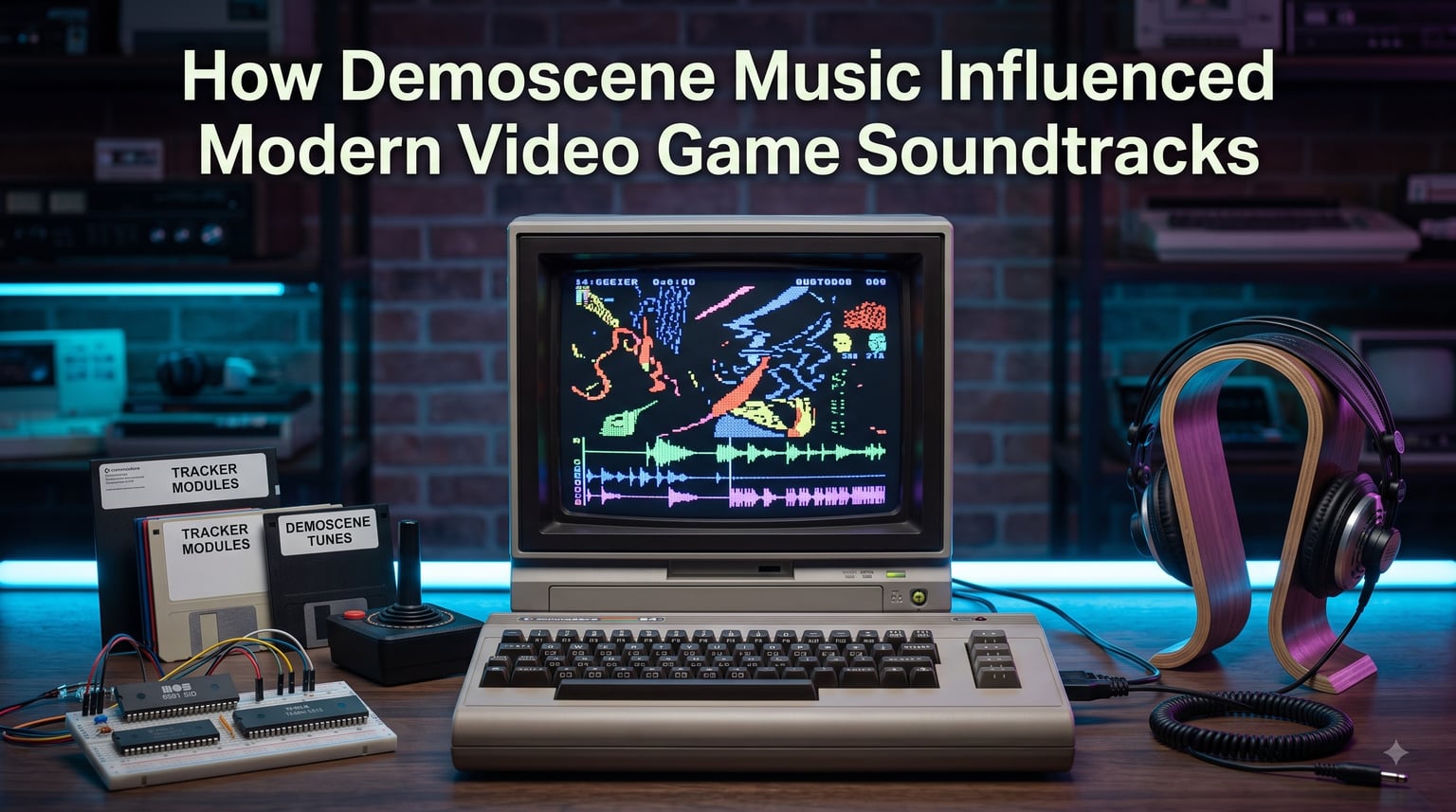
Every time you hear a game soundtrack that shifts intensity based on whether you are sneaking or fighting, you are listening to a concept born in the demoscene. The connection between these underground computer demos and the billion-dollar game audio industry runs deeper than most players realize.
In this article, we explore how demoscene music influenced modern video game soundtracks. We will trace the journey from cracked game intros in the 1980s to the adaptive music systems powering today’s biggest titles. You will learn about tracker technology, key groups like Future Crew, the rise of keygen music, and why hardware constraints produced some of the most memorable melodies in gaming history.
Whether you are a game audio enthusiast, a chiptune fan, or someone who stumbled into the rabbit hole of MOD files, this is the story of how an underground art movement quietly shaped the way games sound.
IN THIS ENTRYTable of Contents
- 1What Is the Demoscene?
- 2The Technology Behind Demoscene Music
- 3How Demoscene Music Influenced Modern Video Game Soundtracks
- 4Key Demoscene Groups That Shaped Game Audio
- 5From Cracktros to Keygen Music Culture
- 6Adaptive and Dynamic Music: The Demoscene Legacy
- 7Notable Demoscene Musicians Who Went Professional
- 8The Creativity Paradox: Constraints Versus Unlimited Technology
- 9FAQs
- 10How does soundtrack music affect the video game experience?
- 11What is considered the greatest video game soundtrack of all time?
- 12Why did early video game composers have to be creative with their music?
- 13Why are video game soundtracks so good?
- 14What is tracker music in video games?
- 15The Enduring Influence of Demoscene Music
What Is the Demoscene?
The demoscene is a computer art subculture where programmers, musicians, and graphic artists create self-running audiovisual demonstrations called demos. These are not games or applications in the traditional sense. They are competitive art pieces built to push hardware to its absolute limits while delivering synchronized music and visuals in real time.
It started in the early 1980s on platforms like the Commodore 64 and Amiga. Software crackers would add small animated intros to their cracked games as digital signatures, showing off their skills and group identity. Over time, these cracktros became more elaborate than the games themselves. The intro sequence became the main event, and a new creative community was born.
By the late 1980s and early 1990s, the demoscene had separated from piracy entirely. Groups formed purely to create demos for competitions at demoparties across Europe. These gatherings became the proving ground for some of the most technically gifted programmers and musicians in the world.
The cultural significance of this movement is now formally recognized. In 2020, Finland became the first country to add the demoscene to its UNESCO national register of intangible cultural heritage, with Norway and Germany following suit. What began as digital graffiti is now celebrated as a foundational computer art form.
The Technology Behind Demoscene Music
Demoscene musicians worked under constraints that would terrify a modern composer. A demo might need to fit an entire soundtrack into just a few kilobytes of memory while simultaneously rendering complex 3D graphics. This forced a level of audio engineering creativity that had no parallel in mainstream gaming.
The answer was tracker software. Programs like ScreamTracker, FastTracker II, and ProTracker allowed musicians to sequence music using a grid of notes and effects commands. Unlike MIDI, which only stores instructions for a synthesizer to interpret, tracker music stores both the note data and the actual instrument samples as digital audio. This is the MOD file format, and it was revolutionary.
A MOD file could contain a full arrangement using real recorded sounds, all packed into a fraction of the space an orchestra recording would require. A single four-minute track might fit into 100 kilobytes. The musician would define patterns of notes, assign sample instruments to each channel, and let the tracker play everything back in real time through the computer’s sound hardware.
This was fundamentally different from how the professional game industry handled audio at the time. Commercial games often relied on General MIDI playback, which meant the music sounded different depending on what sound card the player owned. Tracker music sounded identical on every machine because the samples were embedded in the file itself.
The technical mastery required to write effective tracker music under these constraints trained a generation of composers to think differently about sound. Every byte mattered. Every sample had to be trimmed, every pattern optimized. This discipline of doing more with less became the defining philosophy of demoscene audio, and it carried directly into game development.
How Demoscene Music Influenced Modern Video Game Soundtracks
The influence flows through several distinct channels, starting with the people who made the music. Many of the composers who defined iconic game soundtracks in the 1990s and 2000s came directly from the demoscene. Their tracker skills, sample manipulation techniques, and approach to adaptive audio became the foundation for professional game composition.
Games like Doom (1993) carried unmistakable demoscene DNA. Bobby Prince’s soundtrack used MIDI instruments in ways that mirrored tracker composition, layering aggressive guitar samples and driving rhythms that felt like they belonged in a demo competition. The energy and structure of those tracks reflected the aesthetic the demoscene had spent a decade perfecting.
Star Control II (1992) went further by using actual MOD files for its in-game music. The developers embraced tracker technology directly, and the result was a rich, layered soundtrack that sounded far beyond what most games of that era achieved. Each alien race had its own musical identity, all delivered through the same sample-based playback system the demoscene pioneered.
Deus Ex (2000) is perhaps the most frequently cited example among fans. Its atmospheric, electronic soundtrack bears all the hallmarks of tracker composition: tight samples, layered textures, and a moody ambience that feels directly descended from the intros and keygen tunes of the late 1990s. Players on forums like r/Demoscene still point to this game as proof that the demoscene aesthetic reached mainstream gaming intact.
Beyond specific titles, the demoscene influence on video game soundtracks shows up in three core areas that define modern game audio. First, sample-based music playback became the industry standard, replacing reliance on hardware synthesizers. Second, the philosophy of creating maximum emotional impact from minimal resources shaped how composers approached interactive audio. Third, the tracker workflow itself, the idea of building music from small reusable patterns, directly informed how game audio middleware like FMOD and Wwise operate today.
Key Demoscene Groups That Shaped Game Audio
No discussion of the demoscene is complete without Future Crew. This Finnish group, active primarily in the early 1990s on the PC platform, produced what many consider the most influential demo of all time: Second Reality (1993).
Second Reality was a watershed moment. It combined real-time 3D rendering, software-generated visuals, and a synchronized electronic soundtrack into a single four-megabyte production that ran on a standard 486 PC. The music, composed using tracker software, demonstrated that a small team of hobbyists could produce audiovisual work rivaling professional studios. The demo was distributed on bulletin board systems worldwide and became required viewing for anyone interested in PC audio.
Future Crew members went on to found Futuremark, the company behind 3DMark benchmarking software. But more importantly for game audio, their approach to synchronized music and real-time sound generation influenced a generation of developers who saw what was possible on consumer hardware.
Other groups like Farbrausch, Kewlers, and Purple continued pushing audio boundaries well into the 2000s. Farbrausch’s 2004 demo .the .product generated its entire soundtrack procedurally in real time, using synthesis techniques that foreshadowed the procedural audio systems now used in games like No Man’s Sky and Spore.
The competitive nature of demoparties meant that groups constantly one-upped each other in audio quality, file size efficiency, and technical innovation. This pressure cooker environment produced breakthroughs that would have taken years to emerge in the slower-moving commercial game industry.
From Cracktros to Keygen Music Culture
Here is where the story takes a turn that most articles skip entirely. The same creative energy that powered demos also flowed into cracktros, the animated intros attached to cracked software. As software protection methods grew more sophisticated in the 1990s, crackers developed tools called keygens, programs that generated valid license keys for commercial software.
Keygen creators began adding music to their tools, and a distinct genre was born. Keygen music is chiptune-adjacent but carries its own identity: tight, melodic, and engineered to loop perfectly while the user generated a serial number. These tracks were typically composed in trackers and packed into the keygen executable, which meant the entire song often had to fit into just a few kilobytes.
The result was a body of work that is genuinely impressive on its musical merits. Keygen tunes feature complex arpeggios, driving basslines, and hook-driven melodies that stick in your head for days. Sites dedicated to preserving this music, including this one, exist because the community recognizes its artistic value apart from its origins.
The connection to game soundtracks is direct. The same composers who made keygen music were often making game music, and the techniques were identical: tracker composition, sample optimization, and assembly-level audio routines. Many players who grew up in the 1990s and early 2000s absorbed the demoscene aesthetic through keygen music without even knowing what they were hearing.
This culture also preserved skills that might otherwise have been lost. As commercial game audio moved toward streaming audio and full orchestral recordings, the demoscene and keygen communities kept the art of tracker composition alive. When the chiptune revival arrived in the 2000s, the techniques were ready and waiting.
Adaptive and Dynamic Music: The Demoscene Legacy
One of the most significant contributions the demoscene made to game audio is the concept of music that responds to what is happening on screen. In the demoscene, music was always synchronized to visual events. The soundtrack had to adapt to what the renderer was showing in real time. This is the exact same problem game audio designers face.
LucasArts addressed this in 1991 with the iMUSE system, used in games like Monkey Island 2 and Star Wars: TIE Fighter. iMUSE allowed music to transition smoothly between different thematic sections based on gameplay events. If you entered combat, the music could shift to a more intense arrangement without an audible break. If you solved a puzzle, it could resolve into a victory fanfare.
This technique, called horizontal re-sequencing, moves between different musical sections in real time. It is directly analogous to how demoscene demos switch between scenes with synchronized musical changes. The underlying concept of music as a responsive system rather than a fixed recording comes straight from the demoscene playbook.
Another technique, vertical layering, adds or removes instrumental layers based on gameplay intensity. A quiet exploration section might feature just ambient pads. When enemies appear, drums and melody kick in. When combat peaks, the full arrangement blares. This layering approach mirrors how tracker music works at the technical level, with individual channels and patterns being toggled on and off dynamically.
Modern audio middleware like Wwise and FMOD are built around these concepts. They allow composers to define music in layers and sections, then trigger changes based on game parameters. The entire architecture of modern adaptive game audio descends from the real-time, pattern-based, sample-driven approach that the demoscene perfected decades ago.
Procedural audio takes this even further. Games like No Man’s Sky generate music algorithmically based on player location, time of day, and exploration context. This is the ultimate expression of demoscene thinking: the music is not a recording at all, but a system that creates itself in real time from small, optimized components.
Notable Demoscene Musicians Who Went Professional
The pipeline from demoscene to professional game composition is one of the most underreported stories in game audio history. Many of the composers who shaped the sound of modern gaming got their start making music for demos, cracktros, and keygens on home computers.
Andrew Sega, known in the demoscene as Necros, was a member of groups like Five Musicians and Iris. He went on to compose music for games published by Epic Games and contributed to titles that defined the late 1990s PC gaming era. His tracker compositions for the demoscene directly informed his professional work in interactive audio.
Jeroen Tel, one of the most celebrated Commodore 64 composers, produced both demoscene music and commercial game soundtracks simultaneously. His work on games like RoboCop 3 and Myth: History in the Making showed the same technical precision and melodic invention that defined his demo productions.
Jonne Valtonen, known as Purple Motion in the demoscene, was a key member of Future Crew. His work on Second Reality and other demos made him one of the most recognized demoscene musicians in the world. He later transitioned into professional audio work, bringing his signature style of high-energy, emotionally charged electronic music with him.
The career path was remarkably consistent. A musician would start making tracker music for the demoscene, build a reputation through party competitions, and then get recruited by game studios who needed exactly those skills: someone who could create high-quality audio under tight technical constraints. The demoscene functioned as an unofficial training academy for game audio professionals, and the industry benefited enormously from the talent pipeline it provided.
The Creativity Paradox: Constraints Versus Unlimited Technology
A debate that comes up repeatedly in gaming forums is whether modern game music is actually worse than it used to be. The argument sounds counterintuitive at first. Modern composers have full orchestras, unlimited audio channels, and massive storage budgets. How could that produce worse music?
The answer the demoscene community offers is the creativity paradox. When composers had 4 kilobytes of memory and three audio channels, every note had to earn its place. Melodies were crafted to be instantly memorable because there was no room for filler. The constraints forced a level of musical precision that stuck with players for decades.
Reddit discussions on r/truegaming capture this tension well. Users note that older game soundtracks featured strong, hummable melodies because hardware limitations forced composers to communicate emotion through melody rather than texture. Modern soundtracks, with unlimited resources, often lean on atmosphere and mood instead, which can be effective but tends to be less memorable.
This is not a nostalgia argument. The same principle applies in every creative field. Limitation breeds invention. The demoscene proved this at an extreme level, producing music that sounded impossible for its hardware. Modern game composers who understand this principle, who self-impose constraints to drive creativity, often produce the most distinctive soundtracks.
The lesson the demoscene teaches is that technology should enable creativity, not replace it. Having a full orchestra does not automatically produce better music than having a tracker and four channels. What matters is the musical decisions the composer makes within whatever constraints they face. This is the real, enduring influence of the demoscene on game audio: not a specific technique or tool, but a philosophy of creative resourcefulness that will never become obsolete.
FAQs
How does soundtrack music affect the video game experience?
Soundtrack music shapes the emotional tone of every scene, guides player attention, and creates immersion. Adaptive music systems pioneered by demoscene techniques can shift between tension and calm in real time, making gameplay feel responsive and alive. A well-designed soundtrack can make a good game unforgettable.
What is considered the greatest video game soundtrack of all time?
There is no single agreed answer, but frequently cited contenders include Nobuo Uematsu’s work on the Final Fantasy series, Koji Kondo’s Super Mario and Legend of Zelda scores, and the Deus Ex soundtrack for its demoscene-influenced atmospheric electronic style. The question is subjective and depends heavily on nostalgia and personal gaming history.
Why did early video game composers have to be creative with their music?
Early game composers faced extreme hardware limitations: a few kilobytes of memory, limited audio channels, and basic sound chips. They had to compose memorable melodies using just three or four simultaneous voices, often working in assembly language. These constraints forced innovations in melody writing, sound design, and real-time audio generation that the demoscene later pushed to its limits.
Why are video game soundtracks so good?
Game soundtracks benefit from the unique demands of interactive media. Music must loop without becoming annoying, adapt to gameplay changes, and evoke specific emotions on demand. The demoscene tradition of creating maximum impact from minimal resources trained composers to write music that is tight, memorable, and emotionally efficient, qualities that define the best game soundtracks.
What is tracker music in video games?
Tracker music is a format where compositions are stored as note data and instrument samples in a single file, typically a MOD file. Unlike MIDI, which depends on the playback device, tracker music sounds the same on every system because the samples are embedded. Games like Star Control II used tracker files directly, and the format heavily influenced modern game audio middleware.
The Enduring Influence of Demoscene Music
Understanding how demoscene music influenced modern video game soundtracks means recognizing that the most innovative ideas in game audio did not come from professional studios. They came from teenagers in their bedrooms, competing to make the most impressive audiovisual experience possible on limited hardware.
The tracker format, adaptive music systems, sample-based playback, and the philosophy of creative constraint all trace back to the demoscene. Every time a game soundtrack responds to your actions, layers instruments dynamically, or packs an emotional punch from minimal resources, you are hearing the demoscene’s legacy at work.
If this article sparked your curiosity, the best next step is to listen for yourself. Explore the keygen music archives on this site, watch a recording of Second Reality, or load up a MOD file in a modern player. The influence becomes obvious the moment you hear it.