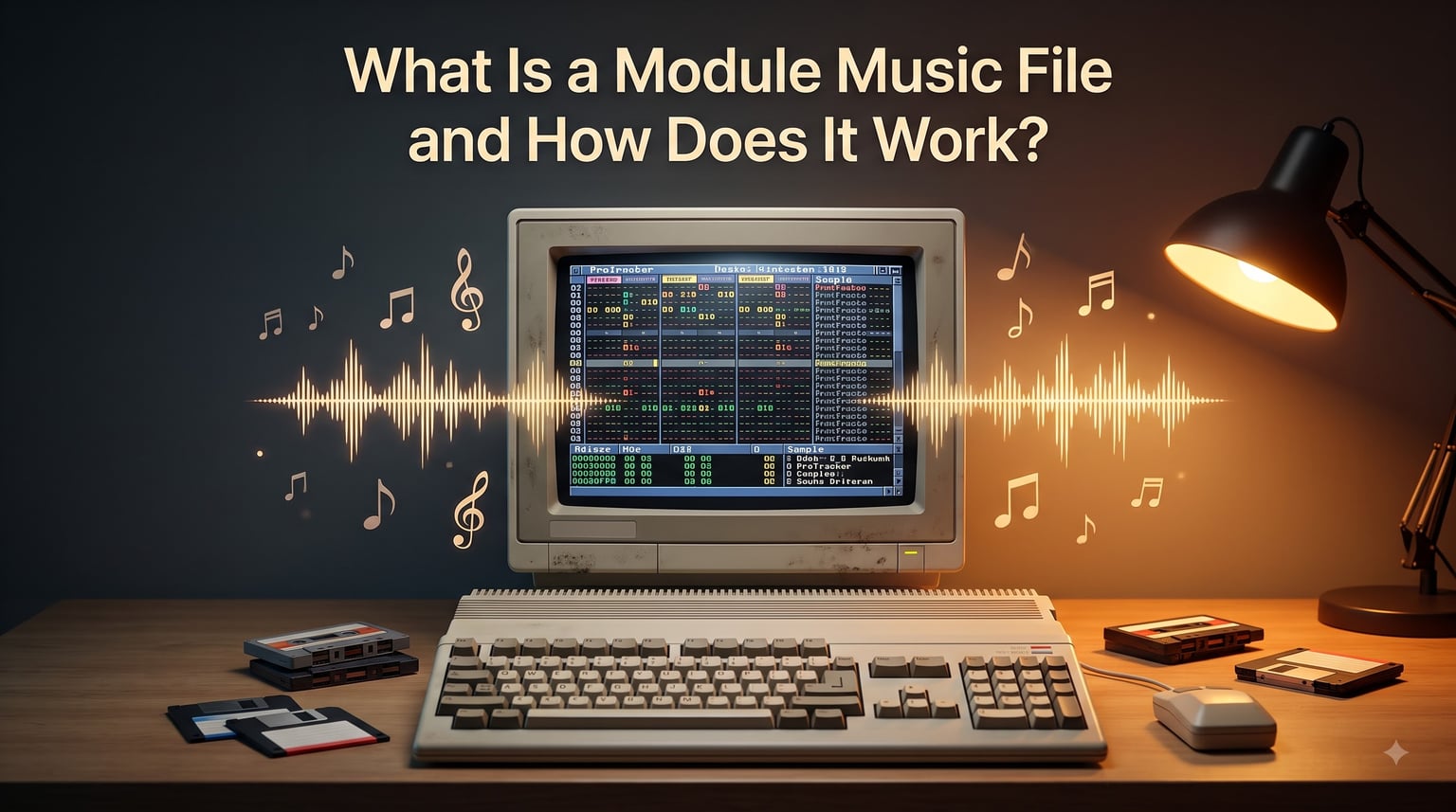
If you have ever downloaded a keygen, played a classic Amiga game, or browsed a demoscene archive, you have probably heard a module music file without realizing it. A module music file (also called a tracker module or MOD file) is a digital music format that bundles audio samples and playback instructions into a single self-contained file. The format originated on the Commodore Amiga in 1987 and went on to define the sound of the demoscene, shareware gaming, and the entire keygen music tradition.
Unlike a standard MP3 that stores a fixed audio waveform, a module file stores short recorded instrument samples alongside a pattern-based score that tells the computer exactly when and how to play each one. This approach gives module files two remarkable properties: they are incredibly small, and they loop infinitely without any awkward seams. A full song can weigh in at under 100 kilobytes.
The easiest way to understand the difference is to compare module files with formats you already know. A MIDI file contains note data but no sounds, so playback depends entirely on the synthesizer built into your device. An MP3 contains a full audio recording but cannot be edited or looped cleanly. A module music file splits the difference by carrying both the notes and the instrument sounds, which is exactly why tracker music has that distinctive, punchy character that MIDI can never quite match.
At keygenmusic.net, module files are the lifeblood of our archive. Every keygen tune in our collection started life as a pattern grid in a tracker program, with each note painstakingly placed by a musician working in hexadecimal notation. In this guide, we explain exactly what a module music file is, how the technology works, where the format came from, and how you can play these files yourself.
IN THIS ENTRYTable of Contents
- 1What Is a Module Music File?
- 2How Module Music Files Work: The Technical Side
- 3Samples: The Raw Instruments
- 4Patterns: The Musical Score
- 5Channels: Simultaneous Voices
- 6The Playback Engine: Putting It All Together
- 7The History of Module Music
- 8Module File Formats Explained: MOD, XM, S3M, and IT
- 9MOD (The Original Amiga Format)
- 10XM (Extended Module)
- 11S3M (ScreamTracker 3 Module)
- 12IT (Impulse Tracker Module)
- 13Format Comparison at a Glance
- 14Module Files vs MIDI vs MP3: What Is the Difference?
- 15Module Files vs MIDI
- 16Module Files vs MP3
- 17Quick Comparison Table
- 18How to Play Module Music Files
- 19Desktop Players
- 20Step-by-Step: Playing Your First Module File
- 21Converting Module Files to Other Formats
- 22Module Music and the Keygen Scene
- 23Why Module Music Still Matters in 2026
- 24FAQs
- 25How do I open a .MOD file?
- 26What plays .MOD files?
- 27What is the oldest music tracker?
- 28What is the difference between a tracker and a sequencer?
- 29Why are module files so small?
- 30Can I convert a module file to MP3?
- 31The Enduring Legacy of Module Music
What Is a Module Music File?
A module music file is a type of digital audio format that stores digitized instrument samples and pattern-based sequencing instructions in one file. When a module file plays, the software reads those instructions, triggers the correct samples at the correct pitches, applies effects in real time, and mixes everything together into the final sound you hear. Think of it as a recipe for assembling a song from raw ingredients rather than a pre-cooked meal.
This design makes the format fundamentally different from streaming audio formats. An MP3, WAV, or FLAC file is a single continuous recording of a finished song. A module file is more like a musical score bundled with its own set of instrument recordings. The playback software acts as the orchestra, reading the score and performing the music live from the provided instruments every single time you press play.
That distinction matters because it means module files are fully editable. You can open any module file in a tracker program, examine exactly which notes were placed on which channels, swap out individual instrument samples, change the tempo, add new sections, or strip away parts. This is why tracker music has remained a creative medium for decades rather than becoming a static recording format.
Module files go by several names depending on context. Musicians and demoscene veterans often call them tracker modules, MOD files, or simply modules. The file extensions you will encounter most frequently are .mod, .xm, .s3m, and .it, each representing a different generation of tracker software with different capabilities. We break down all four formats in detail later in this article.
How Module Music Files Work: The Technical Side
Understanding how a module music file works means understanding three core building blocks: samples, patterns, and the playback engine. Once you grasp these concepts, the entire format clicks into place and you can see why it produces such a distinctive sound.
Samples: The Raw Instruments
A sample is a short digital audio recording of a single sound. It could be a piano note, a drum hit, a synthesized bass tone, a vocal snippet, or even a recorded sound effect. The module file stores these samples as raw waveform data, typically in 8-bit or 16-bit resolution. Each sample includes metadata like a loop point so the sound can sustain indefinitely when a note is held.
The quality and character of the samples define the personality of the module. A module created on an Amiga in 1987 will use small, lo-fi 8-bit samples that give it that gritty, warm retro sound. A module created in OpenMPT today might use high-resolution 16-bit samples that sound crisp and modern. The format itself does not impose a quality ceiling, which is why tracker music spans the full range from primitive chiptune bleeps to surprisingly rich, professional-sounding compositions.
Patterns: The Musical Score
If samples are the instruments, patterns are the sheet music. A pattern is a grid of rows and channels. Each row represents one tick of playback time, and each channel represents one simultaneously playing voice. At each row, the tracker can place a note instruction that tells the playback engine which sample to trigger, at what pitch, and at what volume.
The grid is displayed in a vertical, scrolling format that reads from top to bottom. This is the defining visual characteristic of tracker software, and it is where the term tracker comes from. You are literally tracking notes as they scroll past. Each cell in the grid typically shows four pieces of information: a three-character note name like C-4 or A#3, an instrument number, a volume value, and an effect command.
Effect commands are where tracker music gets its expressive power. Using hexadecimal notation, a composer can trigger pitch slides, volume fades, vibrato, tremolo, arpeggios, portamento, sample offsets, and dozens of other real-time manipulations. A single character can bend a note, and a well-placed effect command can transform a simple melody into something complex and dynamic. These effect commands are processed live during playback, which is why module music can achieve intricate results with minimal data.
Channels: Simultaneous Voices
A channel is one voice in the mix. The original Amiga MOD format supported four channels, meaning up to four samples could play at the same time. Later formats expanded this dramatically. XM, S3M, and IT files can handle dozens of channels, allowing for rich, full arrangements with separate tracks for drums, bass, melody, harmonies, and effects.
The number of channels was historically limited by hardware. The Amiga’s Paula audio chip could play exactly four channels simultaneously, which is why classic MOD files have that characteristic four-track sound. On modern hardware, the limit is effectively your CPU, and modern module files routinely use 32, 64, or even more channels.
The Playback Engine: Putting It All Together
When you open a module file in a player, the playback engine reads the pattern data row by row, triggers the specified samples on the specified channels, applies the specified effects in real time, and mixes all channels together into a single audio stream that your sound card outputs. The engine also handles the song structure, which is defined by a sequence or order list that tells it which patterns to play in what order, how many times to loop each pattern, and when to transition to the next section.
This is why module files loop infinitely and seamlessly. The playback engine is not replaying a recording. It is performing the song live from the score every time, following the same instructions with the same instruments. When it reaches the end of the sequence, it simply returns to the beginning, and since the performance is generated in real time, there is no gap, click, or audible seam at the loop point.
The History of Module Music
The story of module music begins in 1987 on the Commodore Amiga, a home computer that was revolutionary for its time because it included custom hardware chips dedicated to graphics and audio. One of those chips, named Paula, could play four independent digital audio channels simultaneously, which was remarkable for a consumer machine in the late 1980s.
That same year, a developer named Karsten Obarski released a program called Ultimate Soundtracker. It was the first music tracker, and it allowed users to arrange digital audio samples into musical compositions using the vertical grid interface that would become the standard for the entire medium. Ultimate Soundtracker saved files in the MOD format, and those files could be played back independently of the software, making them shareable and portable.
The format caught on immediately in the Amiga demoscene, a subculture of programmers, artists, and musicians who created audiovisual demos to show off their technical skills. Scene musicians, known as trackers, began composing increasingly sophisticated songs within the four-channel limit of the MOD format. They also began sharing and trading instrument samples, building a grassroots library of sounds that the entire community could use.
In the early 1990s, the tracker concept migrated from the Amiga to the PC. A program called ScreamTracker, developed by the Finnish demo group Future Crew, introduced the S3M format and brought tracker music to MS-DOS systems. Then in 1993, a group called Triton released FastTracker II, which introduced the XM format with support for more channels, higher-quality samples, and a wider range of effects. A few years later, Jeffrey Lim released Impulse Tracker, which created the IT format and added features that made it arguably the most powerful tracker ever built for DOS.
Throughout the 1990s, module music was everywhere. It powered the soundtracks of countless shareware and commercial games, from Unreal Tournament to Deus Ex. It provided the background music for disk magazines, BBS intros, and cracktros. And it became the signature sound of the keygen scene, where software crackers used tiny module files to add musical flair to their key generators. By the late 1990s, the demoscene had produced hundreds of thousands of module files, and archives like ModArchive began collecting them for posterity.
The tracker format never truly died. While mainstream music production shifted to digital audio workstations and sample libraries, the demoscene kept producing module music. Open-source projects like OpenMPT, MilkyTracker, and Schism Tracker kept the tracker interface alive on modern operating systems. And the chiptune revival of the 2000s and 2010s brought a new wave of musicians back to the format, drawn by its distinctive aesthetic and creative constraints.
Module File Formats Explained: MOD, XM, S3M, and IT
Over the years, four major module file formats emerged, each tied to a specific generation of tracker software. They share the same fundamental concept of samples plus patterns, but they differ in features, channel limits, and sound quality. Here is what you need to know about each one.
MOD (The Original Amiga Format)
The MOD format is where it all started. Created by Ultimate Soundtracker and popularized by ProTracker, MOD files support four channels, 8-bit samples, and a fixed set of effect commands. The format stores 15 to 31 instrument samples and a sequence of patterns that define the song structure. MOD files have a characteristic warm, slightly gritty sound due to the 8-bit sample resolution, and the four-channel limit forces composers to be economical and creative with their arrangements.
XM (Extended Module)
The XM format was introduced by FastTracker II in 1993 and brought tracker music to the PC in a big way. XM supports up to 32 channels (originally 32, often extended further), 16-bit samples, software-generated instruments using volume and panning envelopes, and a broader range of effect commands. The format also introduced per-sample panning and automatic sample vibrato. XM became the most widely used module format of the late 1990s and remains popular today.
S3M (ScreamTracker 3 Module)
The S3M format was created by Future Crew for ScreamTracker 3 and was designed specifically for PC sound hardware. S3M supports up to 32 channels, 16-bit samples, and introduced the concept of adlib instruments that could use FM synthesis alongside digital samples. The format also added more flexible panning and volume control compared to MOD. S3M was extremely popular in the mid-1990s demoscene and in game soundtracks of the era.
IT (Impulse Tracker Module)
The IT format, introduced by Impulse Tracker in 1996, is widely considered the most advanced classic module format. IT supports up to 64 channels, 16-bit samples, multisample instruments with note-to-sample mapping, New Note Actions for sophisticated sample handling, resonant filters, and an extensive set of effect commands. Impulse Tracker was famous for its keyboard-driven interface and powerful editing features. Many consider IT the pinnacle of DOS-era tracker software.
Format Comparison at a Glance
Here is a quick reference to help you tell the four formats apart.
MOD – 4 channels, 8-bit samples, 15-31 instruments. The original Amiga format. Best for that classic retro sound.
XM – Up to 32 channels, 16-bit samples, envelope-based instruments. The most widely used PC tracker format.
S3M – Up to 32 channels, 16-bit samples, FM synthesis support. Popular in the mid-90s demoscene and game soundtracks.
IT – Up to 64 channels, 16-bit samples, multisample instruments, resonant filters. The most feature-rich classic format.
Modern players like OpenMPT and XMPlay can open all four formats, so you rarely need to worry about which one you have. If you want to create your own module music, OpenMPT supports all formats and lets you save in any of them.
Module Files vs MIDI vs MP3: What Is the Difference?
One of the most common questions we hear is how module files compare to MIDI and MP3. The three formats serve very different purposes, and understanding the differences helps explain why module music has a sound that is uniquely its own.
Module Files vs MIDI
A MIDI file is a pure set of performance instructions. It contains note data like pitch, timing, and velocity, but it contains zero audio. When you play a MIDI file, your computer’s built-in synthesizer or a connected MIDI device generates the actual sounds. This means the same MIDI file will sound completely different depending on what hardware or software plays it back. Play a MIDI file on a cheap sound card from 1995 and then on a modern studio synthesizer, and you will hear two very different songs.
A module file solves this problem by embedding the instrument samples directly in the file. The playback instructions and the sounds they control travel together. This means a module file sounds exactly the same on every device because the instruments are part of the file. Forum discussions on Reddit consistently highlight this difference, with users noting that tracker music has a sharper, more defined sound compared to MIDI’s often flat, generic quality.
Module Files vs MP3
An MP3 file is a compressed audio recording of a finished piece of music. It is essentially a photograph of sound. You cannot edit individual instruments, you cannot swap out samples, and you cannot make it loop seamlessly without audible artifacts at the loop point. An MP3 is also much larger than a comparable module file. A three-minute song in MP3 format typically weighs 3 to 5 megabytes, while the same song as a module file might be 50 to 200 kilobytes.
The tradeoff is that MP3s can capture any sound, including full vocals and live recordings, while module files are limited to what can be constructed from samples and patterns. A module file cannot store a human singing a melody the way an MP3 can, unless the vocal is chopped into short sample snippets. But for instrumental electronic music, game soundtracks, and the energetic style of keygen music, the module format is arguably superior in both file size and flexibility.
Quick Comparison Table
Module file – Contains notes and samples. Small size. Loops infinitely. Fully editable. Same sound on every device.
MIDI file – Contains notes only. Tiny size. Loops infinitely. Not editable without special software. Sound varies by playback device.
MP3 file – Contains audio recording. Large size. Does not loop cleanly. Not editable. Same sound everywhere.
How to Play Module Music Files
Playing a module music file is straightforward once you know which software to use. Modern operating systems do not play module files out of the box, but there are excellent free tools available for every platform. Here are the best options depending on your needs.
Desktop Players
For Windows, XMPlay is a lightweight, free audio player that handles all major module formats out of the box. It is fast, uses minimal system resources, and supports a wide range of plugins for even more formats. OpenMPT, while primarily a tracker for creating music, also works as an excellent module player and supports every classic format. VLC Media Player can also play some module formats, though its support is less comprehensive than dedicated tracker players.
For macOS and Linux, MilkyTracker is a cross-platform tracker that plays and creates module files. The Extended Module Player (xmp) is a powerful command-line player that supports over 90 module formats and runs on virtually any Unix-like system. Schism Tracker is another cross-platform option that replicates the Impulse Tracker interface and handles all major formats.
If you want to play module files in your web browser, several web-based players exist. These let you load a module file directly and play it back without installing any software, which is convenient for quick listening or for sharing module files with people who do not have tracker software installed.
Step-by-Step: Playing Your First Module File
Here is a simple walkthrough to get you started.
Step 1: Download a player. For Windows, grab XMPlay. For macOS or Linux, download MilkyTracker or install xmp through your package manager.
Step 2: Download a module file. You can find thousands of free modules at ModArchive.org, or browse the collection right here at keygenmusic.net for keygen-specific tracks.
Step 3: Open the file in your player. Most players support drag-and-drop, so you can simply drag the .mod, .xm, .s3m, or .it file onto the player window.
Step 4: Press play and enjoy. The module will loop continuously, so you can let it run as background music while you work or browse.
Converting Module Files to Other Formats
If you want to convert a module file to WAV or MP3 for use in a project, most tracker software can export to WAV. OpenMPT has a built-in export function that renders your module to a WAV file at any sample rate. From there, you can convert the WAV to MP3 or any other format using a standard audio converter. Keep in mind that converting to MP3 means you lose the infinite looping capability and the small file size, so only convert when you specifically need a standard audio format.
One important note from the tracker community: converting a module file to MP3 and then deleting the original is a mistake. The module file is the source code of the song, and it contains information that the MP3 cannot preserve. Always keep your original module files alongside any conversions you make.
Module Music and the Keygen Scene
If you are visiting keygenmusic.net, you are likely already familiar with the connection between module files and the keygen scene. But for those who are new to the topic, the story of how tracker music became the signature sound of software cracks is worth telling in detail.
In the 1990s and early 2000s, software pirates and cracking groups created small programs called keygens that generated valid license keys for commercial software. These keygens were tiny, often just a few kilobytes in size, and crackers wanted to add a visual and musical component to make their releases stand out. Module music files were the perfect choice because they could deliver a full, energetic song in an extremely small package that fit easily alongside the keygen code.
The result was a unique genre of music. Keygen tunes, composed primarily in XM and IT format, tend to be fast-paced, melodic, and intensely layered. They draw from trance, techno, chiptune, and ambient influences, and they are designed to loop continuously while the user runs the keygen program. Many of these compositions were created by highly skilled tracker musicians, and the best keygen music stands on its own as legitimate electronic music.
The keygen scene effectively created a massive, distributed archive of module music. Thousands of keygens were released over the years, each containing a module file that could be extracted and played independently. This is exactly what keygenmusic.net exists to preserve. Our archive collects these module files so that the music can be enjoyed long after the keygens themselves have become obsolete. Every file in our collection is a piece of demoscene history, and the tracker format is what makes it all possible.
What makes keygen music sound the way it does is the module format itself. The combination of tightly programmed patterns, custom instrument samples, and real-time effect commands gives tracker music a precision and energy that is difficult to replicate in other formats. The arpeggios, pitch bends, and rapid note changes that define the keygen sound are all native capabilities of the module file format. When you listen to a keygen tune, you are hearing the module format pushed to its creative limits.
Why Module Music Still Matters in 2026
You might assume that module music is a relic of the past, but the format is very much alive in 2026. The chiptune revival has brought a new generation of musicians to the tracker interface, attracted by its hands-on, low-level approach to sound design. Modern tracker software like OpenMPT, MilkyTracker, and Schism Tracker runs on current operating systems and offers capabilities that rival the best DOS-era tools.
The demoscene continues to produce new module music at regular parties and competitions around the world. Events like Revision, Assembly, and Sundown host tracker music competitions where composers create original module files within strict format and size limits. These competitions keep the art form evolving and ensure that new module music is being created every year.
Communities like ModArchive and the OpenMPT forums remain active hubs where musicians share their work, discuss technique, and preserve classic modules. Reddit communities like r/modmusic and r/chiptunes provide spaces for newcomers to discover the format and for veterans to share their knowledge. The community aspect is a big part of why module music endures, because the format has always been about sharing and collaboration from the very beginning on the Amiga.
Beyond nostalgia, module music has influenced modern electronic music production in ways that are easy to overlook. The step-sequencing paradigm used in modern DAWs, the emphasis on loop-based composition, and the creative use of short audio samples all have roots in the tracker tradition. Producers who learn to compose in a tracker often develop a unique approach to arrangement and sound design that carries over into whatever software they use next.
FAQs
How do I open a .MOD file?
You can open a .MOD file using a free module player such as XMPlay (Windows), MilkyTracker (cross-platform), or the Extended Module Player (command line). Most players support drag-and-drop, so simply drag the file onto the player window and press play. You can also use OpenMPT, which functions as both a player and a full tracker editor.
What plays .MOD files?
Several free programs play .MOD files. XMPlay and OpenMPT are the best options for Windows. MilkyTracker and Schism Tracker work on Windows, macOS, and Linux. VLC Media Player can play some module formats. For command-line users, the Extended Module Player (xmp) supports over 90 module formats across all major operating systems.
What is the oldest music tracker?
The oldest music tracker is Ultimate Soundtracker, created by Karsten Obarski and released in 1987 for the Commodore Amiga. It was the first program to use the vertical, pattern-based grid interface that defines tracker software, and it introduced the MOD file format that started the entire module music tradition.
What is the difference between a tracker and a sequencer?
A tracker is a specific type of music sequencer that uses a vertical scrolling grid of rows and channels, with notes entered in hexadecimal notation. A traditional sequencer uses a piano roll or linear timeline interface. Trackers are designed for sample-based module music, while general sequencers work with MIDI, audio recordings, and virtual instruments. All trackers are sequencers, but not all sequencers are trackers.
Why are module files so small?
Module files are small because they do not store a full audio recording. Instead, they store short instrument samples and a set of playback instructions. The playback engine assembles the song in real time from these compact components. A three-minute song can fit in 50 to 200 kilobytes because only the raw materials and the score are stored, not the finished audio.
Can I convert a module file to MP3?
Yes, you can convert a module file to MP3 by first rendering it to WAV using tracker software like OpenMPT or MilkyTracker, then converting the WAV to MP3 with any standard audio converter. However, converting loses the infinite looping capability, the small file size, and the editability of the original module. Always keep the original module file alongside any conversions.
The Enduring Legacy of Module Music
A module music file is one of the most clever formats in the history of digital audio. By combining instrument samples with pattern-based playback instructions, it achieves something no other format can match: studio-quality sound in tiny, infinitely loopable, fully editable files. From its origins on the Amiga in 1987 to its role in the keygen scene and its continued use by modern chiptune musicians, the module format has proven remarkably resilient.
If you want to explore module music for yourself, start by browsing the archive here at keygenmusic.net. Download a player like XMPlay or MilkyTracker, open a file, and listen to what decades of tracker musicians have created. If you feel inspired to create your own music, download OpenMPT and try placing your first few notes in the pattern grid. The module music community is welcoming, the tools are free, and there is nothing quite like the satisfaction of building a song from raw samples and hexadecimal note data.