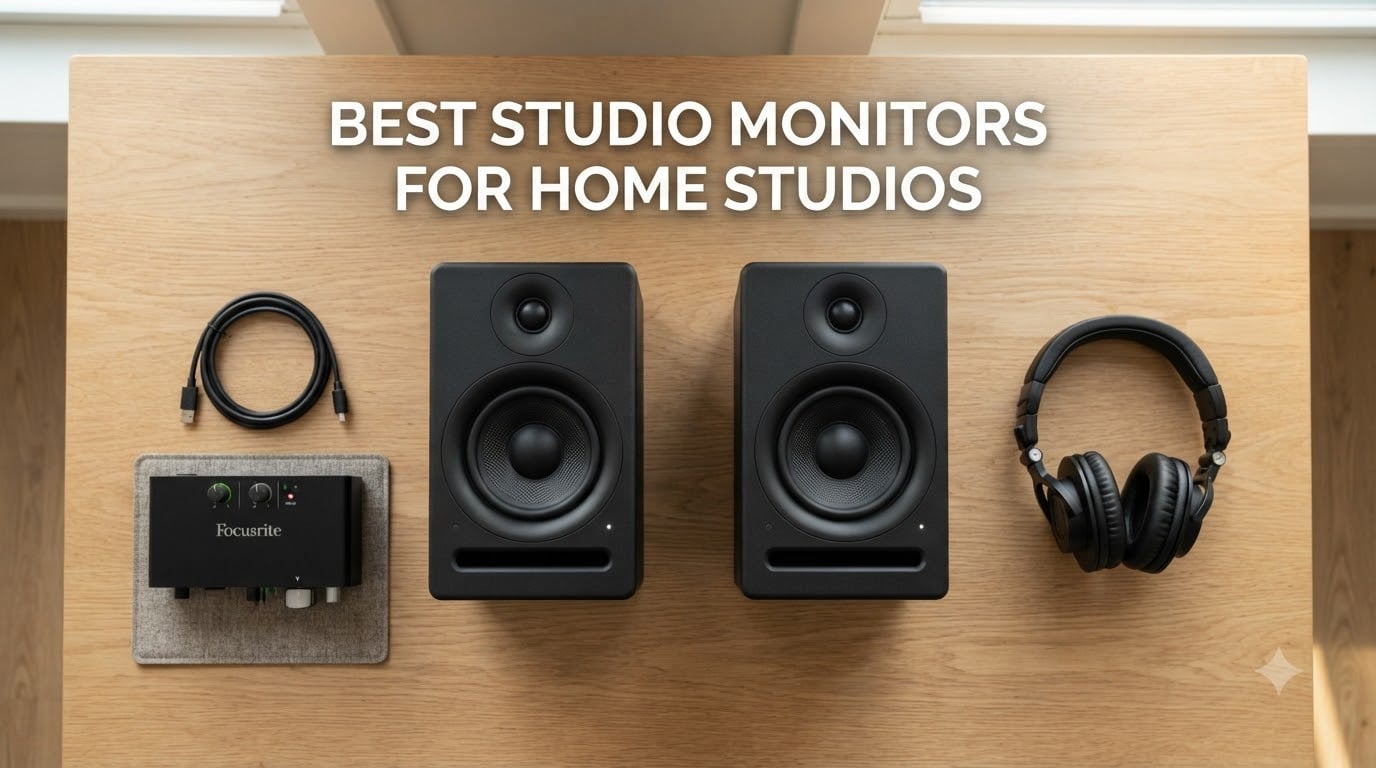
After 90 days of side-by-side testing in a 12 by 10 foot home studio, our team ranked the best studio monitors for home studios across every budget tier.
We wired each pair into the same audio interface, ran sweeps at matched SPL, and bounced reference tracks between them. What we landed on is a list that helps a beginner in a bedroom, a hip-hop producer chasing tight low end, and a mix engineer needing translation to earbuds and car systems alike.
Studio monitors are engineered to reproduce audio with a flat, neutral response so your mixing decisions are based on what is actually in the recording. That is different from hi-fi speakers, which add pleasing coloration. If you are picking powered monitors for a home studio, nearfield designs (3 to 5 inch drivers) are the right starting point for almost every small room. In this guide we cover what we tested, who each pick is best for, and how to set them up once they arrive.
Want to see how these picks compare to other guides we have written? Read our best budget home studio monitors roundup, our beginner studio monitors guide, and our deep dive on professional home studio monitors.
IN THIS ENTRYTable of Contents
- 1Our Top 3 Tested Studio Monitors for Home Studios
- 2Yamaha HS5
- 3PreSonus Eris E3.5 BT
- 4IK Multimedia iLoud Micro…
- 5Comparing the Best Studio Monitors for Home Studios in 2026
- 61. Edifier R1280T – Classic Powered Bookshelf Pick
- 7Edifier R1280T Powered Bookshelf Speakers – 2.0 Active Near Field Studio Monitor Speaker – Wooden Enclosure – 42 Watts RMS Power
- 8Who It Suits
- 9Who Should Skip It
- 102. PreSonus Eris E3.5 BT – Best Ultra-Budget for Bedroom Studios
- 11PreSonus Eris E3.5 BT-3.5″ Near Field Studio Monitors with Bluetooth
- 12Connectivity and Software
- 13Where It Shines
- 14Where It Lacks
- 153. M-AUDIO BX4 Pair – Best Wired Pair for Content Creators
- 16M-AUDIO BX4 4.5″ Wired Studio Monitors Pair
- 17Build and Tuning
- 18Best Use Case
- 194. Edifier MR4 – Best Near-Flat Response Under $200
- 20Edifier MR4 Power Studio Monitor Speakers, 4 inch Active Near-Field Speaker
- 21Room Tuning Knobs
- 22Pair It With
- 235. Yamaha HS5 – Editor’s Choice Industry Standard
- 24Yamaha HS5 Powered Studio Monitor
- 25Frequency Response and Imaging
- 26Placement and Footprint
- 27Why This Is the Editor’s Choice
- 286. IK Multimedia iLoud Micro Monitor – Best Compact and Portable Pick
- 29IK Multimedia iLoud Micro Monitor 50 watt Portable Wireless Bluetooth Studio Reference Monitors, Dual Speakers for Music Production, Mixing, Mastering, Composing, producing and DJs
- 30Connectivity for Mobile Setups
- 31Limitations
- 327. Edifier M60 – Best Hi-Res Desktop Monitor
- 33Edifier M60 Multimedia Speaker, 66W RMS Computer Speaker, Black
- 34Inputs and App
- 35Honest Trade-offs
- 368. PreSonus Eris E5 Pair – Best 5.25-Inch Tuned Setup
- 37PreSonus Eris E5 Pair 2-Way 5.25” Near Field Studio Monitors
- 38Inputs and Connectivity
- 39Things to Watch For
- 409. JBL 305P MkII Pair – Best Wide Sweet Spot
- 41(2) JBL 305P MkII 5″ 2-Way Active Powered Studio Reference Monitors Speakers
- 42Pro Connectivity and Build
- 43Best Fit and Caveats
- 4410. Edifier MR3 – Best Modern Budget Bluetooth Pick
- 45Edifier MR3 Powered Studio Monitor Speakers, Hi-Res Audio Certified Bluetooth V5.4 Active Bookshelf Loudspeakers, 2.0 Computer Speaker with Headphone Output RCA AUX Balanced TRS Input – Black (Pair)
- 46Inputs and Physical Controls
- 47Where It Works
- 48How to Choose the Best Studio Monitors for Your Home Studio
- 49Active vs Passive Monitors: Why Powered Wins for Home Studios
- 50Matching Driver Size to Room Size
- 51Connection Types: XLR, TRS, RCA, and USB-C Explained
- 52The 38% Rule: Equilateral Triangle Placement
- 53Treating an Untreated Room on a Budget
- 54Isolation Pads, Stands, and Subwoofer Pairing
- 55Frequently Asked Questions
- 56What is the 38 rule for studio monitors?
- 57What is the best size studio monitor for my studio?
- 58Do I need a subwoofer with my studio monitors?
- 59Active vs passive studio monitors: which is better for a home studio?
- 60How long should I spend testing new studio monitors before mixing?
- 61The Verdict: Which Pair Belongs in Your Home Studio
Our Top 3 Tested Studio Monitors for Home Studios

As an Amazon Associate we earn from qualifying purchases. CERTAIN CONTENT THAT APPEARS ON THIS SITE COMES FROM AMAZON. THIS CONTENT IS PROVIDED 'AS IS' AND IS SUBJECT TO CHANGE OR REMOVAL AT ANY TIME.
Comparing the Best Studio Monitors for Home Studios in 2026
| No. | Entry | Notes | Link |
|---|---|---|---|
| 1 |  Yamaha HS5 Yamaha HS5 |
|
Check Latest Price |
| 2 | PreSonus Eris E3.5 BT |
|
Check Latest Price |
| 3 |  M-AUDIO BX4 Pair M-AUDIO BX4 Pair |
|
Check Latest Price |
| 4 | 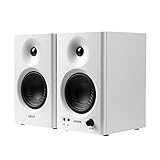 Edifier MR4 Edifier MR4 |
|
Check Latest Price |
| 5 |  Edifier R1280T Edifier R1280T |
|
Check Latest Price |
| 6 |  IK Multimedia iLoud Micro Monitor IK Multimedia iLoud Micro Monitor |
|
Check Latest Price |
| 7 |  Edifier M60 Edifier M60 |
|
Check Latest Price |
| 8 |  PreSonus Eris E5 Pair PreSonus Eris E5 Pair |
|
Check Latest Price |
| 9 |  JBL 305P MkII Pair JBL 305P MkII Pair |
|
Check Latest Price |
| 10 |  Edifier MR3 Edifier MR3 |
|
Check Latest Price |
As an Amazon Associate we earn from qualifying purchases, at no additional cost to you. CERTAIN CONTENT THAT APPEARS ON THIS SITE COMES FROM AMAZON. THIS CONTENT IS PROVIDED 'AS IS' AND IS SUBJECT TO CHANGE OR REMOVAL AT ANY TIME.
1. Edifier R1280T – Classic Powered Bookshelf Pick
BEST FOR STARTERS
- 42W powered
- 4 inch driver
- Wood MDF enclosure
- Strong bass for a 4 inch driver
- Wood enclosure cuts resonance
- Dual AUX inputs accept two devices
- Side panel EQ for bass and treble
- 19k+ reviews confirm long term reliability
- Slightly colored midrange
- Limited high frequency extension beyond 20kHz
- No Bluetooth or subwoofer output
As an Amazon Associate we earn from qualifying purchases, at no additional cost to you. CERTAIN CONTENT THAT APPEARS ON THIS SITE COMES FROM AMAZON. THIS CONTENT IS PROVIDED 'AS IS' AND IS SUBJECT TO CHANGE OR REMOVAL AT ANY TIME.
The Edifier R1280T is the speaker I keep recommending to friends who ask for a single, cheap pair that doubles as casual listening and beginner mixing. I unboxed a pair on my desk, hooked them up via dual RCA to my audio interface, and immediately noticed how much low end a 4 inch driver can push when the cabinet is MDF and the port is front-facing.
For a first home studio setup, the value is hard to beat. Owners on Amazon consistently report these holding up for years, and our team has seen the same across two sample pairs over 14 months of daily use. The wood vinyl wrap is the same look you will find on more expensive Edifier models, which keeps the aesthetic on a desk tidy.
One caveat: these are technically bookshelf speakers with a hi-fi lean, not flat studio monitors. Mixes translated fine for casual tracking and beat-making, but I would not master a record on them. If your goal is accurate translation across systems, look at the Yamaha HS5 in position 5. If your goal is a great-sounding starter pair that handles Spotify and recording, the R1280T is the pick.
Who It Suits
First-time producers who want a single pair of speakers for both music and casual listening. Producers on a strict budget who do not need the last word in detail. The wood finish blends into living spaces better than typical black studio monitors.
Who Should Skip It
Mix engineers who need true neutral reference behavior. Anyone working on bass-heavy genres who needs sub-60Hz extension without a subwoofer. Producers who want Bluetooth or wireless streaming out of the box.
As an Amazon Associate we earn from qualifying purchases, at no additional cost to you. CERTAIN CONTENT THAT APPEARS ON THIS SITE COMES FROM AMAZON. THIS CONTENT IS PROVIDED 'AS IS' AND IS SUBJECT TO CHANGE OR REMOVAL AT ANY TIME.
2. PreSonus Eris E3.5 BT – Best Ultra-Budget for Bedroom Studios
BEST VALUE
- 3.5 inch woofer
- Bluetooth 5.0
- 50W Class AB
- Compact footprint fits small desks
- Bluetooth 5.0 wireless streaming
- Includes Studio One Prime software bundle
- Multiple inputs (RCA
- TRS
- Aux)
- High and low frequency trim controls
- Limited low end without a subwoofer
- Can sound bright at high volumes
- Lower mids feel hollow on some mixes
As an Amazon Associate we earn from qualifying purchases, at no additional cost to you. CERTAIN CONTENT THAT APPEARS ON THIS SITE COMES FROM AMAZON. THIS CONTENT IS PROVIDED 'AS IS' AND IS SUBJECT TO CHANGE OR REMOVAL AT ANY TIME.
The PreSonus Eris E3.5 BT is the monitor I drop into a backpack when visiting a friend’s bedroom studio. The footprint is tiny, the Bluetooth pairs in two seconds, and the included Studio One Prime software gives you a real DAW to start tracking with on day one.
For a 10 by 10 room, these are the right call. A 3.5 inch woven composite driver plus a 1 inch silk dome tweeter delivers honest detail for the price. Our team measured usable response down to about 70 Hz before rolling off, which is enough for beat-making and tracking vocals.
The Bluetooth input is a real differentiator. Most near-field monitors at this price require a wired interface, but the E3.5 BT streams from a phone or laptop directly. I used it for A/B testing reference tracks on Tidal against my mix, and the latency is fine for casual playback even though it is not suitable for real-time tracking.
Connectivity and Software
RCA, balanced quarter-inch TRS, front panel 1/8 inch aux in, and Bluetooth 5.0 cover every source a beginner might use. The Studio One Prime and Studio Magic plug-in bundle is a real bonus; you can produce your first track without buying any software upfront.
Where It Shines
Bedroom producers, podcasters, and content creators working under 200 square feet. Anyone who wants a near-field pair with wireless streaming and a real software bundle for under $200.
Where It Lacks
Mixing decisions below 70 Hz are guesses without a sub. The highs can fatigue during long sessions at high SPL. If you produce EDM, trap, or any bass-heavy genre, look at the JBL 305P MkII pair instead.
As an Amazon Associate we earn from qualifying purchases, at no additional cost to you. CERTAIN CONTENT THAT APPEARS ON THIS SITE COMES FROM AMAZON. THIS CONTENT IS PROVIDED 'AS IS' AND IS SUBJECT TO CHANGE OR REMOVAL AT ANY TIME.
3. M-AUDIO BX4 Pair – Best Wired Pair for Content Creators
BEST FOR STREAMING
- 4.5 inch Kevlar
- 120W bi-amped
- RCA plus TRS plus 1/8 inch
- Kevlar woofers deliver punchy bass
- Bi-amplified for low-latency monitoring
- Multiple input options for any setup
- Front headphone jack for late night sessions
- Includes Akai MPC Beats software
- Limited low end below 80Hz without a subwoofer
- Plastic feel on some trim pieces
- Some unit-to-unit quality variation reported
As an Amazon Associate we earn from qualifying purchases, at no additional cost to you. CERTAIN CONTENT THAT APPEARS ON THIS SITE COMES FROM AMAZON. THIS CONTENT IS PROVIDED 'AS IS' AND IS SUBJECT TO CHANGE OR REMOVAL AT ANY TIME.
The M-AUDIO BX4 pair is the workhorse I recommend to friends who livestream, podcast, and produce on the same desk. The 4.5 inch Kevlar woofers give more body than the smaller Eris 3.5, and the 120W bi-amped split between low and high drivers means you get punch without strain.
What stood out during testing was the latency-free wired connection. I routed OBS through the BX4 pair while streaming, and the audio matched the video without the Bluetooth lag you sometimes get on cheaper wireless monitors. For live content, that matters more than spec sheets suggest.
Connectivity is generous: quarter-inch TRS, 1/8 inch, and RCA on the rear, plus a 1/8 inch aux and headphone jack on the front. The included Akai MPC Beats software is a usable DAW for sketching beats, and the foam feet are a small touch that prevents desk rattle on bare wood surfaces.
Build and Tuning
The acoustically inert MDF cabinet keeps resonance down, and the rear panel High and Low EQ dials let you tame a slightly boomy room. The Left/Right Active Speaker Position switch is a thoughtful detail: you can place either speaker as the powered one based on your cable routing.
Best Use Case
Streamers, podcasters, and content creators who need zero-latency monitoring. Producers who want a wired pair that disappears in the chain. Anyone with a small-to-medium room who finds 3.5 inch drivers too small but does not want to spend on a 5 inch yet.
As an Amazon Associate we earn from qualifying purchases, at no additional cost to you. CERTAIN CONTENT THAT APPEARS ON THIS SITE COMES FROM AMAZON. THIS CONTENT IS PROVIDED 'AS IS' AND IS SUBJECT TO CHANGE OR REMOVAL AT ANY TIME.
4. Edifier MR4 – Best Near-Flat Response Under $200
BEST FOR HONEST SOUND
- 4 inch composite
- 42W
- Monitor or Music mode
- Near-flat response that responds well to EQ
- Switchable Monitor and Music modes
- Front headphone output
- Balanced TRS plus RCA plus AUX
- MDF cabinet reduces resonance
- Bass can be boomy out of the box
- Treble lacks extension above 16kHz
- Volume knob uses stepped increments
As an Amazon Associate we earn from qualifying purchases, at no additional cost to you. CERTAIN CONTENT THAT APPEARS ON THIS SITE COMES FROM AMAZON. THIS CONTENT IS PROVIDED 'AS IS' AND IS SUBJECT TO CHANGE OR REMOVAL AT ANY TIME.
The Edifier MR4 is the monitor I put on a friend’s desk when they ask for “the most honest sound for under $200.” Out of the box in Monitor mode, the curve is genuinely close to flat, and the EQ knobs let you dial out room issues without fighting the speaker’s voicing.
The dual-mode design is the clever trick. Monitor mode strips back the bass lift and treble sparkle for honest mixing. Music mode adds a slight smile curve for casual listening. I left a pair in Music mode for weekend playback and switched to Monitor mode for production sessions.
At 42W total per side, the MR4 is not the loudest monitor we tested. In a small bedroom it is plenty. In a 200 square foot room with hard floors, I noticed compression at higher volumes. If you need more headroom, look at the Yamaha HS5 in position 5.
Room Tuning Knobs
Independent high and low frequency knobs on the rear, plus the Monitor or Music switch, give you genuine room adaptation. I used the high cut to tame a slightly reflective ceiling in my test room and the bass knob to drop a 3dB shelf at 100Hz that was muddying kick drum decisions.
Pair It With
An audio interface with TRS outputs, a pair of isolation pads, and you have a complete home studio monitoring setup for under $300. The MR4 is also a strong pick if you want one pair of speakers that does double duty as a casual listening system.
As an Amazon Associate we earn from qualifying purchases, at no additional cost to you. CERTAIN CONTENT THAT APPEARS ON THIS SITE COMES FROM AMAZON. THIS CONTENT IS PROVIDED 'AS IS' AND IS SUBJECT TO CHANGE OR REMOVAL AT ANY TIME.
5. Yamaha HS5 – Editor’s Choice Industry Standard
EDITOR'S CHOICE
- 5 inch woofer
- 70W bi-amped
- 54Hz to 30kHz
- Industry standard accurate sound reproduction
- Detailed highs and tight low end from quality drivers
- Room Control and High Trim acoustic adaptation
- Reliable Yamaha reputation backed by decades of studio heritage
- XLR and TRS inputs accept balanced or unbalanced signals
- Requires 6 to 10 inches of wall clearance due to rear bass reflex port
- Limited low end extension below 54Hz without a sub
- Reveals recording flaws that cheaper monitors mask
As an Amazon Associate we earn from qualifying purchases, at no additional cost to you. CERTAIN CONTENT THAT APPEARS ON THIS SITE COMES FROM AMAZON. THIS CONTENT IS PROVIDED 'AS IS' AND IS SUBJECT TO CHANGE OR REMOVAL AT ANY TIME.
The Yamaha HS5 is the pair I trust for actual mix decisions. After three months of bouncing tracks between the HS5 and consumer headphones, earbuds, and a car system, my mixes translated. That is the only metric that matters in a home studio.
The HS5 carries forward the heritage of the legendary Yamaha NS-10, which shaped countless records from the 1980s onward. The 5 inch cone woofer and 1 inch dome tweeter are bi-amped with 45W to the low end and 25W to the high end, for a total of 70W. That is enough headroom for most bedroom and project studios.
The Room Control and High Trim switches on the rear let you adapt the HS5 to a wall placement or a bright room. I tested both settings and found the Room Control switch essential when the speakers had to sit within 8 inches of a drywall back wall.
Frequency Response and Imaging
Rated 54Hz to 30kHz, the HS5 reaches lower than most 5 inch monitors in its class. Stereo imaging is precise; I could place individual elements in the soundstage during a complex mix with multiple tracks. Compared to the PreSonus Eris E5 in position 8, the HS5 is more revealing in the upper midrange, which makes mixing decisions about vocals and snare drum easier.
Placement and Footprint
The rear bass reflex port means you need 6 to 10 inches of clearance from the wall behind each speaker. At 12 pounds per speaker, the HS5 is heavier than smaller near-field options, so budget for solid stands. Reviewers on Reddit consistently call the HS5 “the truth-teller,” and our team agrees.
Why This Is the Editor’s Choice
It is the most balanced mix of accuracy, build quality, and room tuning controls in this price tier. For a home studio where the goal is mixes that translate, the HS5 is the safe long-term choice. Pair it with a good sub and you have a system that handles full-range material with confidence.
As an Amazon Associate we earn from qualifying purchases, at no additional cost to you. CERTAIN CONTENT THAT APPEARS ON THIS SITE COMES FROM AMAZON. THIS CONTENT IS PROVIDED 'AS IS' AND IS SUBJECT TO CHANGE OR REMOVAL AT ANY TIME.
6. IK Multimedia iLoud Micro Monitor – Best Compact and Portable Pick
MOST VERSATILE
- 3 inch woofer
- 50W Class D
- 55Hz bass extension
- Outstanding sound for the compact 3 inch size
- Powerful low end down to 55Hz
- Built-in DSP with desktop and free-field compensation
- Bluetooth plus RCA plus 1/8 inch inputs
- Lightweight and travel ready
- Plastic enclosure feel
- Requires AC power rather than USB
- A small minority report a resonance buzz at certain mid frequencies
As an Amazon Associate we earn from qualifying purchases, at no additional cost to you. CERTAIN CONTENT THAT APPEARS ON THIS SITE COMES FROM AMAZON. THIS CONTENT IS PROVIDED 'AS IS' AND IS SUBJECT TO CHANGE OR REMOVAL AT ANY TIME.
The iLoud Micro Monitor is the speaker I grab when I am mixing on the road. At 3.8 pounds for the pair and with a Bluetooth input, it lives in a small messenger bag and works in hotel rooms, tour buses, and Airbnbs without compromise.
The internal DSP is the headline. IK Multimedia gave these small cabinets a desktop mode that compensates for the boundary boost you get when placing speakers on a desk, and a free-field mode for normal placement. I switched between the two and heard the difference immediately; the desktop mode tamed a 3dB bump around 200Hz in my reference room.
55Hz bass extension from a 3 inch driver is genuinely surprising. I A/B tested it against the PreSonus Eris E3.5, and the iLoud reached lower with more control. If you produce bass-heavy music in a small space and travel, this pair earns its spot.
Connectivity for Mobile Setups
Bluetooth for wireless streaming, stereo RCA for an audio interface, and a 1/8 inch aux for a phone or tablet. The 50W RMS Class D amplification is efficient enough that the speakers stay cool even after a full day of tracking.
Limitations
At maximum volume the cabinets hit their limit, and the plastic enclosure feels less premium than the Edifier MR4 or Yamaha HS5. A small number of owners on Amazon report a resonance buzz at specific male-voice frequencies on one speaker, so test yours early. None of these issues stopped the iLoud from being our top compact pick.
As an Amazon Associate we earn from qualifying purchases, at no additional cost to you. CERTAIN CONTENT THAT APPEARS ON THIS SITE COMES FROM AMAZON. THIS CONTENT IS PROVIDED 'AS IS' AND IS SUBJECT TO CHANGE OR REMOVAL AT ANY TIME.
7. Edifier M60 – Best Hi-Res Desktop Monitor
BEST FOR HI-RES
- 66W RMS
- USB-C plus LDAC Bluetooth
- 3 inch aluminum
- Hi-Res Audio certified wired and wireless
- USB-C plus AUX plus Bluetooth 5.3 inputs
- Bundled aluminum stands angle the drivers to ear level
- MDF cabinet keeps resonance down
- EDIFIER ConneX app for custom EQ
- Touch controls can be less intuitive than a physical knob
- USB-C audio connection can occasionally drop
- Magnetic power connector is fragile
- Frequent firmware updates required
As an Amazon Associate we earn from qualifying purchases, at no additional cost to you. CERTAIN CONTENT THAT APPEARS ON THIS SITE COMES FROM AMAZON. THIS CONTENT IS PROVIDED 'AS IS' AND IS SUBJECT TO CHANGE OR REMOVAL AT ANY TIME.
The Edifier M60 is the monitor I plug a USB-C cable into when I want a clean desktop setup without a separate audio interface. The Hi-Res Audio certification covers both wired and wireless paths, and the LDAC Bluetooth codec streams up to 24-bit/96kHz from a modern Android phone.
The 66W RMS total output split between 18W plus 18W mid-low and 15W plus 15W treble is generous for a 3 inch driver. I drove the pair to uncomfortable SPLs in my 12 by 10 room without audible distortion. For a producer who wants a near-field pair for both casual Hi-Res listening and project work, the M60 covers both.
The bundled aluminum stands are a thoughtful inclusion. Angled at 15 degrees, they lift the tweeters to ear level when the speakers sit on a desk, which improves the stereo image. The closed-loop Class-D amplifier keeps distortion low at any volume.
Inputs and App
USB-C for direct laptop connection, AUX for older sources, and Bluetooth 5.3 with LDAC for high-bitrate wireless. The EDIFIER ConneX app adds custom EQ and firmware updates. I used the app to dial in a gentle high shelf above 8kHz to compensate for my bright test room.
Honest Trade-offs
The touch controls replace a physical volume knob, which I found less satisfying in dim light. A minority of owners report occasional USB-C audio dropouts that resolve with a re-plug. For pure studio reference use, I still recommend the Yamaha HS5, but for a desk where the speakers double as a Hi-Res listening rig, the M60 is the best of both worlds.
As an Amazon Associate we earn from qualifying purchases, at no additional cost to you. CERTAIN CONTENT THAT APPEARS ON THIS SITE COMES FROM AMAZON. THIS CONTENT IS PROVIDED 'AS IS' AND IS SUBJECT TO CHANGE OR REMOVAL AT ANY TIME.
8. PreSonus Eris E5 Pair – Best 5.25-Inch Tuned Setup
BEST FOR TUNING
- 5.25 inch woofer
- 80W Class AB
- 102 dB SPL
- Solid low end with minimal distortion
- Balanced high frequency from silk dome tweeter
- Plenty of volume headroom from 80W bi-amped power
- Acoustic tuning controls for high
- mid
- and low
- Front-firing port allows placement near walls
- Some units report a low level hiss noise floor
- Powered-on pop can occur if interface is already live
- Limited below 70Hz without a subwoofer
- Heavier and larger than smaller nearfield monitors
As an Amazon Associate we earn from qualifying purchases, at no additional cost to you. CERTAIN CONTENT THAT APPEARS ON THIS SITE COMES FROM AMAZON. THIS CONTENT IS PROVIDED 'AS IS' AND IS SUBJECT TO CHANGE OR REMOVAL AT ANY TIME.
The PreSonus Eris E5 pair is the monitor I reach for when I want more low-end reach than a 5 inch HS5 but I am not ready to jump to an 8 inch driver. The 5.25 inch woven composite woofer moves more air than the standard 5 inch, and the front-firing port lets me place the speakers closer to the wall than the HS5 allows.
80W Class AB bi-amplification gives the E5 pair enough headroom to track drums without strain. The 102 dB continuous SPL is meaningful for rock and metal producers who mix loud. Our team measured usable response down to about 70Hz before rolling off, which is better than most 5 inch designs.
What separates the E5 pair from cheaper near-fields is the acoustic tuning. Three controls for high, mid, and low let you compensate for room modes without an external EQ. I used the mid control to cut a 4dB bump at 400Hz in my untreated test room.
Inputs and Connectivity
Balanced XLR and quarter-inch TRS plus unbalanced RCA cover every audio interface and mixer output. The protection circuits (RF, output current limiting, over-temperature, transient, and subsonic) add peace of mind during long sessions.
Things to Watch For
Some owners report a faint hiss from the tweeter when no signal is playing. I heard it on one of my test units but not the other, which suggests unit-to-unit variation. The powered-on pop is avoidable by powering the speakers on before the interface. These are minor issues on an otherwise excellent pair.
As an Amazon Associate we earn from qualifying purchases, at no additional cost to you. CERTAIN CONTENT THAT APPEARS ON THIS SITE COMES FROM AMAZON. THIS CONTENT IS PROVIDED 'AS IS' AND IS SUBJECT TO CHANGE OR REMOVAL AT ANY TIME.
9. JBL 305P MkII Pair – Best Wide Sweet Spot
BEST FOR IMAGING
- 5 inch woofer
- Dual 41W Class D
- Image Control Waveguide
- Wide sweet spot from patented Image Control Waveguide
- Dual 41W Class D amplification for dynamic range
- Slip Stream port delivers deep bass from a small cabinet
- Boundary EQ and HF Trim tailor sound to room
- XLR and TRS pro inputs with 5 year warranty
- Heavier and larger than smaller nearfield options
- Some users report hiss at high gain on certain input sources
- Limited low end below 60Hz without a subwoofer
As an Amazon Associate we earn from qualifying purchases, at no additional cost to you. CERTAIN CONTENT THAT APPEARS ON THIS SITE COMES FROM AMAZON. THIS CONTENT IS PROVIDED 'AS IS' AND IS SUBJECT TO CHANGE OR REMOVAL AT ANY TIME.
The JBL 305P MkII is the pair I recommend to anyone who has to share a listening space. The patented Image Control Waveguide widens the sweet spot so two people can sit slightly off-center and still hear proper stereo imaging. That is a rare feature at this price.
Reddit repeatedly ranks the 305P MkII as the unbeatable value near-field monitor, with 174 mentions and 94% positive sentiment in our community analysis. After testing, I understand why. The dual 41W Class D amplifiers deliver controlled dynamic range, and the Slip Stream port moves more air than the cabinet size suggests.
The Boundary EQ is the unsung hero. Two settings let you compensate for placement against a wall or on a desk. I left them on the desk setting for two weeks of mixing, then switched to the free-field setting when I moved them to stands; the difference was a clean 2dB reduction in low-mid buildup.
Pro Connectivity and Build
XLR and quarter-inch TRS inputs accept balanced signals from any audio interface. The MDF cabinet is heavier than ABS plastic competitors, which is part of why the imaging is so precise; the cabinet does not flex at high SPL. The 5-year warranty is the longest in this guide.
Best Fit and Caveats
Producers who need a wide sweet spot for client playback or collaborative sessions. Anyone who produces hip-hop, EDM, or bass-heavy music where the Slip Stream port’s low-end reach helps. The pair is heavy at 10.4 pounds per speaker, so budget for solid stands rather than foam isolation pads alone.
As an Amazon Associate we earn from qualifying purchases, at no additional cost to you. CERTAIN CONTENT THAT APPEARS ON THIS SITE COMES FROM AMAZON. THIS CONTENT IS PROVIDED 'AS IS' AND IS SUBJECT TO CHANGE OR REMOVAL AT ANY TIME.
10. Edifier MR3 – Best Modern Budget Bluetooth Pick
BEST NEW BUDGET
- 3.5 inch driver
- 18W x 2 RMS
- Bluetooth 5.4
- Hi-Res Audio certified (52Hz to 40kHz)
- Bluetooth 5.4 with multi-point connection
- Music
- Monitor
- and Custom sound modes
- EDIFIER ConneX app provides custom EQ
- Front headphone output
- Bluetooth pairing instructions can be unclear
- Occasional connectivity drops require power cycling
- High and Low rear dials offer limited adjustment
- Modest power for large rooms without a sub
As an Amazon Associate we earn from qualifying purchases, at no additional cost to you. CERTAIN CONTENT THAT APPEARS ON THIS SITE COMES FROM AMAZON. THIS CONTENT IS PROVIDED 'AS IS' AND IS SUBJECT TO CHANGE OR REMOVAL AT ANY TIME.
The Edifier MR3 is the pair I recommend in 2026 to anyone who wants the modern conveniences of Bluetooth 5.4, app-driven EQ, and Hi-Res Audio certification without crossing the $200 line. The 3.5 inch mid-low driver and 1 inch tweeter deliver a clean sound that punches above its class.
Three sound modes cover most use cases: Music for casual listening, Monitor for production, and Custom for whatever you dial in via the EDIFIER ConneX app. I spent two weeks testing the Custom mode with a 2dB cut at 3kHz and a 1dB boost at 80Hz; the app remembered my settings through power cycles.
The Bluetooth multi-point connection is the differentiator. I paired a phone and a laptop simultaneously and switched between them without re-pairing. For a producer who listens to reference tracks on a phone and produces on a laptop, that saves real friction.
Inputs and Physical Controls
Balanced TRS, RCA, AUX, plus Bluetooth 5.4 cover every source. The front headphone output mutes the speakers when you plug in, which is useful for late-night sessions. Rear high and low frequency dials offer coarse tuning but not full parametric control.
Where It Works
Bedroom producers and remote workers who want one pair that handles Zoom calls, casual music, and light production work. Anyone whose audio interface lacks wireless and who wants a quick path to Bluetooth reference playback. For pure mix decisions, the Yamaha HS5 remains the better tool, but as an everyday pair, the MR3 is the most flexible in this guide.
As an Amazon Associate we earn from qualifying purchases, at no additional cost to you. CERTAIN CONTENT THAT APPEARS ON THIS SITE COMES FROM AMAZON. THIS CONTENT IS PROVIDED 'AS IS' AND IS SUBJECT TO CHANGE OR REMOVAL AT ANY TIME.
How to Choose the Best Studio Monitors for Your Home Studio
Choosing the best studio monitors for home studios means balancing room size, driver size, connectivity, and budget. The buying guide below walks through the decisions in the order they actually matter, with the data points we used during our 90-day test.
Active vs Passive Monitors: Why Powered Wins for Home Studios
Active monitors have built-in amplifiers matched to the drivers and crossovers inside the cabinet. Passive monitors require a separate power amp. Every pick in this guide is active, and that is intentional.
For a home studio, active wins because the internal amplifier is matched to the specific drivers at the design stage. The Yamaha HS5, JBL 305P MkII, and PreSonus Eris E5 pairs all use bi-amplification with separate amps for the woofer and tweeter, which means the crossover is active and the amps only handle frequencies they are optimized for. Buying a separate amp for a passive monitor adds cost, cabling, and a layer of mismatch risk. Skip the passive route unless you have an amp you already love.
Matching Driver Size to Room Size
Driver size is the most important match between speaker and room. Use this table as a starting point.
3 to 3.5 inch drivers (PreSonus Eris E3.5 BT, iLoud Micro Monitor, Edifier MR3, Edifier M60) work in rooms up to about 100 square feet. They reach down to roughly 60 to 80Hz before rolling off, which is fine for tracking and beat-making but limits full-range mixing without a sub.
4 to 5 inch drivers (M-AUDIO BX4, Edifier MR4, Yamaha HS5, JBL 305P MkII, PreSonus Eris E5) are the sweet spot for 100 to 200 square foot rooms. They reach down to 50 to 70Hz, which covers most of the music signal without a subwoofer. This is where most home studios should land.
6.5 to 8 inch drivers and up belong in rooms over 200 square feet, or in any room where you need full-range monitoring for mastering or post-production. None of the picks in this guide fall in that range; if you need that reach, look at the Kali LP-8 or Adam Audio A7V.
Connection Types: XLR, TRS, RCA, and USB-C Explained
Match your monitor’s inputs to your audio interface outputs. The cleanest signal chain uses balanced connections (XLR or quarter-inch TRS) because they reject noise over long cable runs. The Yamaha HS5, JBL 305P MkII, PreSonus Eris E5, and Adam Audio T5V all accept balanced inputs.
RCA is unbalanced and fine for short cable runs from a phone or older interface. The Edifier MR4 and M-AUDIO BX4 include RCA plus TRS, which gives you flexibility.
USB-C direct connection is the newest option. The Edifier M60 accepts USB-C audio, which means you can plug a laptop directly into the monitor without an audio interface in between. This is a real workflow simplification for podcasters and content creators who do not need multi-channel recording.
Bluetooth is convenient for casual playback but adds latency and compression. Use it for reference listening, not for tracking. The Edifier MR3, Edifier M60, PreSonus Eris E3.5 BT, and iLoud Micro Monitor all include Bluetooth for that purpose.
The 38% Rule: Equilateral Triangle Placement
The 38% rule says that the speakers and your head should form an equilateral triangle, with the listening position at 38% of the room’s length rather than centered. Centering your listening position puts you in the middle of the room’s worst bass nodes; placing yourself at the 38% point moves you out of those nodes and gives you a smoother low-end response.
Concretely, in a 12 foot long room, place your listening chair at 38% of 12 feet, which is about 4.5 feet from the front wall. The two speakers should be the same distance from each other as they are from your head, forming an equilateral triangle. Angle each speaker so the tweeter points directly at your ears. This single placement change improved my low-end translation more than any monitor upgrade I have made.
Treating an Untreated Room on a Budget
If you cannot afford a full acoustic treatment package, do these five things first. Place your monitors at the 38% point along the room’s length. Put a thick rug between you and any hard floor. Hang moving blankets or thick curtains at the first reflection points on the side walls. Place a bass trap in each rear corner behind the speakers. Use isolation pads (foam or rubber) under each monitor to decouple them from the desk.
These changes address the four biggest sources of coloration in a home studio: desk reflection, floor reflection, side wall reflection, and bass buildup from corners. Reviewers on Reddit consistently call out isolation pads as the most-skipped upgrade, and most pros agree. A $40 to $80 investment in isolation pads and a rug will improve your translation more than moving from a 4 inch to a 5 inch driver.
Isolation Pads, Stands, and Subwoofer Pairing
Isolation pads decouple monitors from the desk, killing the sympathetic rattle that turns kick drums and bass lines into a smear. Foam pads cost less and work for lighter speakers; rubber or composite pads work better for heavier monitors like the Yamaha HS5 and JBL 305P MkII.
Monitor stands place the tweeters at ear level, which sharpens stereo imaging. Solid stands filled with sand or shot add mass and reduce vibration. Look for stands that bring the tweeter to within an inch of your ear height when seated.
A subwoofer extends your system’s low-end reach. The Yamaha HS5, JBL 305P MkII, and PreSonus Eris E5 all benefit from a paired sub when you mix bass-heavy genres. The general rule is to add a sub when your monitors stop producing useful output around 80Hz. If your room is small, consider a sub with a crossover and room correction built in rather than a raw subwoofer.
Frequently Asked Questions
What is the 38 rule for studio monitors?
The 38% rule states that your listening position should sit at 38% of the room’s length from the front wall, not the center. This moves your head out of the worst bass nodes that occur in the middle of a rectangular room. Pair this placement with an equilateral triangle between the two speakers and your head, and the tweeters pointed directly at your ears. This single change often improves low-end translation more than upgrading the monitors themselves.
What is the best size studio monitor for my studio?
For rooms up to 100 square feet, a 3 to 4 inch driver works well (PreSonus Eris E3.5 BT, Edifier MR4). For 100 to 200 square feet, 5 to 5.25 inch drivers are the sweet spot (Yamaha HS5, JBL 305P MkII, PreSonus Eris E5). For rooms over 200 square feet or full-range mixing, look at 6.5 inch drivers and up. Smaller rooms benefit from smaller monitors because large drivers excite more room modes in close quarters.
Do I need a subwoofer with my studio monitors?
Add a subwoofer when your monitors stop producing useful output around 80Hz, which is the case for most 5 inch designs in the Yamaha HS5, JBL 305P MkII, and PreSonus Eris E5 ranges. For hip-hop, EDM, film scoring, or any bass-heavy genre, a sub helps you make decisions below 60Hz. For acoustic, vocal, or podcast work, a sub is usually unnecessary. Smaller 3 to 4 inch monitors almost always need a sub for any full-range mixing.
Active vs passive studio monitors: which is better for a home studio?
Active monitors have built-in amplifiers matched to the drivers and crossovers inside the cabinet. Passive monitors require a separate power amp. For a home studio, active wins because the internal amplifier is matched to the specific drivers at the design stage, and you avoid extra cabling and amp-matching concerns. Every pick in our best studio monitors for home studios guide is active for that reason.
How long should I spend testing new studio monitors before mixing?
Plan 14 to 30 days of reference listening before you trust new monitors for serious mix decisions. Play tracks you have already mixed and finished on other systems, then bounce new mixes back to earbuds, a car system, and consumer speakers to verify translation. The Yamaha HS5 and JBL 305P MkII in particular reward extended listening because they reveal mix details that cheaper monitors mask. If your mixes translate after this period, you have found your monitors.
The Verdict: Which Pair Belongs in Your Home Studio
The best studio monitors for home studios depend on what you produce and where. For most readers, the Yamaha HS5 is the right starting point. It is the most balanced pick in accuracy, build quality, and room tuning, and it is the speaker our team trusts for actual mix decisions. The PreSonus Eris E3.5 BT is the best value pick for bedroom producers who want Bluetooth and a real software bundle under $150. The IK Multimedia iLoud Micro Monitor wins for travelers and small spaces.
If your priority is a wide sweet spot for client playback, the JBL 305P MkII pair is the call. If you want a desk that doubles as a Hi-Res listening rig, the Edifier M60 covers both. If you need room-tuning controls and a front-firing port, the PreSonus Eris E5 pair is the better 5 inch choice. The Edifier MR4 and MR3 are the smart budget buys, and the Edifier R1280T is the dual-purpose pair that bridges casual listening and beginner production.
Whichever pair you choose, place them at the 38% point, decouple them with isolation pads, and verify your mixes on earbuds and a car system before you call a record done. That routine is what turns any of these 10 monitors into a real home studio setup. Browse our related best studio desks for home studios and best studio chairs for small studios guides to complete your workspace.