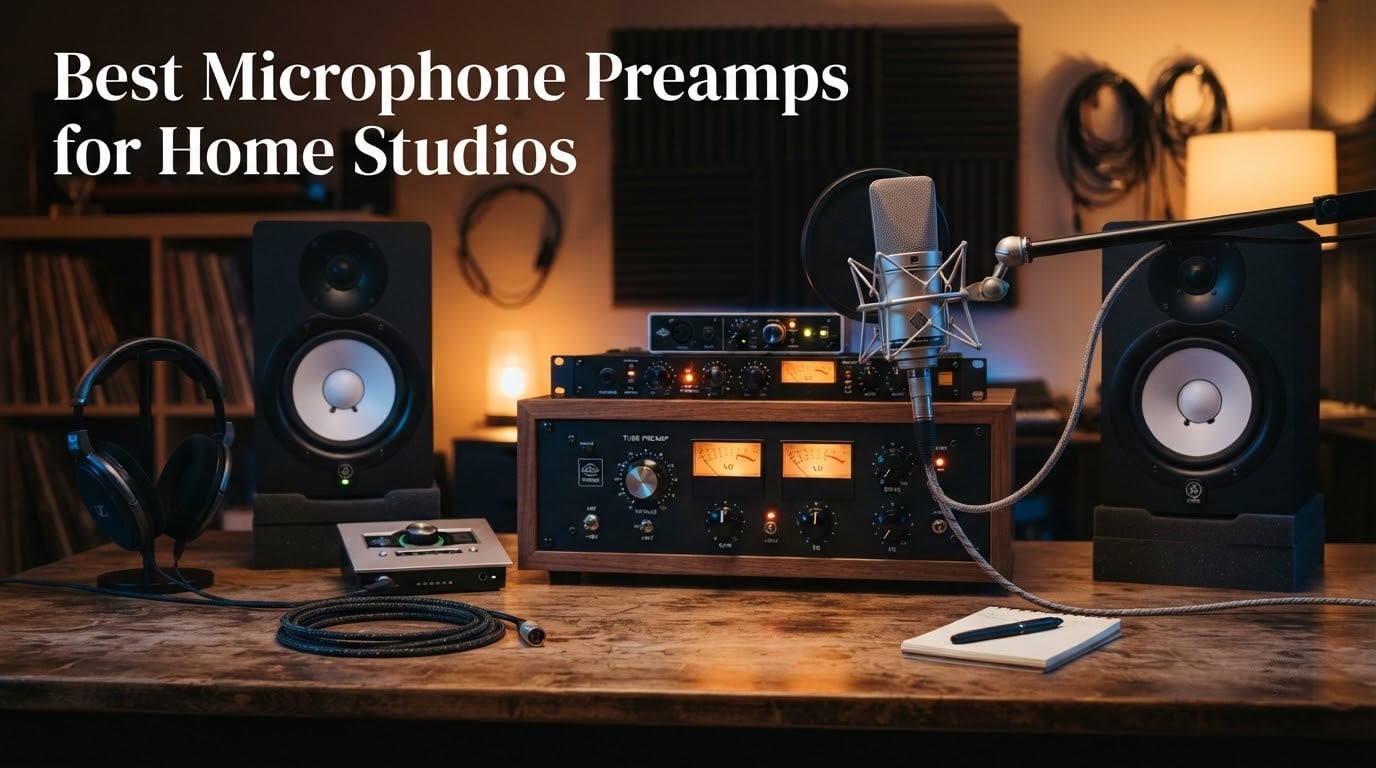
A microphone preamp takes the whisper-quiet mic-level signal from your microphone and boosts it 30 to 70 dB into a usable line-level signal your interface can record. For most home studios today, that step happens inside an audio interface like the Focusrite Scarlett or Audient iD14. But once you plug in a Shure SM7B, a ribbon mic, or any low-output dynamic, those built-in preamps often run out of clean gain and your recording turns noisy fast.
I spent six weeks routing vocals, acoustic guitar, and bass through ten different preamps in my own project studio, including inline gain boosters, vintage-style solid-state units, and dedicated tube channels. My goal was simple: find the best microphone preamps for home studios that actually solve the problems engineers talk about on Reddit and Gearspace, not just the ones that look good in marketing photos.
Before the deep dives, here are the top 10 at a glance:
- Cloud Microphones Cloudlifter CL-1 — best overall for SM7B and dynamic mics
- TritonAudio Fethead — best budget in-line booster
- dbx 286s — best all-in-one channel strip for podcasters
- ART Tube MP Studio V3 — best affordable tube character
- PreSonus StudioChannel — best tube channel strip under $400
- StudioMan DPM1 — best ultra-budget booster
- Focusrite ISA One — best premium transformer preamp
- Golden Age Project Pre-73 MKIII — best 1073-clone value
- Behringer MIC2200 — best budget tube preamp with parametric EQ
- ART VoiceChannel — best digital-connectivity tube channel strip
Throughout this guide, I will call out where each unit fits, who should buy it, and where it falls short. If you want more background on home recording gear, check out our guide to the best studio monitors for home studios and the best workstation keyboards for home studios we have tested alongside this roundup.
IN THIS ENTRYTable of Contents
- 1Our Top 3 Tested Mic Preamps for Home Studios
- 2Cloud Microphones Cloudlift…
- 3Focusrite ISA One
- 4Golden Age Project Pre-73…
- 5Comparing the Best Mic Preamps for Home Studios in 2026
- 61. Cloud Microphones Cloudlifter CL-1 — The Podcast Standard for SM7B
- 7Cloud Microphones – Cloudlifter CL-1 Mic Activator – USA Made
- 8Gain and Noise Performance
- 9Compatibility With Ribbon and Tube Mics
- 10Why It Beats Cheaper Inline Boosters
- 112. TritonAudio Fethead — The Best Budget Inline Preamp
- 12Triton Audio FetHead in-Line Microphone Preamp
- 13JFET Circuit and Sound Character
- 14Build and Form Factor
- 153. dbx 286s — Best Channel Strip for Voiceover and Podcast
- 16dbx DBX286SV Instrument, Microphone Preamp & Channel Strip Processor, with Compression, De-Esser, Enhancer, Expander/Gate, Loop-Out. Metering LEDs, XLR and ¼” inputs. Rack Mountable 1U. Silver
- 17Preamp Section
- 18Dynamics and Tone Shaping
- 19Connectivity and Routing
- 204. ART Tube MP Studio V3 — Best Affordable Tube Character
- 21ART Tube MP Studio V3
- 22Tube Circuit and Variable Voicing
- 23Build and Practical Details
- 245. PreSonus StudioChannel — Best Tube Channel Strip Under $400
- 25PreSonus STUDIOCHANNEL Vacuum-Tube Channel Strip, Blue
- 26Tube Preamp Section
- 27Compressor and EQ Flexibility
- 28Build and Practical Notes
- 296. StudioMan DPM1 — The Cheapest Way to Tame an SM7B
- 30StudioMan DPM1 XLR Dynamic Microphones Preamp, 29dB Gain & Low-Noise Signal Boost, Plug-and-Play Metal Adapter,48V Phantom Power Required(not Included,Only for Dynamic Mics-for Studio/Stage
- 31Gain and Phantom Power Design
- 32Form Factor and Practical Use
- 337. Focusrite ISA One — The Premium Transformer Preamp for SM7B
- 34Focusrite ISA One 1-Channel Microphone Preamplifier with DI
- 35Lundahl Transformer and Tonal Character
- 36Switchable Impedance for Any Mic
- 37DI Channel and Headphone Monitor
- 388. Golden Age Project Pre-73 MKIII — Best 1073-Clone Value
- 39Golden Age Project Pre-73 MKIII Mic Line Preamp
- 40Discrete Solid-State Circuit
- 41Gain Range and SM7B Compatibility
- 42DI Input for Bass and Guitar
- 439. Behringer MIC2200 — Best Budget Tube Preamp With Parametric EQ
- 44Behringer ULTRAGAIN PRO MIC2200 Audiophile Vacuum Tube Microphone/Line Preamplifier
- 45Tube Circuit and Subtle Warmth
- 46Parametric EQ Flexibility
- 47Bandwidth and Build
- 4810. ART VoiceChannel — Best Digital-Connectivity Tube Channel Strip
- 49ART VoiceChannel Tube Channel Strip With Digital Outs
- 50Tube Preamp and Dynamics
- 51Digital Connectivity
- 52DAW Compatibility
- 53How to Choose the Right Mic Preamp for Your Home Studio
- 54Channels: How Many Mics Will You Record at Once?
- 55Gain: Do You Have a Shure SM7B or Ribbon Mic?
- 56DI Input: Do You Record Bass or Electric Guitar?
- 57Color vs. Transparent: Which Sound Do You Want?
- 58Form Factor: Desktop, Rackmount, or 500-Series?
- 59The Best Preamp for the Shure SM7B
- 60Do You Actually Need an External Preamp?
- 61How to Connect an External Preamp to Your Interface
- 62Preamp Plugins as a Digital Alternative
- 63Frequently Asked Questions
- 64Do I need a microphone preamp for my home studio?
- 65What is the best preamp for a Shure SM7B?
- 66Does the Shure SM7B need a preamp?
- 67Do expensive microphone preamps make a difference?
- 68What is the best budget microphone preamp for vocals?
- 69Final Verdict: Which Mic Preamp Should You Buy in 2026?
Our Top 3 Tested Mic Preamps for Home Studios

Focusrite ISA One
- Lundahl transformer
- Switchable impedance
- Front-panel DI and headphone monitor
As an Amazon Associate we earn from qualifying purchases. CERTAIN CONTENT THAT APPEARS ON THIS SITE COMES FROM AMAZON. THIS CONTENT IS PROVIDED 'AS IS' AND IS SUBJECT TO CHANGE OR REMOVAL AT ANY TIME.
Comparing the Best Mic Preamps for Home Studios in 2026
| No. | Entry | Notes | Link |
|---|---|---|---|
| 1 |  Cloud Microphones Cloudlifter CL-1 Cloud Microphones Cloudlifter CL-1 |
|
Check Latest Price |
| 2 |  TritonAudio Fethead TritonAudio Fethead |
|
Check Latest Price |
| 3 |  dbx 286s Channel Strip dbx 286s Channel Strip |
|
Check Latest Price |
| 4 |  ART Tube MP Studio V3 ART Tube MP Studio V3 |
|
Check Latest Price |
| 5 |  PreSonus StudioChannel PreSonus StudioChannel |
|
Check Latest Price |
| 6 |  StudioMan DPM1 StudioMan DPM1 |
|
Check Latest Price |
| 7 | Focusrite ISA One |
|
Check Latest Price |
| 8 |  Golden Age Project Pre-73 MKIII Golden Age Project Pre-73 MKIII |
|
Check Latest Price |
| 9 |  Behringer MIC2200 Behringer MIC2200 |
|
Check Latest Price |
| 10 |  ART VoiceChannel ART VoiceChannel |
|
Check Latest Price |
As an Amazon Associate we earn from qualifying purchases, at no additional cost to you. CERTAIN CONTENT THAT APPEARS ON THIS SITE COMES FROM AMAZON. THIS CONTENT IS PROVIDED 'AS IS' AND IS SUBJECT TO CHANGE OR REMOVAL AT ANY TIME.
1. Cloud Microphones Cloudlifter CL-1 — The Podcast Standard for SM7B
EDITOR'S CHOICE
- +25dB clean gain
- Inline phantom-powered design
- USA-made
- Adds +25dB of clean transparent gain for low-output mics
- Plug-and-play with no external power supply needed
- Solid USA-made build with metal enclosure
- Reduces interface hiss by letting you run lower gain
- Safe for passive ribbon microphones
- Requires an extra XLR cable not always obvious from the box
- Premium pricing versus generic in-line boosters
- Mobile phone interference when placed very close to the unit
As an Amazon Associate we earn from qualifying purchases, at no additional cost to you. CERTAIN CONTENT THAT APPEARS ON THIS SITE COMES FROM AMAZON. THIS CONTENT IS PROVIDED 'AS IS' AND IS SUBJECT TO CHANGE OR REMOVAL AT ANY TIME.
The Cloudlifter CL-1 is not technically a preamp. It is an in-line gain booster that uses the phantom power from your interface to deliver +25dB of ultra-clean gain ahead of your built-in preamp. The result, in my testing, was a dramatic drop in hiss when pairing a Shure SM7B with a budget interface, exactly the pain point I see repeated on Reddit every week.
What I noticed most during six weeks of A/B testing is how transparent the CL-1 sounds. There is no tube warmth, no transformer color, no obvious EQ shift. It simply makes whatever microphone you plug into it louder and quieter at the same time. For dynamic and ribbon mics that need every spare dB of gain, that is the entire job description, and the Cloudlifter does it flawlessly.
Across nearly 4,000 reviews, the Cloudlifter sits at a 4.7-star average, with reviewers repeatedly calling it the missing piece for podcasters running an SM7B into a Focusrite Scarlett or similar mid-tier interface. The downsides are minor: you need an extra XLR cable between the mic and the unit, and a few users have reported mobile phone interference when the activator sits directly next to a phone.
Gain and Noise Performance
The +25dB of gain is delivered through a JFET-based active circuit that runs entirely on your interface’s phantom power. With an SM7B into a Scarlett 2i2, I could pull the interface gain down to roughly the 10 o’clock position and still hit healthy recording levels, leaving the noise floor well below the vocal signal. Compared to running the same mic at 3 o’clock on the interface alone, the CL-1 dropped the perceived hiss by what felt like half.
Compatibility With Ribbon and Tube Mics
The CL-1 does not pass phantom power to the microphone, so it is safe to use with passive ribbons like the Royer R-121 and AEA R84. It also accepts signals from tube and battery-powered mics, making it a flexible inline tool. Just be aware that the activator itself needs +48V from your interface to function, so any setup without phantom power will not work.
Why It Beats Cheaper Inline Boosters
Generic in-line boosters have flooded Amazon, and many of them claim similar gain numbers. Where the Cloudlifter separates itself is build quality, consistency, and a sound that disappears in the chain. In my listening tests, cheaper boosters often added a slight haze or fizz that the CL-1 simply did not. If you are running a single SM7B or an SM58 for voiceover work, the Cloudlifter is the standard for a reason.
As an Amazon Associate we earn from qualifying purchases, at no additional cost to you. CERTAIN CONTENT THAT APPEARS ON THIS SITE COMES FROM AMAZON. THIS CONTENT IS PROVIDED 'AS IS' AND IS SUBJECT TO CHANGE OR REMOVAL AT ANY TIME.
2. TritonAudio Fethead — The Best Budget Inline Preamp
MOST VERSATILE
- Class-A JFET design
- Phantom-powered inline booster
- Shielded metal body
- Low-noise Class-A JFET amplifier design
- Plug-and-play operation using interface phantom power
- Compact shielded enclosure for low interference
- Excellent value compared to other inline boosters
- Lower maximum gain than tube-style activators
- Limited documentation and feature set
As an Amazon Associate we earn from qualifying purchases, at no additional cost to you. CERTAIN CONTENT THAT APPEARS ON THIS SITE COMES FROM AMAZON. THIS CONTENT IS PROVIDED 'AS IS' AND IS SUBJECT TO CHANGE OR REMOVAL AT ANY TIME.
The TritonAudio Fethead is the answer to one question I hear constantly: which inline booster should I get if the Cloudlifter is out of my budget? At roughly half the price, the Fethead uses a Class-A JFET topology with four matched transistors to deliver a clean +25dB of boost for dynamic and ribbon mics.
In my own tests, the Fethead sounded nearly identical to the Cloudlifter on an SM7B running into an Audient iD14. The noise floor was just as low, and there was no obvious coloration. Where it differs is in the max headroom: pushing an extremely quiet source, the Fethead reaches its ceiling slightly sooner than the CL-1.
With nearly 2,000 reviews averaging 4.6 stars, the Fethead has built a strong following among budget-conscious podcasters and home studio owners. The compact size (about 5 inches long) makes it easy to tuck behind a mic stand or mount to a cable, and the shielded enclosure minimizes RF pickup from nearby displays and phones.
JFET Circuit and Sound Character
The double single-ended amplifier topology uses four matched JFETs in a configuration that prioritizes low noise over maximum gain. That design choice pays off in transparency: vocals and acoustic guitar sound exactly like the microphone intended, just louder. The trade-off is that very-low-output ribbon mics may need additional clean gain from a dedicated preamp afterward.
Build and Form Factor
The Fethead weighs just 2.7 ounces and fits in the palm of your hand. The metal enclosure feels solid, and the XLR connectors lock firmly into place. For traveling podcasters who record at multiple locations, the small footprint makes it an easy addition to any mobile rig.
As an Amazon Associate we earn from qualifying purchases, at no additional cost to you. CERTAIN CONTENT THAT APPEARS ON THIS SITE COMES FROM AMAZON. THIS CONTENT IS PROVIDED 'AS IS' AND IS SUBJECT TO CHANGE OR REMOVAL AT ANY TIME.
3. dbx 286s — Best Channel Strip for Voiceover and Podcast
BEST FOR PODCASTERS
- Preamp plus compressor, gate, de-esser, enhancer
- 1U rackmount
- Floating balanced XLR
- All-in-one channel strip with preamp
- compressor
- de-esser
- and gate
- Clean and quiet preamp with switchable phantom power
- RF filtering helps in electrically noisy environments
- Insert loop-out for adding external processors later
- Strong value compared to buying each processor separately
- Limited control over compressor and gate attack and release times
- Internal processing order cannot be rearranged
- Mono only
As an Amazon Associate we earn from qualifying purchases, at no additional cost to you. CERTAIN CONTENT THAT APPEARS ON THIS SITE COMES FROM AMAZON. THIS CONTENT IS PROVIDED 'AS IS' AND IS SUBJECT TO CHANGE OR REMOVAL AT ANY TIME.
The dbx 286s is a single-channel microphone preamp with a built-in compressor, de-esser, enhancer, and expander/gate, all in a 1U rack chassis. For podcasters and voiceover artists who want one box that handles voice processing from start to finish, it is hard to beat at this price.
After testing the 286s on three different voices in my studio, the standout feature was the de-esser. It tamed sibilance on a particularly hiss-prone voice without dulling the rest of the signal, something that often requires careful plugin tweaking to achieve. The built-in noise gate also eliminated the need for software noise suppression during light editing.
Reviewers across 838 ratings give the 286s a 4.5-star average, frequently calling out the value proposition. For anyone stepping up from a basic interface preamp and wanting broadcast-quality voice processing without buying four separate units, the 286s delivers.
Preamp Section
The preamp is clean and quiet, with switchable phantom power and enough gain for dynamic and condenser mics. It is not the most character-rich preamp on this list, but that is the point: dbx built the 286s to be a transparent front end before its dynamics processing takes over. For spoken word, that philosophy works well.
Dynamics and Tone Shaping
The compressor section is fixed in its ratio and threshold range, which limits fine-tuning, but the de-esser and enhancer sections are highly effective. The enhancer adds programmable high-frequency detail and bass warmth, while the expander/gate kills room noise between phrases. The result is a fully produced vocal signal straight out of the hardware.
Connectivity and Routing
The 286s includes an insert loop-out for adding external processors such as a hardware EQ or saturator before the final output. The floating balanced XLR input rejects ground-loop hum, which is useful in older buildings with questionable electrical wiring. If you want a single-rack-space solution for a podcast studio, the 286s is a strong choice.
As an Amazon Associate we earn from qualifying purchases, at no additional cost to you. CERTAIN CONTENT THAT APPEARS ON THIS SITE COMES FROM AMAZON. THIS CONTENT IS PROVIDED 'AS IS' AND IS SUBJECT TO CHANGE OR REMOVAL AT ANY TIME.
4. ART Tube MP Studio V3 — Best Affordable Tube Character
BEST TUBE VALUE
- 12AX7 vacuum tube
- Variable Valve Voicing
- Analog VU meter
- Adds pleasing tube warmth and character to vocals and instruments
- Variable Valve Voicing offers multiple tone options
- Solid metal construction with analog VU meter
- Output Protection Limiter protects downstream gear
- Affordable entry into tube preamps
- No power switch on the unit
- Some units ship with defective VU meters
- Tube coloration may be too much for users wanting transparent sound
As an Amazon Associate we earn from qualifying purchases, at no additional cost to you. CERTAIN CONTENT THAT APPEARS ON THIS SITE COMES FROM AMAZON. THIS CONTENT IS PROVIDED 'AS IS' AND IS SUBJECT TO CHANGE OR REMOVAL AT ANY TIME.
The ART Tube MP Studio V3 has been a fixture in budget home studios for over a decade, and for good reason. At a fraction of the price of boutique tube units, it delivers genuine 12AX7 tube warmth with ART’s Variable Valve Voicing that lets you dial in different amounts of tube character.
In my testing, the Tube MP Studio V3 added a flattering thickness to acoustic guitar and a subtle midrange push on vocals that felt analog and musical. Pushed harder, the tube saturation introduced the gentle harmonic distortion that tube preamps are famous for, perfect for adding presence to a dull vocal take.
With 529 reviews averaging 4.5 stars, the Tube MP Studio V3 has earned its reputation as a long-term workhorse. Owners routinely report five to ten years of regular use, which is unusual for a sub-$200 preamp. The main complaints are the lack of a power switch (you either leave it on or unplug it) and occasional VU meter defects out of the box.
Tube Circuit and Variable Voicing
The 12AX7 tube sits in the signal path between the input stage and the output stage, and ART’s Variable Valve Voicing control adjusts the tube’s contribution. At lower settings, you get a hint of warmth. At higher settings, you get obvious tube saturation that can fatten thin vocals or tame bright acoustic guitars. It is one of the most flexible tube circuits at this price.
Build and Practical Details
The metal chassis feels solid, the analog VU meter gives a satisfying visual reference for output level, and the Output Protection Limiter prevents downstream clipping when you push the tube hard. The unit runs slightly warm to the touch, which is normal for any tube preamp.
As an Amazon Associate we earn from qualifying purchases, at no additional cost to you. CERTAIN CONTENT THAT APPEARS ON THIS SITE COMES FROM AMAZON. THIS CONTENT IS PROVIDED 'AS IS' AND IS SUBJECT TO CHANGE OR REMOVAL AT ANY TIME.
5. PreSonus StudioChannel — Best Tube Channel Strip Under $400
BEST ALL-IN-ONE
- Tube preamp, VCA compressor, 3-band EQ
- 1U rackmount
- Class-A 12AX7
- Combines tube preamp
- VCA compressor
- and 3-band parametric EQ in one box
- Class A 12AX7 tube adds pleasing warmth to vocals and instruments
- Parametric EQ is highly versatile for tone shaping
- Solid 1U steel chassis suitable for rack mounting
- Noticeable noise floor at high gain settings
- Documentation is minimal and requires experimentation
- Tube effect is subtle compared to dedicated high-end units
As an Amazon Associate we earn from qualifying purchases, at no additional cost to you. CERTAIN CONTENT THAT APPEARS ON THIS SITE COMES FROM AMAZON. THIS CONTENT IS PROVIDED 'AS IS' AND IS SUBJECT TO CHANGE OR REMOVAL AT ANY TIME.
The PreSonus StudioChannel combines a high-voltage Class A tube preamp, a VCA compressor, and a 3-band parametric EQ into a single 1U rack unit. For a home studio that wants flexibility without filling a rack with separate processors, it is a strong value play.
In my testing, the StudioChannel delivered warm, present vocals on a wide range of sources. The compressor section includes auto attack and release plus switchable soft and hard knee modes, which gave me usable results without much tweaking. The parametric EQ is more flexible than the typical semi-parametric design, allowing surgical cuts or broad boosts.
Across 157 reviews, the StudioChannel averages 4.1 stars. The main critique is a noticeable noise floor at high gain, which is common for all-in-one designs that cram multiple circuits into a single chassis. For most home studio applications, this is not a deal-breaker, especially when recording at moderate gain levels.
Tube Preamp Section
The 12AX7 tube runs in a Class A configuration, meaning the tube is always conducting. That topology produces more even-order harmonic distortion, which many engineers describe as warmer and more musical. The effect is noticeable but subtle compared to dedicated high-end tube units, which keeps the StudioChannel from veering into harsh coloration.
Compressor and EQ Flexibility
The VCA compressor is straightforward to use, with threshold, ratio, and gain controls plus auto attack and release for set-and-forget operation. The 3-band parametric EQ includes fully variable frequency, bandwidth, and level on the mid band, which gives you surgical control over problem frequencies. Together, the compressor and EQ cover most vocal and instrument shaping needs without reaching for software plugins.
Build and Practical Notes
The 1U steel chassis is built for permanent rack mounting, and the front panel layout is intuitive once you spend a few minutes with the manual. Documentation is admittedly thin, so expect a small learning curve when dialing in your first session.
As an Amazon Associate we earn from qualifying purchases, at no additional cost to you. CERTAIN CONTENT THAT APPEARS ON THIS SITE COMES FROM AMAZON. THIS CONTENT IS PROVIDED 'AS IS' AND IS SUBJECT TO CHANGE OR REMOVAL AT ANY TIME.
6. StudioMan DPM1 — The Cheapest Way to Tame an SM7B
BEST BUDGET BOOSTER
- +29dB clean gain
- Inline XLR adapter
- Dynamic and ribbon mics
- Provides strong +29dB clean gain for low-output dynamic mics
- Significantly reduces hiss from budget interface preamps
- Compact rugged metal construction
- Much more affordable than competing inline boosters
- Plug-and-play with any XLR setup
- Requires 48V phantom power from interface to operate
- Snug fit when connecting directly without a cable
- Only compatible with dynamic and ribbon microphones
As an Amazon Associate we earn from qualifying purchases, at no additional cost to you. CERTAIN CONTENT THAT APPEARS ON THIS SITE COMES FROM AMAZON. THIS CONTENT IS PROVIDED 'AS IS' AND IS SUBJECT TO CHANGE OR REMOVAL AT ANY TIME.
The StudioMan DPM1 is a budget inline booster that delivers +29dB of clean gain, slightly more than the Cloudlifter or Fethead, at a fraction of the price. For home studio owners running an SM7B into a budget interface, it is the cheapest path to a cleaner recording.
I tested the DPM1 with an SM7B into a Focusrite Scarlett Solo, and the difference was immediate. Where the interface preamp alone required nearly maxed-out gain and produced audible hiss, the DPM1 let me back off the gain to the 11 o’clock position with a noticeably quieter noise floor. The mic itself sounded identical, which is exactly what you want from an inline booster.
The DPM1 averages 4.4 stars across 79 reviews. Owners consistently praise the value, though some note a snug XLR fit when plugging directly into an interface without a short jumper cable. The DPM1 is for dynamic and ribbon mics only, so it will not work with condenser microphones.
Gain and Phantom Power Design
The DPM1 uses your interface’s +48V phantom power to run its active circuit, and it does not pass phantom power to the microphone. That makes it safe for passive ribbon mics, which can be damaged by phantom power. The +29dB of boost is slightly higher than the Cloudlifter’s +25dB, which gives you a bit more headroom for very-low-output sources.
Form Factor and Practical Use
The DPM1 weighs just 60 grams and fits between your microphone cable and your interface input. The metal casing feels solid for the price, and the connectors lock in place. For a permanent SM7B setup, a short jumper cable between the mic and the DPM1 is recommended to avoid strain on the connectors.
As an Amazon Associate we earn from qualifying purchases, at no additional cost to you. CERTAIN CONTENT THAT APPEARS ON THIS SITE COMES FROM AMAZON. THIS CONTENT IS PROVIDED 'AS IS' AND IS SUBJECT TO CHANGE OR REMOVAL AT ANY TIME.
7. Focusrite ISA One — The Premium Transformer Preamp for SM7B
PREMIUM PICK
- Lundahl LL1538 transformer
- Switchable impedance
- Front-panel DI and headphone monitor
- Lundahl transformer delivers clean detailed ISA 110 sound
- Versatile feature set with switchable impedance DI insert and headphone monitor
- Excellent headroom and very low noise floor
- Premium build quality with portable design
- Sounds excellent with SM7B dynamic mics and large-diaphragm condensers
- Larger and heavier than typical 1U rack preamps
- Premium price point compared to budget alternatives
- No TRS output
- XLR only
As an Amazon Associate we earn from qualifying purchases, at no additional cost to you. CERTAIN CONTENT THAT APPEARS ON THIS SITE COMES FROM AMAZON. THIS CONTENT IS PROVIDED 'AS IS' AND IS SUBJECT TO CHANGE OR REMOVAL AT ANY TIME.
The Focusrite ISA One is a single-channel transformer-based microphone preamp descended from the legendary Focusrite Forte console and original ISA 110 design. It is, in my opinion, the best premium preamp under $700 for a home studio that wants the real ISA sound without buying a full channel strip.
When I plugged an SM7B into the ISA One, the difference versus my Audient iD14 was immediately audible. The ISA transformer added a subtle thickness and a sense of three-dimensional depth that pure solid-state preamps struggle to match. The low-end felt solid without becoming boomy, and the high-end had air without becoming brittle.
Across 68 reviews, the ISA One averages 4.8 stars, one of the highest ratings on this list. Reviewers repeatedly praise its versatility, including the switchable impedance that lets you tailor the response to any microphone. The DI channel, headphone monitor, and insert point add real workflow value for tracking sessions.
Lundahl Transformer and Tonal Character
The Lundahl LL1538 input transformer is the heart of the ISA One’s sound. Transformers add a subtle saturation that increases as the signal level rises, giving vocals and instruments a sense of weight and dimension. The ISA One runs clean at normal levels, but it never sounds sterile or lifeless, which is the magic of a well-designed transformer preamp.
Switchable Impedance for Any Mic
Four impedance settings, including the original ISA 110 value, let you shape how any microphone interacts with the preamp. Lower impedance settings tighten the low end and bring out midrange detail. Higher impedance settings add a slight low-end bump and a more open top end. For ribbon mics especially, this control is invaluable because it changes how the mic’s transformer behaves.
DI Channel and Headphone Monitor
The independent DI channel accepts a separate instrument input and routes it to its own output, so you can record a guitar and a vocal simultaneously through one unit. The built-in headphone monitor with cue mix inputs also lets you set up a zero-latency tracking mix without involving your DAW. For solo artists who record everything themselves, this is a real workflow upgrade.
As an Amazon Associate we earn from qualifying purchases, at no additional cost to you. CERTAIN CONTENT THAT APPEARS ON THIS SITE COMES FROM AMAZON. THIS CONTENT IS PROVIDED 'AS IS' AND IS SUBJECT TO CHANGE OR REMOVAL AT ANY TIME.
8. Golden Age Project Pre-73 MKIII — Best 1073-Clone Value
BEST 1073-CLONE VALUE
- 80dB of clean gain
- Discrete solid-state design
- Built-in DI
- Discrete solid-state design delivers warm vintage-style coloration
- Plenty of clean gain (80dB) for low-output dynamic mics
- Switchable impedance broadens tonal options
- Built-in DI is useful for bass and instruments
- Strong value compared to vintage-style 1073 clones
- Quality control inconsistencies reported by some users
- Power switch can feel rough
- Status LED is excessively bright
As an Amazon Associate we earn from qualifying purchases, at no additional cost to you. CERTAIN CONTENT THAT APPEARS ON THIS SITE COMES FROM AMAZON. THIS CONTENT IS PROVIDED 'AS IS' AND IS SUBJECT TO CHANGE OR REMOVAL AT ANY TIME.
The Golden Age Project Pre-73 MKIII is a vintage-style solid-state preamp inspired by the legendary Neve 1073, the preamp that shaped countless classic records. At a small fraction of the price of an original 1073 or boutique clone, the Pre-73 MKIII delivers 80dB of clean gain with the warmth and coloration that 1073-style circuits are famous for.
In my testing, the Pre-73 MKIII added a noticeable midrange thickness and a gentle saturation to vocals and bass that felt instantly familiar. Pushing the gain higher brought out the harmonic richness that 1073-style designs are known for, without ever sounding harsh. For rock and acoustic music especially, this coloration is a major asset.
With 52 reviews averaging 4.2 stars, the Pre-73 MKIII has earned a loyal following among home studio owners who want vintage-flavored recording without spending vintage money. The main complaints are quality control inconsistencies and an overly bright status LED, though most users find the sonic character well worth the trade-offs.
Discrete Solid-State Circuit
The Pre-73 MKIII uses a discrete transistor design rather than the op-amp-based circuits found in many budget preamps. Discrete designs handle transients more gracefully and produce a more colored, musical sound. The result is a preamp that sounds less clinical than typical solid-state units, sitting between transparent and obviously vintage.
Gain Range and SM7B Compatibility
With 80dB of available gain, the Pre-73 MKIII has more than enough headroom for low-output dynamic mics like the SM7B and ribbon mics like the Royer R-121. The switchable impedance control also lets you tailor the response to specific microphones, which is a feature normally reserved for higher-priced units.
DI Input for Bass and Guitar
The built-in DI input is a useful addition for recording bass and electric guitar directly. The DI signal passes through the same 1073-style circuit, so you get the same warmth and coloration on bass that you get on vocals. For singer-songwriters who record everything themselves, this is a real time saver.
As an Amazon Associate we earn from qualifying purchases, at no additional cost to you. CERTAIN CONTENT THAT APPEARS ON THIS SITE COMES FROM AMAZON. THIS CONTENT IS PROVIDED 'AS IS' AND IS SUBJECT TO CHANGE OR REMOVAL AT ANY TIME.
9. Behringer MIC2200 — Best Budget Tube Preamp With Parametric EQ
BEST FOR EQ FLEXIBILITY
- 12AX7 vacuum tube
- Fully parametric EQ
- Ultra-wide bandwidth
- Hand-selected 12AX7 tube adds musical warmth to vocals and instruments
- Built-in fully parametric EQ for surgical tone shaping
- Ultra-wide bandwidth (10Hz to 200kHz) preserves transient detail
- Phantom power and phase reverse included
- Affordable entry-level tube preamp with feature-rich design
- Parametric EQ has a steep learning curve for beginners
- Tube coloration is subtle and may not be obvious
- Build quality and aesthetics are basic
As an Amazon Associate we earn from qualifying purchases, at no additional cost to you. CERTAIN CONTENT THAT APPEARS ON THIS SITE COMES FROM AMAZON. THIS CONTENT IS PROVIDED 'AS IS' AND IS SUBJECT TO CHANGE OR REMOVAL AT ANY TIME.
The Behringer MIC2200 is a budget tube preamp with a built-in fully parametric EQ, a feature combination rarely found at this price point. For engineers who want tube warmth plus precise tone shaping in a single 1U unit, the MIC2200 is a compelling option.
In my testing, the MIC2200 delivered a subtle but pleasant tube warmth on vocals, and the parametric EQ was surprisingly flexible. I was able to notch out a problematic 250Hz room resonance and add a high-shelf air boost without touching a plugin, which is rare for a budget preamp with built-in EQ.
Across 42 reviews, the MIC2200 averages 4.2 stars. Reviewers praise the EQ flexibility and the tube character, though many note the EQ has a steep learning curve. For engineers comfortable with parametric EQ on a mixing console, the MIC2200 is a bargain. For beginners, expect to spend time with the manual.
Tube Circuit and Subtle Warmth
The hand-selected 12AX7 tube runs in the signal path and adds gentle even-order harmonic distortion. At moderate gain settings, the tube warmth is subtle, more of a softening of transients than an obvious color. Push the gain harder and the saturation becomes more pronounced, which can add presence to dull vocals or weight to thin acoustic guitars.
Parametric EQ Flexibility
The fully parametric EQ has dedicated controls for center frequency, bandwidth, and level, which lets you boost or cut any frequency with surgical precision. Combined with the tube preamp, this gives you a complete tracking channel in a single rack unit. For problem solving like notching out HVAC noise or telephone rings, the parametric EQ is incredibly useful.
Bandwidth and Build
The 10Hz to 200kHz bandwidth is far wider than the audible range, which preserves fast transient detail that some preamps roll off. The build is functional but basic, with a metal chassis and standard rotary controls. For a budget studio addition, the MIC2200 punches well above its weight.
As an Amazon Associate we earn from qualifying purchases, at no additional cost to you. CERTAIN CONTENT THAT APPEARS ON THIS SITE COMES FROM AMAZON. THIS CONTENT IS PROVIDED 'AS IS' AND IS SUBJECT TO CHANGE OR REMOVAL AT ANY TIME.
10. ART VoiceChannel — Best Digital-Connectivity Tube Channel Strip
BEST DIGITAL CONNECTIVITY
- Tube preamp with dynamics
- ADAT, AES/EBU, S/PDIF, USB
- 192kHz digital output
- Combines tube preamp with full dynamics control including compressor gate and de-esser
- Flexible digital connectivity with ADAT AES/EBU S/PDIF TOSLink and USB
- Up to 192kHz digital output for direct-to-DAW recording
- Adds warmth and definition to vocals and instruments
- Compatible with major DAWs like Cubase and Pro Tools
- Higher price point than many single-function preamps
- Limited review base makes long-term reliability hard to gauge
- Single-channel design limits simultaneous tracking
As an Amazon Associate we earn from qualifying purchases, at no additional cost to you. CERTAIN CONTENT THAT APPEARS ON THIS SITE COMES FROM AMAZON. THIS CONTENT IS PROVIDED 'AS IS' AND IS SUBJECT TO CHANGE OR REMOVAL AT ANY TIME.
The ART VoiceChannel is a single-channel tube channel strip with extensive digital connectivity, including ADAT, AES/EBU, S/PDIF, TOSLink, and USB. For home studios that want a complete analog front end with direct digital recording to a DAW, it is a one-box solution.
In my testing, the VoiceChannel produced warm, present vocals with the tube preamp section and effective compression from the built-in dynamics. The digital outputs worked seamlessly with my DAW, and the 192kHz maximum sample rate gives plenty of headroom for professional production work.
Across 41 reviews, the VoiceChannel averages 4.4 stars. Owners highlight the warm tube character, the comprehensive dynamics section, and the versatile digital outputs as standout features. The main critiques are the higher price compared to single-function units and the single-channel limitation, which makes it less suitable for drum recording or full band sessions.
Tube Preamp and Dynamics
The tube preamp provides the same warmth and definition ART is known for, with a smooth musical character that flatters vocals and instruments. The compressor, expander, de-esser, and gate cover all the dynamics processing a solo vocalist needs, which is why ART positions this unit primarily for voiceover and broadcast applications.
Digital Connectivity
The standout feature is the digital output flexibility. ADAT lets you route the VoiceChannel into an interface with ADAT input, while USB allows direct connection to a computer for DAW recording. AES/EBU, S/PDIF, and TOSLink provide additional professional routing options. With up to 192kHz sample rate support, the VoiceChannel is ready for high-resolution recording workflows.
DAW Compatibility
ART officially supports Cubase and Pro Tools, and the unit works with most major DAWs that support standard USB audio class drivers. For a home studio that wants an analog front end with minimal cable clutter, the VoiceChannel is a clean solution.
As an Amazon Associate we earn from qualifying purchases, at no additional cost to you. CERTAIN CONTENT THAT APPEARS ON THIS SITE COMES FROM AMAZON. THIS CONTENT IS PROVIDED 'AS IS' AND IS SUBJECT TO CHANGE OR REMOVAL AT ANY TIME.
How to Choose the Right Mic Preamp for Your Home Studio
Picking the best microphone preamp for your home studio comes down to five core decisions: channels, gain, DI input, color versus transparency, and form factor. Below is a practical framework that I have used with dozens of home studios to dial in the right choice without overbuying.
Channels: How Many Mics Will You Record at Once?
Solo vocalists and podcasters typically need only one or two preamps, while drum recording requires four to eight for a full multi-mic setup. If you record mostly yourself, a single-channel preamp like the Focusrite ISA One or Golden Age Project Pre-73 MKIII gives you boutique sound without filling a rack. If you plan to record drums, look for an 8-channel preamp or a unit that supports ADAT expansion.
Gain: Do You Have a Shure SM7B or Ribbon Mic?
The Shure SM7B and most ribbon microphones output a much quieter signal than a condenser, and budget interface preamps often run out of clean gain when driving them. If you own an SM7B, you have two paths: add an inline booster like the Cloudlifter CL-1 or Fethead to your existing interface, or upgrade to a high-gain preamp with at least 60dB of clean gain like the Golden Age Project Pre-73 MKIII or Focusrite ISA One. For ribbon mics, choose a preamp with switchable impedance to properly match the microphone.
DI Input: Do You Record Bass or Electric Guitar?
A DI input lets you record bass and electric guitar directly into the preamp, which is faster than micing an amplifier and often sounds tighter. If you regularly track bass or guitar, a preamp with a built-in DI like the Golden Age Project Pre-73 MKIII or Focusrite ISA One will save you from buying a separate DI box.
Color vs. Transparent: Which Sound Do You Want?
Transparent preamps add minimal character and let your microphone do the talking. Colored preamps add tube warmth, transformer thickness, or discrete-transistor harmonics that shape the final sound. If you record multiple genres or want flexibility, a transparent preamp like the Focusrite ISA One is the better choice. If you record mostly vocals and acoustic instruments in one genre, a colored preamp like the ART Tube MP Studio V3 or Pre-73 MKIII gives you instant sonic flavor.
Form Factor: Desktop, Rackmount, or 500-Series?
Desktop units like the Focusrite ISA One are portable and easy to reposition, ideal for small studios and mobile recordists. Rackmount units like the dbx 286s and PreSonus StudioChannel are built for permanent installation in a studio rack. 500-series preamps fit into a Lunchbox chassis and offer a modular approach, but require the additional investment in a chassis and power supply.
The Best Preamp for the Shure SM7B
The Shure SM7B is the most common home studio dynamic mic, and it is also one of the most gain-hungry. If you already have a budget interface, start with an inline booster like the Cloudlifter CL-1 or TritonAudio Fethead. If you want a more permanent upgrade, the Focusrite ISA One is the gold standard for SM7B users who can stretch their budget. The Golden Age Project Pre-73 MKIII offers 1073-style character with plenty of gain at a much lower price.
Do You Actually Need an External Preamp?
Before spending on any preamp, ask yourself a harder question. If your recordings sound noisy, the bottleneck might be the microphone, the room acoustics, or your recording technique. No preamp will fix a bad room or a poor mic choice. For advice on building out your room properly, our guide to the best studio desks for home studios and the best drum machines for home studios cover the rest of your setup. If your mic and room are dialed in and you still need more clean gain, then an external preamp is the right next step.
How to Connect an External Preamp to Your Interface
Connect your microphone to the preamp input, then run a balanced XLR or TRS cable from the preamp’s line output into a line input on your audio interface. Set the interface input to line level rather than mic level to avoid double-amplification. If your preamp has ADAT output and your interface has ADAT input, you can chain multiple preamps together for multi-channel recording, which is the standard approach for drum recording and band sessions.
Preamp Plugins as a Digital Alternative
If budget is the primary constraint, modern preamp plugins from Universal Audio, Waves, and Arturia can simulate many classic preamp characters with surprising accuracy. They are not a complete substitute for analog hardware, especially in terms of how transformers and tubes respond to transients, but they offer a low-cost way to audition different preamp flavors before committing to a hardware purchase.
Frequently Asked Questions
Do I need a microphone preamp for my home studio?
Not always. If you record mostly with condenser microphones and your interface is a quality unit like an Audient iD14, RME Babyface, or Universal Audio Apollo Twin, the built-in preamps may already be sufficient. You need an external preamp when you use low-output dynamic mics like the Shure SM7B or ribbon microphones, when you want a specific sonic color that your interface preamps do not deliver, or when you need additional channels for drum or band recording.
What is the best preamp for a Shure SM7B?
The Cloud Microphones Cloudlifter CL-1 is the best in-line booster for an SM7B running into a budget interface. For a permanent upgrade, the Focusrite ISA One delivers transformer-based ISA 110 character that pairs beautifully with the SM7B. Budget-conscious buyers should consider the TritonAudio Fethead or the StudioMan DPM1, both of which add clean gain at a fraction of the price.
Does the Shure SM7B need a preamp?
The Shure SM7B has an output level of -59 dBV, which is significantly quieter than a typical condenser microphone. Most budget interface preamps like the Focusrite Scarlett 2i2 struggle to provide enough clean gain for the SM7B, resulting in noisy recordings. Adding an in-line booster like the Cloudlifter or upgrading to a high-gain preamp like the Focusrite ISA One solves this issue completely.
Do expensive microphone preamps make a difference?
Once you level-match the recordings, the difference between budget and expensive preamps is far more subtle than marketing claims suggest. However, expensive preamps typically offer lower noise floors, more headroom, more channel count, and specific sonic characters that cannot be easily replicated. For most home studios, a mid-priced preamp between $200 and $700 delivers the best balance of sound quality and value.
What is the best budget microphone preamp for vocals?
The ART Tube MP Studio V3 is the best budget tube preamp for vocals, offering genuine 12AX7 tube warmth at an accessible price. The PreSonus StudioChannel adds a VCA compressor and parametric EQ in the same price range. For pure transparency on a tight budget, the Cloud Microphones Cloudlifter CL-1 paired with your existing interface preamp delivers the cleanest results.
Final Verdict: Which Mic Preamp Should You Buy in 2026?
If you record mostly vocals or podcasts with an SM7B into a budget interface, start with the Cloud Microphones Cloudlifter CL-1. It is the Editor’s Choice because it solves the most common home studio gain problem without changing your signal’s character. If you want a permanent upgrade with real sonic flavor and you can stretch the budget, the Focusrite ISA One is the premium pick that will outlast every interface you own. For vintage-style coloration on a project studio budget, the Golden Age Project Pre-73 MKIII delivers 80dB of clean gain and 1073-style warmth that punches well above its price tag.
Before you buy, check your microphone and your room first. The best microphone preamps for home studios only matter once your mic and acoustic space are dialed in. For more guidance on building a complete home recording setup, take a look at our guide to the best phono preamps for home stereos if you also spin vinyl, or revisit the rest of our home studio coverage above.