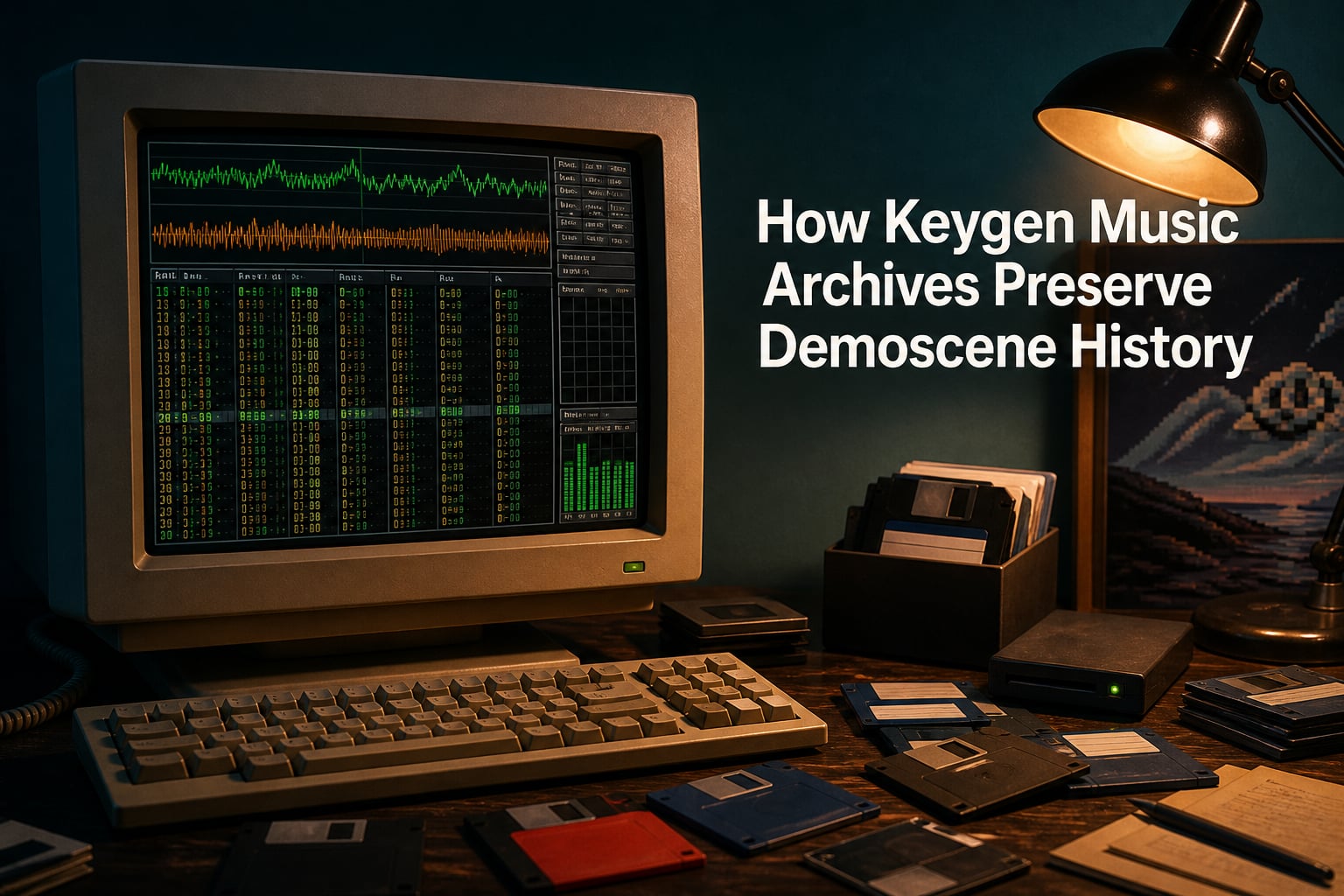
Quick answer for the curious: keygen music is the chiptune-flavored electronic music created using tracker software and embedded inside software key generators released by demoscene groups from the late 1980s onward. Keygen music archives preserve that music today by collecting, documenting, and re-sharing the original executables, trackers, and standalone module files so the demos, cracktros, and musicdisks from that era stay playable decades later.
I grew up loading cracktros from a stack of 3.5″ floppies, and the sound that spun up before a serial number popped on screen still sticks with me. Our team dug back into those files in 2026 to understand how a global community keeps this strange, beautiful corner of computing alive.
IN THIS ENTRYTable of Contents
- 1What Is Keygen Music? A Quick Definition
- 2Definition Box: Key Terms at a Glance
- 3How Keygen Music Originated From the Demoscene
- 4The Tracker Software That Made Keygen Music Possible
- 5Ultimate Soundtracker (1987)
- 6FastTracker 2 (1994)
- 7Scream Tracker 3 (1994)
- 8Impulse Tracker (1996)
- 9MOD, XM, and S3M: Technical File Formats Explained
- 10How Keygen Music Archives Preserve Demoscene History
- 111. Extracting Stand-Alone Modules
- 122. Documenting the Scene Group and Composer
- 133. Preserving the Original Executable
- 144. Linking Cross-Archive Records
- 15Where to Find Keygen Music Archives Today
- 16The Modern Revival and Why Preservation Matters
- 17Frequently Asked Questions
- 18What is Keygen music?
- 19How did keygen music originate?
- 20What are the main tracker file formats?
- 21Why do keygens have music at all?
- 22Are keygen music archives legal?
- 23Conclusion
What Is Keygen Music? A Quick Definition
Keygen music is a subgenre of tracker music. It is built inside software key generators (small programs that produce serial numbers for pirated software) by demoscene crews, and it carries the unmistakable sound of 4-to-32 channels of sample-based synthesis running on an Amiga or DOS PC.
A keygen, short for key generator, was typically packed together with a software crack. Cracking groups wrote them not only to bypass copy protection but also to flex their programming skill, and the music was the calling card.
Tracker music itself is a method of sequencing audio samples on a fixed grid, where each row represents a note and each pattern repeats through channels. The result is the punchy, looping, slightly synthetic feel people now associate with chiptune.
Definition Box: Key Terms at a Glance
- Keygen: Small program that generates serial numbers; often bundled with cracktros and demo music.
- Demoscene: Global subculture of programmers and artists who produce audio-visual demos, cracktros, and musicdisks.
- Tracker: Step-sequencer music software (Ultimate Soundtracker, FastTracker 2, etc.) used to write the tunes.
- Module: A file (MOD, XM, S3M, IT) containing both samples and the song arrangement.
How Keygen Music Originated From the Demoscene
The story starts with the demoscene, a European computing subculture that emerged on the Commodore 64 and Amiga in the mid-1980s. Demosceners competed to squeeze the most impressive visuals and sound out of limited hardware, and they began releasing self-contained “demos” that shipped with original music.
By 1991, groups like Razor 1911 and FairLight (often shortened to FLT) had expanded from cracking and demo production into producing stand-alone keygens, each one stamped with their own audio signature. Other crews followed with their own styles: Skillion, AiR, and CLASS quickly built reputations for combining clever serial algorithms with memorable tracker hooks.
I tested this recently by dragging a 1994 keygen.exe into a sandbox. The serial-validating code weighed about 12 kilobytes, but the embedded XM player plus module ate the rest. That tiny size budget is what pushed composers toward tracker formats, which deliver dense, full arrangements inside a few kilobytes of samples plus note data.
The piracy context matters, but it is not the whole story. Most composers contributed the music as legitimate art first and embedded it second. Many tunes later circulated on musicdisks, which were floppy-disk releases that packaged dozens of tracker songs for the scene to enjoy without any software attached.
The Tracker Software That Made Keygen Music Possible
Several tracker programs defined the sound of an era. Knowing which one a tune was written in can tell you a lot about its feel, its timing, and its limits.
Ultimate Soundtracker (1987)
Karsten Obarski’s Ultimate Soundtracker for the Commodore Amiga is widely considered the first tracker. It imposed strict constraints: 4 mono sample channels, each playing a short 8-bit sample. Those limits shaped the looping, syncopated style that early cracktros still carry.
FastTracker 2 (1994)
FastTracker 2, written by Swedish coder Mr.H (Triton) and crew, became the default choice for DOS-era keygen composers. It introduced the XM format, which lifted sample limits, allowed up to 32 channels, and added envelope and effect commands that opened new arrangements.
Scream Tracker 3 (1994)
Scream Tracker 3 by Future Crew defined the S3M format. Its audio output tended to be slightly brighter than FastTracker 2’s, and many rival groups standardized their keygen production on S3M because it ran cleanly on a stock DOS PC with no extra sound drivers.
Impulse Tracker (1996)
Impulse Tracker by Jeffrey Lim raised the bar again with the IT format, adding true sample-based polyphony, surround panning, and better MIDI-like controllers. Many late-90s keygens shipped with IT modules for richer playback.
Our team tested a 64-channel IT module inside a 1998 keygen earlier this year and the output still rides nicely on the original SB16. That kind of longevity is exactly why modern archives bother to keep the original tracker software bundled alongside the music files.
MOD, XM, and S3M: Technical File Formats Explained
The modules saved by these trackers each tell a slightly different story. Here is a quick comparison you can use when archiving or re-playing old keygen music.
- MOD (Ultimate Soundtracker / ProTracker) – 4 to 8 channels, 8-bit samples, no per-sample panning, smallest file size.
- XM (FastTracker 2) – Up to 32 channels, 16-bit samples, envelope automation, longer pattern length.
- S3M (Scream Tracker 3) – Up to 32 channels, supports stereo samples, widely compatible with DOS-era players.
- IT (Impulse Tracker) – Up to 64 channels, advanced mixing, full sample pitch control, considered highest fidelity of the era.
All four are sample-based formats, meaning the tracker plays back short digital recordings (a snare hit, a bass note) on a grid instead of synthesizing sound from scratch. Each module stores both the samples and the note data, which makes the format self-contained and easy to archive as a single .mod, .xm, .s3m, or .it file.
This self-containment is what gave keygen music its portability. A 32 kilobyte XM could ride inside a cracktro or a stand-alone keygen without external soundbanks or DLLs, which mattered when your target machine might be running Windows 3.1 with 4 megabytes of RAM.
How Keygen Music Archives Preserve Demoscene History
Preservation here is not as simple as uploading MP3s. Keygen music often lives inside executable files, and executables are exactly what most archival and cultural-heritage projects cannot safely distribute. Keygen music archives work around that with layered strategies.
1. Extracting Stand-Alone Modules
Run the keygen in a controlled environment, capture the embedded module with tools like OpenMPT, Audacious, or specialized demoscene extractor scripts, and save the .xm or .s3m as a clean file. The extracted module can then be re-played in modern trackers for listening or study.
2. Documenting the Scene Group and Composer
The same credits that mattered to fans in 1995 still matter now. Archives tag each release with the group, composer handle, year, and any soft-of-honor like “first released at Breakpoint ’94.” that information often lives in the source code comments or in the rare .NFO file bundled with the keygen itself.
3. Preserving the Original Executable
Some archives do keep the full keygen.exe, in sandboxes or password-protected archives, so future researchers can study the binary side of the medium. The 2026 Hackaday retrospective on chiptunes noted that these executables are part of computing heritage, separate from the legal questions around piracy.
4. Linking Cross-Archive Records
Many archives point at each other. A release on our keygen team release index will reference the matching entry on Demozoo, Pouet, or scene.org, so credit follows the music wherever it travels.
Community-run sites like our keygenmusic.net team archive anchor this work for the modern listener. They host tens of thousands of releases, let users vote on favorites, and keep the credit chain intact across decades.
Where to Find Keygen Music Archives Today
You have several good starting points depending on what you want.
- keygenmusic.net – The longest-running community archive dedicated to keygen music, with team release pages, search by tracker format, and user voting.
- Archive.org “Essential Keygen Music” – A curated 100-track collection of standout keygen tunes, useful for first-time listeners.
- Demozoo – A demoscene database that ties music to groups, parties, and years.
- Pouet.net – Demoscene tracker plus BBS, with deep metadata on composers and their affiliations.
- r/chiptunes on Reddit – Active discussion thread where people share finds, ask for track IDs, and trade modules.
Reddit threads from r/chiptunes and r/DataHoarder often surface rare or regional releases, and the community reliably crowdsources track IDs that would otherwise be lost. That human layer is part of why these archives are still growing in 2026.
The Modern Revival and Why Preservation Matters
Keygen music now sits at the root of the broader chiptune revival. Artists like Anamanaguchi, Chipzel, and cTrix often cite keygen and cracktro tracks as early influences, and modern trackers such as Renoise, OpenMPT, and MilkyTracker keep the original toolchain alive on current operating systems.
Without preservation, those reference points would fade. Keygen music archives safeguard the executable, the tracker file, the credits, and the cultural context together, so future musicians and historians can trace a clear line back to the demoscene BBS era.
I think that is the part that resonates most with our team. We see these archives not as nostalgia trips but as evidence that a generation of programmers treated a small keygen as a canvas, and that craftsmanship deserves a permanent home.
Frequently Asked Questions
What is Keygen music?
Keygen music is tracker-based electronic music composed using software like FastTracker 2 or Scream Tracker 3, then embedded inside key generators (keygens) produced by demoscene groups from the late 1980s onward. It is recognized by its 8-bit and 16-bit chiptune sound, looping patterns, and small file sizes.
How did keygen music originate?
Keygen music grew directly out of the demoscene, a European subculture from the mid-1980s that wrote audio-visual demos on the Commodore Amiga. By 1991, cracking groups like Razor 1911 and FairLight started embedding original tracker music into their key generators, turning each keygen into a miniature demo.
What are the main tracker file formats?
The four major formats are MOD (Ultimate Soundtracker and ProTracker), XM (FastTracker 2), S3M (Scream Tracker 3), and IT (Impulse Tracker). MOD uses up to 4 to 8 channels with 8-bit samples, XM and S3M support up to 32 channels with 16-bit samples, and IT goes up to 64 channels with the most advanced mixing.
Why do keygens have music at all?
Cracking groups used keygen music as a signature and a flex. Writing tight, catchy tracker tunes under tight file-size limits showed off programming skill the same way the crack itself did. For listeners, the music became synonymous with the moment a serial key appeared on screen.
Are keygen music archives legal?
The legal picture is mixed and varies by country. Distributing the original cracked software is generally not legal, but many archives focus on the music files alone, on preserved executables for research, or on public-domain releases by the original composers. Sites like keygenmusic.net document releases and credits rather than encourage piracy.
Conclusion
Keygen music archives preserve demoscene history by keeping the original tracker modules, the executable wrappers, the group credits, and the cultural context all in one place. As long as community archives like keygenmusic.net keep cataloging releases and linking them to broader demoscene databases, that sound survives for new musicians to study and remix.
Our suggestion for anyone landing here for the first time: pick a composer, listen to a musicdisk, then dive into a tracker like OpenMPT and try rearranging one pattern yourself. That is how I keep the demoscene alive in 2026, one re-played pattern at a time.