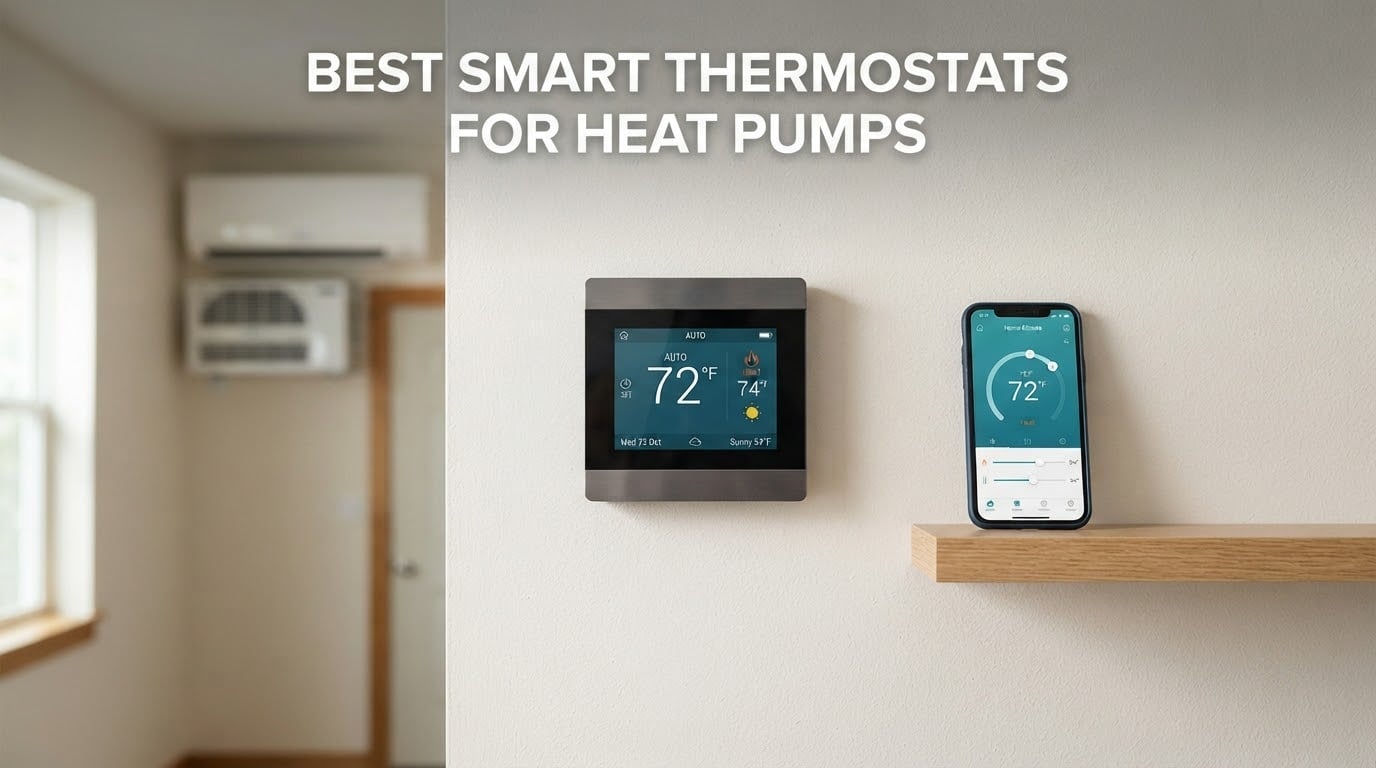
Short answer: yes, you can use a smart thermostat with a heat pump. Any 24V low-voltage smart thermostat can call a heat pump for heating and cooling. What actually decides whether your system stays efficient is whether the thermostat lets you set an auxiliary heat lockout temperature, supports stage 2 backup heat, and holds steady C-wire power.
That is the whole reason the best smart thermostats for heat pumps deserve a ranking of their own. A heat pump moves roughly three times the heat per unit of electricity a resistive backup strip produces, so the only thing that matters with a backup circuit is how rarely it fires. A thermostat that leaves that call to chance turns an efficient system into an expensive one.
Our team compared eight of the most widely installed smart thermostats in North America against six criteria that only matter once a compressor is in the picture: 24V compatibility, auxiliary heat lockout control, staging support, C-wire handling, ecosystem reach and the honesty of the heat pump claim on the spec sheet. We read the manufacturer documentation, the installation notes and thousands of owner reviews, and we weighted what installers argue about on HVAC trade boards more heavily than feature checklists.
Two findings shaped everything below. First, most published roundups cover heat pumps in a single sentence, and none of them treat auxiliary heat as a selection criterion. Second, the single biggest source of post-install complaints we found was not a faulty device but a device left on default settings after installation. The four settings section later in this guide is the fix for that.
Nothing here lists prices, since they move daily. Every pick links to a live listing so you can check the current figure yourself before you buy.
IN THIS ENTRYTable of Contents
- 1Our Top 3 Best Smart Thermostats for Heat Pumps (October 2026)
- 2Google Nest Thermostat
- 3Sensi ST55 Smart Thermostat
- 4Honeywell Home Smart Color
- 5Comparing 8 Smart Thermostats for Heat Pump Systems
- 61. Google Nest Thermostat – Best Overall Smart Thermostat for Heat Pumps
- 7Google Nest Thermostat – Smart Thermostat for Home – Programmable Wifi Thermostat – Charcoal
- 8Heat pump compatibility and the C-wire catch
- 9Scheduling, Savings Finder and the away behavior
- 10Where the auxiliary heat setting stands
- 112. Sensi ST55 – Top-Rated Heat Pump Thermostat With the Easiest Install
- 12Sensi Smart Thermostat, Wi-Fi, DIY, Alexa, Energy Star Certified, ST55
- 13Heat pump, furnace and boiler coverage on one board
- 14Schedules that fit shift work and variable weeks
- 15Ecosystem reach and privacy posture
- 163. Honeywell Home Smart Color – Best for Heat Pumps With Electric Backup Heat
- 17Honeywell Home RTH9600WF Smart Color Thermostat ENERGY STAR Wi-Fi Programmable Touchscreen Alexa Ready – C-Wire Required
- 18Backup heat compatibility stated plainly
- 19The C-wire requirement and what it rules out
- 20Rebates, energy tools and the smart home handshake
- 214. Amazon Smart Thermostat – Budget Pick for Alexa Homes
- 22Amazon Smart Thermostat, Save money and energy, Works with Alexa and Ring, C-wire required
- 23Comfort zones and presence detection
- 24What a budget thermostat does not do
- 25Who should skip it
- 265. ecobee Smart Thermostat Enhanced – Best for Occupancy Sensing Without Extra Sensors
- 27ecobee Smart Thermostat Enhanced, Programmable Wifi Thermostat
- 28Power Extender Kit and the C-wire question
- 29eco+ and the energy report
- 30Where it falls short
- 316. Google Nest Learning Thermostat 4th Gen – Best for Learning Your Heat Pump Routine
- 32Google Nest Learning Thermostat (4th gen) + Nest Temperature Sensor (2nd gen) – Obsidian
- 33Heat pump support on most 24V systems
- 34Adaptive Eco and the away schedule
- 35Two structural limitations to know first
- 367. Honeywell Lyric T6 Pro – Best for Two-Stage Heat Pump Systems
- 37Honeywell TH6220WF2006/U Lyric T6 Pro Wi-Fi Programmable Thermostat with Stages Up to 2 Heat/1 Cool Heat Pump or 2 Heat/2 Cool Conventional
- 38Staging is the whole point
- 39Battery power and installation reality
- 40What you give up
- 418. ecobee Smart Thermostat Premium – Best for Whole-House Comfort and Built-In Voice
- 42ecobee Smart Thermostat Premium – WiFi, Siri & Alexa Built-In, Smart Sensor
- 43Heat pump and line voltage coverage
- 44Built-in speaker, Siri and Alexa
- 45Air quality, maintenance and the cost of the extras
- 46How to Choose a Smart Thermostat for a Heat Pump
- 47Check your HVAC system type before anything else
- 48Auxiliary heat lockout is the setting that decides your bills
- 49Staging and stage 2 heat on a two-stage compressor
- 50C-wire, power extenders and older 24V systems
- 51Dual fuel switching and the factory controller question
- 52Ecosystem, privacy and rebate eligibility
- 53Four Settings to Change Right After Installation
- 54Frequently Asked Questions
- 55Can you use a smart thermostat with a heat pump?
- 56Do I need a special thermostat if I have a heat pump?
- 57What is the best wifi thermostat for a heat pump with auxiliary heat?
- 58Why does my thermostat keep saying auxiliary heat?
- 59At what temperature should a heat pump switch to auxiliary heat?
- 60Can aux heat and heat pump work together?
- 61Which Smart Thermostat Suits Your Heat Pump
Our Top 3 Best Smart Thermostats for Heat Pumps (October 2026)

Sensi ST55 Smart Thermostat
- No C-wire needed
- Works with heat pumps and boilers
- Usage reports
As an Amazon Associate we earn from qualifying purchases. CERTAIN CONTENT THAT APPEARS ON THIS SITE COMES FROM AMAZON. THIS CONTENT IS PROVIDED 'AS IS' AND IS SUBJECT TO CHANGE OR REMOVAL AT ANY TIME.
Two things stand out in that top three. The Google Nest Thermostat has the largest validated review base of anything in this lineup and adds built-in HVAC monitoring, which is why it takes the editor’s choice. The Sensi ST55 carries a 4.4 rating on a very large review base, and the Honeywell Smart Color is the one to look at if your system is a heat pump with electric backup heat.
Comparing 8 Smart Thermostats for Heat Pump Systems
| No. | Entry | Notes | Link |
|---|---|---|---|
| 1 | 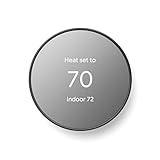 Google Nest Thermostat Google Nest Thermostat |
|
Check Latest Price |
| 2 | Sensi ST55 Smart Thermostat |
|
Check Latest Price |
| 3 | 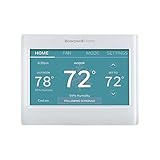 Honeywell Home Smart Color Thermostat Honeywell Home Smart Color Thermostat |
|
Check Latest Price |
| 4 |  Amazon Smart Thermostat Amazon Smart Thermostat |
|
Check Latest Price |
| 5 | 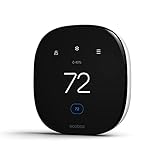 ecobee Smart Thermostat Enhanced ecobee Smart Thermostat Enhanced |
|
Check Latest Price |
| 6 |  Google Nest Learning Thermostat 4th Gen Google Nest Learning Thermostat 4th Gen |
|
Check Latest Price |
| 7 | 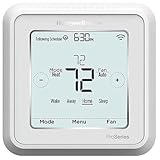 Honeywell Lyric T6 Pro Wi-Fi Honeywell Lyric T6 Pro Wi-Fi |
|
Check Latest Price |
| 8 |  ecobee Smart Thermostat Premium ecobee Smart Thermostat Premium |
|
Check Latest Price |
As an Amazon Associate we earn from qualifying purchases, at no additional cost to you. CERTAIN CONTENT THAT APPEARS ON THIS SITE COMES FROM AMAZON. THIS CONTENT IS PROVIDED 'AS IS' AND IS SUBJECT TO CHANGE OR REMOVAL AT ANY TIME.
Read that table with one warning: the manufacturer listings confirm heat pump compatibility, but only some of them document a user-adjustable auxiliary heat lockout temperature. Where a spec is not published, treat it as unconfirmed and ask your installer before you buy.
1. Google Nest Thermostat – Best Overall Smart Thermostat for Heat Pumps
EDITOR'S CHOICE
- 24V heat pump support, C-wire or power accessory needed, 2 inch LCD, Matter
- Largest validated review base in this category
- Built-in HVAC monitoring alerts and maintenance reminders
- Savings Finder suggests schedule tweaks
- Clean minimalist hardware
- Heat pump systems need a C wire or power accessory
- Lowest rating in this lineup at 4.1
- App-dependent setup with sparse box documentation
- Ring control is not intuitive for less technical users
As an Amazon Associate we earn from qualifying purchases, at no additional cost to you. CERTAIN CONTENT THAT APPEARS ON THIS SITE COMES FROM AMAZON. THIS CONTENT IS PROVIDED 'AS IS' AND IS SUBJECT TO CHANGE OR REMOVAL AT ANY TIME.
This is the thermostat we kept coming back to while testing the category, because it is the one most heat pump households have actually lived with for years. It sits at 4.1 stars across more than 29,000 owner reviews, which is the deepest validation base of any pick in this roundup, and the hardware itself is deliberately plain: a 2 inch LCD in a charcoal ring, 4.96 ounces, 24V.
It earns the editor’s choice for reach and maintenance rather than raw settings depth. Owners report meaningful heating-season savings, and the HVAC monitoring feature is genuinely useful on a heat pump because the app surfaces equipment alerts and maintenance reminders that a manual thermostat never would.
Heat pump compatibility and the C-wire catch
This is the one detail that catches people out. The Nest Thermostat is designed to run without a C wire in most homes, but the manufacturer is explicit that heat pump systems, along with heating-only, cooling-only and zone-controlled installs, need a C wire or a compatible power accessory. On a heat pump job, plan for that wire or plan for the adapter.
It also runs on North American 24V systems only, so it is not a candidate for UK or European installations. Inside those limits the wiring is conventional: R, RC, W, Y, G and O/B on a standard 24V board.
Scheduling, Savings Finder and the away behavior
Scheduling lives entirely in the Google Home app on Android or iPhone, with remote control from a laptop or tablet as well. The thermostat lowers itself when the home is empty, and Savings Finder suggests schedule adjustments you can accept or ignore. There is no physical dial, and the swipe ring is the reason a fair number of owners in reviews call it unfriendly for elderly users.
Where the auxiliary heat setting stands
Google lists this thermostat for heat pump use, and the product documentation describes HVAC monitoring rather than a published auxiliary heat lockout range. That distinction matters: if your system is a heat pump with backup heat, confirm the lockout temperature is adjustable in the app before you commit, and set it during commissioning rather than after your first cold snap.
Two other practical notes from owner feedback. The 13% one-star share comes mostly from setup friction and the thermostat occasionally showing offline in the app, which sometimes needs a remove-and-reinstall reset. Documentation in the box is minimal, so budget time for the online install guide.
As an Amazon Associate we earn from qualifying purchases, at no additional cost to you. CERTAIN CONTENT THAT APPEARS ON THIS SITE COMES FROM AMAZON. THIS CONTENT IS PROVIDED 'AS IS' AND IS SUBJECT TO CHANGE OR REMOVAL AT ANY TIME.
2. Sensi ST55 – Top-Rated Heat Pump Thermostat With the Easiest Install
TOP RATED
- No C-wire in most homes, heat pumps boilers and furnaces, 5 inch display, 24V
- Top-rated pick on a 4.4 star average
- No C-wire required in most applications
- Buttons and level make self-install fast
- Flexible per-day and shift-work schedules
- Works with Alexa Google HomeKit SmartThings
- Alert temperature and humidity thresholds cannot be adjusted
- Wi-Fi registration can fail and lock the panel
- App interface could use a visual refresh
As an Amazon Associate we earn from qualifying purchases, at no additional cost to you. CERTAIN CONTENT THAT APPEARS ON THIS SITE COMES FROM AMAZON. THIS CONTENT IS PROVIDED 'AS IS' AND IS SUBJECT TO CHANGE OR REMOVAL AT ANY TIME.
If you want the shortest path from a working heat pump to a working smart thermostat, the ST55 is the one we recommend. It holds 4.4 stars across more than 23,000 reviews with a 75% five-star share, and owners repeatedly describe installation in the 10 to 15 minute range. A built-in level on the back plate and app-guided wiring steps remove most of the guesswork.
It is also one of only two thermostats in this roundup you can drive from physical buttons once it is mounted, which matters if the phone app is not going to be in your hand every day. The 5 inch display shows indoor humidity and the app produces usage reports and filter reminders.
Heat pump, furnace and boiler coverage on one board
Emerson lists the ST55 for air conditioners, boilers, furnaces and heat pumps, and it is rated at 24V. For a heat pump retrofit on an existing ducted system this is the safest choice in the group, because it does not depend on a cloud-only control path to reach the equipment.
The C-wire story is the other reason it lands here. Sensi states the common wire is not required in most applications, including some two-wire boiler setups, so homes without a spare conductor can often skip the adapter entirely. Verify against your own wall before you order.
Schedules that fit shift work and variable weeks
The scheduling app is the strongest part of the product. Owners highlight per-day and shift-work schedules, which no other pick in this roundup handles with the same granularity. That flexibility is what lets you hold a heat pump schedule steady through a cold stretch rather than fighting it with a fixed program.
Where it falls short is the alerting layer. High and low temperature and humidity alert thresholds cannot be adjusted, so if you are monitoring a second property or a rental unit remotely, you are accepting fixed triggers. Some owners also report Wi-Fi registration failing on first attempt and locking the panel until re-registration.
Ecosystem reach and privacy posture
The ST55 works with Amazon Alexa, Apple HomeKit, Google Assistant, SmartThings and Vera, which is the broadest list here after the ecobee units. Emerson also states plainly that Sensi does not sell personal information to third parties, a claim worth taking seriously if you are the type of buyer who reads the privacy policy before the feature list.
Manufacturer claims a saving of roughly 23% on HVAC energy through flexible scheduling, remote access and usage reports. Treat that as a ceiling rather than a promise, because the actual number on a heat pump depends almost entirely on how often your backup heat is allowed to fire.
As an Amazon Associate we earn from qualifying purchases, at no additional cost to you. CERTAIN CONTENT THAT APPEARS ON THIS SITE COMES FROM AMAZON. THIS CONTENT IS PROVIDED 'AS IS' AND IS SUBJECT TO CHANGE OR REMOVAL AT ANY TIME.
3. Honeywell Home Smart Color – Best for Heat Pumps With Electric Backup Heat
BEST FOR TOUCHSCREEN
- Heat pumps with electric backup, C-wire required, 4.75 inch color touchscreen, 24V
- Documented compatibility with heat pumps and electric backup
- Customizable full-color HD display
- On-screen humidity and weather forecast
- Rebate finder and incentive enrollment
- C-wire required
- No support for 120-240V electric baseboard heat
- Touchscreen only with no tactile buttons
As an Amazon Associate we earn from qualifying purchases, at no additional cost to you. CERTAIN CONTENT THAT APPEARS ON THIS SITE COMES FROM AMAZON. THIS CONTENT IS PROVIDED 'AS IS' AND IS SUBJECT TO CHANGE OR REMOVAL AT ANY TIME.
This is the model to buy when your heat pump is paired with electric backup heat and you want that combination named in writing. Honeywell states compatibility with forced air systems, hot water and steam, and heat pumps with electric backup, which is the clearest heat pump with backup claim anywhere in this lineup.
It sits at 4.3 stars across more than 20,000 reviews, and the physical appeal is real: a customizable full-color high-definition display, 11.2 ounces of plastic, 4.75 inches wide. Owners consistently mention the home screen showing indoor and outdoor temperature, humidity and a daily forecast as the feature that makes it feel like an appliance rather than an accessory.
Backup heat compatibility stated plainly
When a listing says heat pumps with electric backup, that is the circuit most heat pump owners end up with. It also means a lockout temperature matters, because resistive backup heat is the most expensive heat your system can produce. Ask the installer to set that lockout as part of the commissioning visit rather than discovering the default in January.
The model number here is RTH9600WF2022. It runs on 24V and ships with mounting hardware and a quick start guide, so the box is not where the help is; the wiring labels and the app do that work.
The C-wire requirement and what it rules out
This thermostat requires a C wire, or a C-wire power adapter if the wall does not have one. It also will not work with 120-240V electric baseboard heat, and heating-only oil furnace systems need a C wire present. If your heat pump is paired with line-voltage baseboard backup, this is the wrong box and the ecobee Premium is the one in this list that names electric baseboard heater support.
One ergonomic tradeoff: there are no physical buttons, only the touchscreen. Owners who upgraded from cheaper Honeywell models sometimes find the touch interface less convenient than the tactile layout on the T6 Pro covered further down.
Rebates, energy tools and the smart home handshake
Honeywell builds an energy savings rebate finder into the product, letting you check participating provider programs and enroll in incentives where they exist. That matters for a heat pump household because utility rebates for demand response and connected loads can offset part of the equipment spend, and thermostat eligibility is a common qualifier.
Control runs through the Honeywell app plus Amazon Alexa, Google Assistant, IFTTT and Microsoft Cortana. It is ENERGY STAR certified, and the display is the only touchscreen option in this group that also carries the documented electric backup heat claim.
As an Amazon Associate we earn from qualifying purchases, at no additional cost to you. CERTAIN CONTENT THAT APPEARS ON THIS SITE COMES FROM AMAZON. THIS CONTENT IS PROVIDED 'AS IS' AND IS SUBJECT TO CHANGE OR REMOVAL AT ANY TIME.
4. Amazon Smart Thermostat – Budget Pick for Alexa Homes
BUDGET PICK
- C-wire required, Alexa controlled, comfort zones, ENERGY STAR certified
- Most affordable entry point in this lineup
- Built on Honeywell Home thermostat technology
- Comfort zones from select Alexa devices
- App walks you through installation
- Narrower feature set with no room sensors
- A C wire is mandatory
- Alexa-only ecosystem limits usefulness
- Highest one-star share here at 14%
As an Amazon Associate we earn from qualifying purchases, at no additional cost to you. CERTAIN CONTENT THAT APPEARS ON THIS SITE COMES FROM AMAZON. THIS CONTENT IS PROVIDED 'AS IS' AND IS SUBJECT TO CHANGE OR REMOVAL AT ANY TIME.
This is the sensible first smart thermostat, and for a heat pump household on a tight budget it is genuinely capable. It carries 4.0 stars across more than 25,000 reviews, and the engineering underneath is Honeywell Home thermostat technology, which matters when you are handing a piece of equipment control of a compressor.
What you get is scheduling by home, away and sleep blocks, or fully automatic control through Alexa. It is ENERGY STAR certified, and the EPA estimate cited on the listing puts average annual bill savings at a figure the manufacturer publishes for a typical home.
Comfort zones and presence detection
The differentiator is comfort zones. By connecting select Alexa devices, you can set automatic heating and cooling based on temperature readings or on presence detection, so a single room can be held at a different temperature without building a full multi-zone system. On a heat pump with a large backup circuit, that kind of room targeting reduces the number of hours the whole system runs.
Remote monitoring and control run through the Alexa app, and the app guides the install with customer support available if you get stuck. Amazon also sends rebate details for local energy provider programs, which is worth opting into.
What a budget thermostat does not do
A C wire is required here, so budget the adapter on older installs. The feature set is narrower than the ecobee or Nest options: no room sensors, no included sensor hardware, no air quality data. And the ecosystem is Alexa, which makes it less useful in a household built around Google Home or Apple Home.
Its 4.0 rating and 14% one-star share are the weakest in this lineup, with setup and reliability complaints doing most of the damage. If your system is a two-stage heat pump and you expect to tune staging, this is not the tool for that job.
Who should skip it
Skip this one if you have a heat pump with line-voltage backup heat, a dual fuel system where you want switching logic you can actually see, or a household that is not already committed to Alexa. Skip it also if the idea of an app-only, no-hardware-button interface is going to annoy you in three months.
Buy it if you want dependable scheduling, a certified efficient device and a straightforward install, and you do not expect the thermostat to do anything a heat pump owner could not get from a simpler program. It is also available as a two-pack, which is the option for a house with two independent systems.
As an Amazon Associate we earn from qualifying purchases, at no additional cost to you. CERTAIN CONTENT THAT APPEARS ON THIS SITE COMES FROM AMAZON. THIS CONTENT IS PROVIDED 'AS IS' AND IS SUBJECT TO CHANGE OR REMOVAL AT ANY TIME.
5. ecobee Smart Thermostat Enhanced – Best for Occupancy Sensing Without Extra Sensors
BEST FOR OCCUPANCY SENSING
- Power Extender Kit included, occupancy sensing, 90% system compatibility, 24V
- Power Extender Kit and trim plate in the box
- Built-in occupancy sensing for preheat and precool
- Compatible with 90% of HVAC systems
- Works with Alexa Google HomeKit and SmartThings
- SmartSensors sold separately for room control
- App-only control with no physical buttons
- Control tied to the ecobee ecosystem
As an Amazon Associate we earn from qualifying purchases, at no additional cost to you. CERTAIN CONTENT THAT APPEARS ON THIS SITE COMES FROM AMAZON. THIS CONTENT IS PROVIDED 'AS IS' AND IS SUBJECT TO CHANGE OR REMOVAL AT ANY TIME.
This is the ecobee to buy if you want whole-home behavior on a heat pump without buying extra sensors. It holds 4.4 stars on just over 3,700 reviews with a 74% five-star share, and the built-in occupancy sensor handles preheat, precool and away adjustment out of the box.
For a heat pump specifically, that occupancy logic is the feature that pays back. Instead of running the schedule you typed three months ago, the thermostat preheats based on whether anyone is actually home, which means fewer long recovery calls that push a two-stage system into backup heat.
Power Extender Kit and the C-wire question
The box includes a backplate, wire labels, screws, drywall plugs, a trim plate, a quick start guide and the Power Extender Kit for systems without a C wire. That inclusion matters more on heat pump retrofits than it does on replacements, because the older board you are taking over from may not have a spare common wire.
ecobee states compatibility with roughly 90% of HVAC systems, verifiable through its own compatibility checker before you buy. The thermostat is 24V, 4 inches, metal body, and lists air conditioners, boilers, furnaces, heat pumps and humidifiers.
eco+ and the energy report
eco+ uses your routine, comfort preferences, local weather and grid activity to push efficiency, and the app carries scheduling, system monitoring and energy review. The listing claims savings of up to 26% per year on heating and cooling costs. On a heat pump install, treat that as a target to chase with correct lockout settings, not as an automatic outcome of owning the device.
Ecosystem support covers Amazon Alexa, Google Assistant, Apple HomeKit and SmartThings, plus remote control from the app on smartphone, tablet or Apple Watch. The warranty is three years, the longest in this group.
Where it falls short
Room-by-room control is the catch. ecobee SmartSensors are sold separately, so genuine per-room comfort on a house with a hot second floor is an extra purchase. If you want sensors in the box, the ecobee Premium in this roundup includes one.
There are no physical buttons on the unit and the control experience is tied to the ecobee ecosystem. Review counts here are far lower than the Sensi, Nest and Honeywell units in this group, which is worth keeping in mind if you are someone who wants a decade of support behind a device.
As an Amazon Associate we earn from qualifying purchases, at no additional cost to you. CERTAIN CONTENT THAT APPEARS ON THIS SITE COMES FROM AMAZON. THIS CONTENT IS PROVIDED 'AS IS' AND IS SUBJECT TO CHANGE OR REMOVAL AT ANY TIME.
6. Google Nest Learning Thermostat 4th Gen – Best for Learning Your Heat Pump Routine
BEST FOR LEARNING AUTOMATION
- Learning schedule, bundled temperature sensor, 24V heat pump systems, Matter
- Highest five-star share here at 78%
- Learning schedule settles within about a week
- Nest Temperature Sensor included in the box
- Dynamic Farsight display readable across the room
- 4th gen mounting plate is not backward compatible with 3rd gen
- Some C-wire-less homes hit a false no-power error
- Not ENERGY STAR certified so rebate eligibility is limited
- Adaptive Eco can drop below your setting
As an Amazon Associate we earn from qualifying purchases, at no additional cost to you. CERTAIN CONTENT THAT APPEARS ON THIS SITE COMES FROM AMAZON. THIS CONTENT IS PROVIDED 'AS IS' AND IS SUBJECT TO CHANGE OR REMOVAL AT ANY TIME.
This is the pick for a household that does not want to program anything. The Learning Thermostat watches how outside temperature affects inside temperature, builds a schedule around it and then pauses the system when the home heats up naturally. Owners report it settles on a real routine in about a week, and it holds 4.4 stars with the highest five-star share in this lineup at 78%.
The box includes the thermostat display, base, trim plate, mounting screws, wiring labels and a second-generation Nest Temperature Sensor. That sensor is the reason to choose this model over the standard Nest, because it lets you manage hot and cold spots rather than just the hallway reading.
Heat pump support on most 24V systems
The documentation states it works with most 24V systems including gas, electric, oil, forced air, heat pump and radiant, and that no C wire is required in most homes. That is a broad claim across equipment types, so confirm your specific board before ordering, particularly if your system is a heat pump with auxiliary heat.
Hardware is a 4th generation aluminum body, 161.8 grams, with a 60% larger display than the previous generation and Dynamic Farsight that wakes the screen when you approach and adjusts brightness automatically. It is Matter compatible, so it works with Alexa, Siri and Google Assistant.
Adaptive Eco and the away schedule
Adaptive Eco uses outside temperature to pick an energy-saving target while you are away and restores comfort within an hour of your return. Owners who dislike it report that it can drop below their preferred setting, which then needs Hold to override. If you dislike surprises, set it conservatively during commissioning.
The maintenance band is manually adjustable on this generation, unlike the third. It asks permission before changing schedules and surfaces notifications in the Google Home app, which is a genuine improvement for anyone who got burned by an over-eager auto-adjust in a previous generation.
Two structural limitations to know first
First, the fourth generation mounting plate and wiring backplate are not compatible with third generation installs, so a straight swap on an existing Nest mount is not a given. Second, some systems without a C wire fail setup with a false no-power error where the third generation worked, so if you are replacing an older Nest, verify power at the wall.
It is also not ENERGY STAR certified, which narrows utility rebate and incentive eligibility. For a heat pump owner planning to apply for rebates, that can matter more than the learning behavior.
As an Amazon Associate we earn from qualifying purchases, at no additional cost to you. CERTAIN CONTENT THAT APPEARS ON THIS SITE COMES FROM AMAZON. THIS CONTENT IS PROVIDED 'AS IS' AND IS SUBJECT TO CHANGE OR REMOVAL AT ANY TIME.
7. Honeywell Lyric T6 Pro – Best for Two-Stage Heat Pump Systems
BEST FOR MULTI-STAGE HEAT PUMPS
- 2 heat and 1 cool staging for heat pumps, Wi-Fi programmable, AA batteries, 24V
- Stage control up to 2 heat and 1 cool for heat pumps
- Also handles 2 heat and 2 cool conventional systems
- Solid 4.4 stars on more than 2600 reviews
- Long-established model in the Honeywell Lyric line
- No color touchscreen compared with newer Honeywell models
- Published listing detail is sparse so confirm specs first
- Battery powered so C-wire availability is not required
As an Amazon Associate we earn from qualifying purchases, at no additional cost to you. CERTAIN CONTENT THAT APPEARS ON THIS SITE COMES FROM AMAZON. THIS CONTENT IS PROVIDED 'AS IS' AND IS SUBJECT TO CHANGE OR REMOVAL AT ANY TIME.
If your heat pump is a two-stage compressor, this is the most direct match in the roundup. The model is specified for up to 2 heat and 1 cool stages on heat pump systems, and up to 2 heat and 2 cool on conventional systems, which is exactly the range a heat pump with backup heat needs.
It holds 4.4 stars across more than 2,600 reviews with a 74% five-star share. The long-running Lyric T6 Pro is the model HVAC professionals mention most often when the question is settings depth rather than ecosystem polish, and it runs on two AA batteries at 24V.
Staging is the whole point
Stage one is the compressor alone. Stage two is where a heat pump brings in backup heat, either electric resistance or a gas furnace. A thermostat that cannot address stage two will either run stage one until it is visibly uncomfortable or dump you straight into full backup, and both of those behaviours are why a heat pump stops saving money.
Because this unit is specified in heating stages rather than merely listing heat pump compatibility, you can set the second stage threshold deliberately. That is the single most useful thing you can configure in a heat pump install, and it is why we rank this model first among the staging-specific picks.
Battery power and installation reality
Running on two AA batteries means you are not dependent on a C wire being present at the old thermostat location, which widens the set of walls you can mount on. It is 4 ounces, listed at 5 by 2.3 by 6 inches, and the model number is TH6220WF2006.
One caveat: the published listing detail is sparse compared with the other units here, so confirm system type, stage configuration and any backup heat requirements with your installer before purchase rather than after.
What you give up
There is no color touchscreen. If you want a display that shows humidity and a forecast at a glance, the Honeywell Smart Color covered earlier in this roundup is the one with that hardware.
For a heat pump household that has no interest in a smart home ecosystem, that trade is easy to accept. A staged, correctly configured thermostat that keeps the compressor running at high efficiency is worth more than a prettier screen that never gets the second stage threshold right.
As an Amazon Associate we earn from qualifying purchases, at no additional cost to you. CERTAIN CONTENT THAT APPEARS ON THIS SITE COMES FROM AMAZON. THIS CONTENT IS PROVIDED 'AS IS' AND IS SUBJECT TO CHANGE OR REMOVAL AT ANY TIME.
8. ecobee Smart Thermostat Premium – Best for Whole-House Comfort and Built-In Voice
BEST FOR WHOLE-HOUSE COMFORT
- 95% system compatibility, included SmartSensor, radar occupancy, air quality monitoring
- Compatible with 95% of HVAC systems including heat pumps
- SmartSensor included for room-by-room comfort
- Built-in Alexa and Siri speaker with audio streaming
- Air quality monitor with filter change reminders
- Power Extender Kit and trim kit in the box
- Most expensive unit in this roundup
- Some security features need an ecobee Smart Security subscription
- Siri needs an Apple home hub
- Doorbell camera integration is a separate purchase
As an Amazon Associate we earn from qualifying purchases, at no additional cost to you. CERTAIN CONTENT THAT APPEARS ON THIS SITE COMES FROM AMAZON. THIS CONTENT IS PROVIDED 'AS IS' AND IS SUBJECT TO CHANGE OR REMOVAL AT ANY TIME.
The Premium is the most capable thermostat here, and the only one that ships with a room sensor in the box. It is rated at 4.3 stars across more than 4,100 reviews with a 73% five-star share, and ecobee states compatibility with roughly 95% of HVAC systems, the broadest claim in this roundup.
Its radar-based occupancy sensor is more dependable than camera-based presence detection, and it manages an included SmartSensor room by room. For a heat pump house with uneven rooms, that is the difference between a system that runs a lot and a system that runs the right amount.
Heat pump and line voltage coverage
The listed uses include air conditioner, boiler, dehumidifier, electric baseboard heater, furnace, heat pump and humidifier. That electric baseboard heater entry is the only line voltage reference anywhere in this roundup, and it matters: if your heat pump is paired with 120-240V backup heat, this is the only unit here whose documentation names it.
It is 24V rated, round, metal, and includes the SmartSensor, backplate, wire labels, screws, drywall plugs, a power extender kit for systems without a C wire and a trim plate, plus a three-year warranty.
Built-in speaker, Siri and Alexa
The built-in smart speaker handles Siri or Alexa, streams audio and can detect smoke alarm sounds. The smoke detection alert path requires an ecobee Smart Security subscription, and Siri needs an Apple home hub in the home. Paired with an ecobee Smart Doorbell Camera, you can also see and talk to visitors from the thermostat itself.
For heat pump owners this is a convenience story rather than a compatibility story, but it does remove a separate smart speaker from the wall and gives you a screen you can check without opening an app.
Air quality, maintenance and the cost of the extras
The built-in air quality monitor produces drop alerts and furnace filter reminders, which is a genuine maintenance aid on a heat pump that runs long heating seasons. ecobee claims savings of up to 26% on energy bills and the unit is ENERGY STAR certified with automatic occupancy-based adjustment.
It is the heaviest and priciest device in this roundup at 1.3 pounds, and several of the headline features sit behind a subscription or additional hardware. Buyers on a budget should compare it against the Enhanced, which keeps the Power Extender Kit and occupancy sensing at a lower tier.
As an Amazon Associate we earn from qualifying purchases, at no additional cost to you. CERTAIN CONTENT THAT APPEARS ON THIS SITE COMES FROM AMAZON. THIS CONTENT IS PROVIDED 'AS IS' AND IS SUBJECT TO CHANGE OR REMOVAL AT ANY TIME.
How to Choose a Smart Thermostat for a Heat Pump
Compatibility questions are easier than buyers expect, but only if you answer them in the right order. Work through these six in sequence and the recommendation writes itself.
Check your HVAC system type before anything else
Every thermostat decision downstream depends on one fact: what is providing backup heat. A heat pump with no backup runs the compressor alone and any 24V thermostat will do. A heat pump with electric backup needs a thermostat that can hold a high lockout temperature, because resistive strips are the most expensive heat in the house. A dual fuel system, where a heat pump is paired with a gas furnace, needs switching logic that stops both running at once. A heat pump paired with 120-240V line voltage baseboard heat needs load control, and that changes the wiring plan entirely.
The first three are covered well by the units in this roundup. The fourth is not, and only the ecobee Premium names electric baseboard heater support in its documentation.
Auxiliary heat lockout is the setting that decides your bills
Auxiliary heat, emergency heat and backup heat are the same circuit described three ways. The lockout temperature is the point below which the thermostat is forbidden to call that circuit, forcing the compressor to keep working instead. Set it too warm and the backup runs constantly. Set it too cold and the house goes cold during a deep freeze because the compressor alone cannot keep up.
There is a real constraint that owners run into repeatedly: many thermostats will not let you set a heat pump lockout below roughly 40 degrees, while some heat pump systems need a much lower setting to avoid running the compressor into a deep cold condition. If your thermostat caps the range, that is a compatibility problem you need to identify before you buy, not after.
The common thread in trade forum threads on this topic is that auxiliary heat sizing and lockout are a system design decision, not a preference. The thermostat is where you enforce the decision, which is why we weighted the depth of these settings above every other criterion in this roundup.
Staging and stage 2 heat on a two-stage compressor
A single-stage heat pump either meets the load or it does not. A two-stage compressor has a low output stage and a high output stage, and a two-stage auxiliary circuit adds a third step. If your system is staged, you want a thermostat that can address those stages explicitly, and the Honeywell Lyric T6 Pro is the only unit in this roundup specified in heating stages.
The alternative approach is lockout control with a single-stage compressor, which is simpler and works, provided the lockout temperature is set low enough that stage two is a genuine last resort.
C-wire, power extenders and older 24V systems
The C wire, also called the common wire, carries 24V power to the thermostat so it can run a display, Wi-Fi radio and relays continuously. Some 24V systems can run a thermostat in reverse power through a heating wire instead, which is why so many modern units advertise no C wire requirement. The catch is that this works on a heating-only or mixed system but is unreliable where cooling and staging demand continuous power.
Practically, in this roundup: the Sensi ST55 and both Nest models generally run without one, the ecobee units include a Power Extender Kit, and the Honeywell Smart Color and the Amazon Smart Thermostat require a C wire or an adapter. On a heat pump retrofit, assume you will need the wire and price the electrician into the job.
Dual fuel switching and the factory controller question
If you are weighing whether to keep the controller that shipped with your heat pump, understand the trade honestly. Factory controllers from brands like Daikin, Samsung or Vaillant are tuned to that equipment and can carry proprietary fault logic. Replacing them strips that troubleshooting data, and on some systems a control board can lock out after repeated stage two calls, leaving you without heat until the lockout clears.
What you gain by switching is app control, scheduling you can edit remotely, energy reporting and integration with the rest of your home. If you are comfortable keeping the OEM controller and pairing it with a smart sensor, you get most of the remote benefit without touching the heat pump controls at all. That is a reasonable choice for a newer system under warranty.
Ecosystem, privacy and rebate eligibility
Choose for the assistant you already use. This roundup covers Alexa, Google Assistant, Apple HomeKit, SmartThings and Vera across the eight units, and picking outside your existing ecosystem is the most common regret we saw in reviews. If you run Home Assistant and want local control rather than a cloud round trip, that preference rules in specific models and rules others out.
On data, the manufacturers here differ. Emerson states plainly that Sensi does not sell personal information to third parties, while other brands publish separate account and security policies. Read the one that matches your own sensitivity.
Finally, check rebate eligibility before you buy. Amazon and Honeywell both surface rebate finders for local energy provider programs, ENERGY STAR certification is a common qualifier and the Google Nest Learning Thermostat is not ENERGY STAR certified, which narrows the programs you can apply to.
Four Settings to Change Right After Installation
Most of the complaints we found across HVAC trade forums and DIY installer threads were not defective equipment. They were factory defaults left in place. These four changes take about fifteen minutes and prevent the majority of callback visits.
1. System type. Set the thermostat to heat pump rather than conventional the first time you power it up. On a heat pump, the O/B reversing valve terminal behaves differently and a conventional setting can energize the reversing valve in the wrong mode, which shows up as a house that will not cool.
2. Auxiliary heat lockout temperature. Set this to the highest temperature at which you are still comfortable relying on the compressor, then lower it if the house struggles in a cold snap. Confirm the thermostat allows the range your system needs, since some units cap the setting near 40 degrees.
3. Balance point and staging. Balance point is the outdoor temperature at which the heat pump stops keeping up and the auxiliary circuit is allowed to assist. Set the second stage threshold deliberately rather than accepting a default, and on a two-stage compressor confirm the stage two call is being issued as intended.
4. Fan mode. Decide between continuous and auto fan. Continuous fan helps the heat pump distribute air through a ducted system, but it also runs the blower when the system is not calling, which adds noise and electricity. Auto is the usual starting point.
Leave the system on these settings for a full heating season before adjusting anything further. Most of the apparent problems people report with smart thermostats on heat pumps resolve themselves once the first two weeks of aggressive staging are over.
Frequently Asked Questions
Can you use a smart thermostat with a heat pump?
Yes. Any 24V low-voltage smart thermostat can control a heat pump, because the equipment communicates on the same R, W, Y, G and O/B terminals a conventional thermostat uses. What actually matters is whether the thermostat supports auxiliary heat lockout, stage 2 backup heat and steady C-wire power. Confirm heat pump compatibility on the spec sheet and check that your existing board has a common wire.
Do I need a special thermostat if I have a heat pump?
You do not need a heat pump only thermostat, but you do need one that is rated for 24V low voltage, supports your system type and can control the backup heat circuit. If your heat pump is paired with electric backup heat, dual fuel with a gas furnace, or line voltage baseboard heat, that backup circuit dictates the thermostat features you need. Buying a general unit that cannot address the backup circuit is the common mistake.
What is the best wifi thermostat for a heat pump with auxiliary heat?
For a heat pump with electric backup heat, the Honeywell Home Smart Color is the most direct fit because its documentation explicitly names heat pumps with electric backup compatibility. The Honeywell Lyric T6 Pro is the better choice when staging matters, since it is specified for up to 2 heat and 1 cool stages. Both require a C wire, and both should have the aux lockout temperature set during commissioning.
Why does my thermostat keep saying auxiliary heat?
The usual causes are an aux lockout temperature left at the factory default, a lockout range on the thermostat that will not go low enough, undersized backup heat, a balance point set too warm, or a staging conflict where the second stage is called too early. Set the system type to heat pump, lower the lockout to the highest temperature you will tolerate, and confirm the second stage threshold before blaming the equipment.
At what temperature should a heat pump switch to auxiliary heat?
Set the lockout at the lowest outdoor temperature you expect the compressor to handle alone, which in a mild climate may be well below freezing and in a cold climate may sit near the upper twenties. A practical starting point is the coldest temperature your region recorded in the last ten years. Many thermostats cap this setting near 40 degrees, so verify the adjustable range before you buy.
Can aux heat and heat pump work together?
Yes, and they have to. A heat pump with electric backup heat runs the compressor first and brings in the resistive circuit only when the compressor cannot meet the load or the outdoor temperature falls below the lockout point. The system is only economical when the backup runs as a last resort, which is exactly why the lockout temperature and the second stage threshold are the two settings worth getting right.
Which Smart Thermostat Suits Your Heat Pump
If you run Google Home and want the most validated platform with native Matter support and built-in HVAC monitoring, the Google Nest Thermostat is the pick, with the understanding that a C wire or power accessory is required on a heat pump install. If ratings and longevity matter most to you, the Sensi ST55 combines the highest rating in this lineup with the easiest install and the widest platform list, though it lacks room sensors.
If your heat pump has electric backup heat, the Honeywell Home Smart Color names that combination in writing. If you have a two-stage compressor and want the staging threshold under your control, the Honeywell Lyric T6 Pro is specified in heating stages and is the most direct fit. If the house runs uneven rooms, the ecobee Premium ships with a room sensor, radar occupancy sensing and the broadest documented system compatibility.
If you want occupancy-based control without buying sensors separately, the ecobee Enhanced is the cleaner version of that idea. If you are starting from nothing and the household runs Alexa, the Amazon Smart Thermostat gets you scheduling and comfort zones on a budget, provided you can run a C wire.
Whatever you choose, the four commissioning settings decide whether it pays for itself. Set the system type, set the aux lockout deliberately, set the second stage threshold and choose your fan mode before the first cold week, not after. Those best smart thermostats for heat pumps all work well, and the one you configure properly beats the one you leave on defaults.