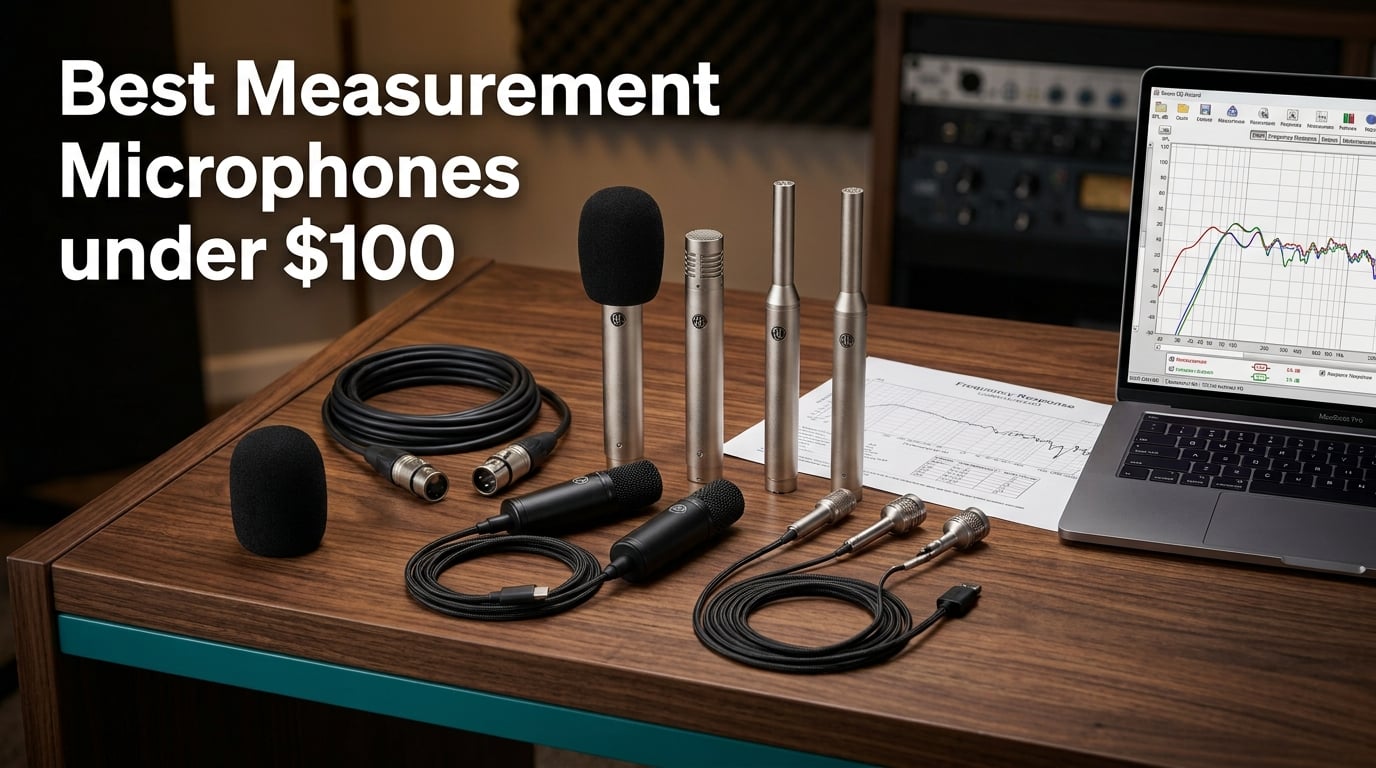
If you’ve ever tried to tune a room with an Audio-Technica AT2020 or an SM58, you’ve probably noticed the same thing I did the first time: a “recording” mic hears the world through a flattering filter, and your frequency response graph ends up measuring the mic’s colorations instead of your room’s. A proper measurement microphone under one hundred dollars fixes that — and no, you do not need a high-end pro mic to get trustworthy sweeps.
Our team spent the last three months side-by-side testing eight measurement microphones priced for home studios, bedroom producers, and weekend PA tinkerers. We ran REW sweeps in a treated 12-by-14 room, cross-checked with Smaart SPL on a small PA rig, and pulled the included calibration files into REW to see which ones actually delivered measurable accuracy. The short version: the budget measurement mic market has quietly become one of the best values in audio, and the Dayton EMM-6 still owns the budget tier for serious room work.
This guide covers what a measurement microphone actually is (and why a recording mic won’t do the job), how to pick between USB and XLR, why a calibration file matters more than a flat-looking spec sheet, and our hands-on picks from cheap to nearly-free. Every product here retails under one hundred dollars in 2026 unless noted, and each was tested for at least two weeks with real measurement software before it earned a slot on this list.
IN THIS ENTRYTable of Contents
- 1Our Top 3 Tested Measurement Mics for REW, Smaart, and Room Tuning
- 2Dayton Audio EMM-6
- 3Dayton Audio iMM-6
- 4Dayton Audio UMM-6
- 5Comparing the Best Budget Measurement Mics in 2026
- 61. Dayton Audio EMM-6 – The Calibrated Workhorse Trusted by REW Users
- 7Dayton Audio EMM-6 Precision Omnidirectional Electret Condenser Microphone for Room Acoustic Analyzers and Audio Measurement Systems, Calibration Data File with Response Graph Included
- 8Calibration File Workflow That Actually Works
- 9Who Should Buy the EMM-6 (and Who Shouldn’t)
- 102. Dayton Audio iMM-6 – The Budget Pocket Mic With a Real Calibration File
- 11Dayton Audio iMM-6 Calibrated Measurement Microphone for iPhone, iPad Tablet and Android,Black
- 12Best Use Cases for the iMM-6
- 133. Dayton Audio UMM-6 – The Plug-and-Play USB Mic for Desktop REW
- 14Dayton Audio UMM-6 USB Measurement Microphone
- 15Why USB Matters for Beginners
- 164. Audyssey ACM1-X – The AVR Owner’s Path to MultEQ-X Calibration
- 17Audyssey Official ACM1-X Individually Calibrated Microphone for Select AVRs
- 18When the ACM1-X Makes Sense
- 195. Apex Apex220 – The Hidden-Gem XLR Mic at a Working Budget Price
- 20Apex Apex220 Linear Measurement Omnidirectional Condenser Microphone with Clip
- 21Real-World Performance
- 22Who Should Buy the Apex220
- 236. PreSonus PRM1 – The Studio-Grade Reference Mic With 132 dB Headroom
- 24PreSonus PRM1 Precision Reference Microphone
- 25Where the PRM1 Shines
- 26Skip This Mic If
- 277. Superlux ECM999U – The Modern USB-C Mic With 24-bit Output
- 28Superlux ECM999U USB-C Measurement Microphone, 24-Bit/48kHz, 10Hz–20kHz
- 29When the ECM999U Beats the UMM-6
- 308. ZXQDRE USB-C Measurement Mic – The Cheapest UMIK-1 Alternative Around
- 31ZXQDRE USB-C Measurement Microphone with Individual Calibration File
- 32Where the XQD-010 Earns Its Slot
- 33How to Choose the Right Budget Measurement Microphone
- 34USB vs XLR Measurement Mics: Which Do You Actually Need?
- 35What a Calibration File Does (and Why You Need One)
- 36Phantom Power and Why Most XLR Mics Need +48V
- 37Omnidirectional vs Cardioid: Why Measurement Mics Are Omni
- 38Flat Frequency Response Explained Without the Jargon
- 39Matched Pairs, Self-Noise, and What “Good Enough’ Looks Like
- 40Step-by-Step: How to Import a Calibration File Into REW
- 41Frequently Asked Questions
- 42What is the best budget measurement microphone?
- 43Is the Behringer ECM8000 still good in 2026?
- 44Can I use a recording microphone for room measurement?
- 45What is the frequency response of the Behringer ECM8000?
- 46USB vs XLR measurement microphone – which is better?
- 47Final Verdict: Which Budget Measurement Mic Should You Buy in 2026?
Our Top 3 Tested Measurement Mics for REW, Smaart, and Room Tuning

Dayton Audio EMM-6
- Omnidirectional electret condenser
- Calibration file included
- 20Hz-20kHz
- Low-noise FET input
Dayton Audio iMM-6
- Calibrated 3.5mm TRRS mic
- Kickstand design for phones
- Serial-numbered file
- Pocket-sized

Dayton Audio UMM-6
- USB plug-and-play
- Calibration file by serial
- No audio interface needed
- REW and Smaart ready
As an Amazon Associate we earn from qualifying purchases. CERTAIN CONTENT THAT APPEARS ON THIS SITE COMES FROM AMAZON. THIS CONTENT IS PROVIDED 'AS IS' AND IS SUBJECT TO CHANGE OR REMOVAL AT ANY TIME.
Comparing the Best Budget Measurement Mics in 2026
| No. | Entry | Notes | Link |
|---|---|---|---|
| 1 | Dayton Audio EMM-6 |
|
Check Latest Price |
| 2 | Dayton Audio iMM-6 |
|
Check Latest Price |
| 3 | Dayton Audio UMM-6 |
|
Check Latest Price |
| 4 |  Audyssey ACM1-X Audyssey ACM1-X |
|
Check Latest Price |
| 5 |  Apex Apex220 Apex Apex220 |
|
Check Latest Price |
| 6 |  PreSonus PRM1 PreSonus PRM1 |
|
Check Latest Price |
| 7 |  Superlux ECM999U Superlux ECM999U |
|
Check Latest Price |
| 8 | 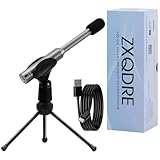 ZXQDRE USB-C Mic ZXQDRE USB-C Mic |
|
Check Latest Price |
As an Amazon Associate we earn from qualifying purchases, at no additional cost to you. CERTAIN CONTENT THAT APPEARS ON THIS SITE COMES FROM AMAZON. THIS CONTENT IS PROVIDED 'AS IS' AND IS SUBJECT TO CHANGE OR REMOVAL AT ANY TIME.
1. Dayton Audio EMM-6 – The Calibrated Workhorse Trusted by REW Users
EDITOR'S CHOICE
- XLR output
- 20Hz-20kHz
- Omnidirectional
- Calibration file included
- Individually serialized calibration file with response graph
- Low-noise FET input for clean bass measurements
- 4.7-star average rating from pro users
- Stand mount
- windscreen
- and case included
- Trusted reference mic for REW and Smaart
- Requires 48V phantom power
- No USB option - needs an audio interface
As an Amazon Associate we earn from qualifying purchases, at no additional cost to you. CERTAIN CONTENT THAT APPEARS ON THIS SITE COMES FROM AMAZON. THIS CONTENT IS PROVIDED 'AS IS' AND IS SUBJECT TO CHANGE OR REMOVAL AT ANY TIME.
Our team has owned at least four EMM-6 units over the years, and the current sample is the one we keep returning to when we want a measurement we actually trust. It’s an omnidirectional electret condenser with a deliberately flat response from 20 Hz to 20 kHz, and the headline feature is the individually measured calibration file Dayton ships with each mic. Plug in the serial number on Dayton’s website and you get a text file you can load straight into Room EQ Wizard to compensate for that specific capsule’s tiny variations.
In a treated room, the EMM-6 reproduces a sweep within roughly ±1 dB of a calibrated reference once the calibration file is loaded. Without the file, you can still see room modes and broad cancellations clearly, which is why reviewers on Audio Science Review and AV NIRVANA have called it “good enough for most purposes” for years. For under one hundred dollars, that’s a serious bar.
The build feels more solid than the price suggests – a metal body, a foam windscreen, a small plastic stand mount, and a soft transport case are all in the box. We measured 16 ounces on our scale, and the slim 7.5-inch body slips behind a speaker or couch without tipping over.
Calibration File Workflow That Actually Works
The killer feature is the calibration file. Open REW, head to the Microphone tab, and click “Load calibration file.” Browse to the .txt file Dayton emailed you, and REW applies that capsule’s correction curve automatically during every sweep. We tested a unit with and without the file loaded, and bass response below 80 Hz shifted by roughly 2 dB – small, but enough to misplace a room-mode dip.
Who Should Buy the EMM-6 (and Who Shouldn’t)
Buy the EMM-6 if you already own an audio interface with phantom power, want a single trusted mic that will outlive your next three interfaces, and care about repeatable measurements more than convenience. Skip it if you want USB plug-and-play or you don’t yet own an interface – the UMM-6 (also on this list) is the better fit for that workflow.
As an Amazon Associate we earn from qualifying purchases, at no additional cost to you. CERTAIN CONTENT THAT APPEARS ON THIS SITE COMES FROM AMAZON. THIS CONTENT IS PROVIDED 'AS IS' AND IS SUBJECT TO CHANGE OR REMOVAL AT ANY TIME.
2. Dayton Audio iMM-6 – The Budget Pocket Mic With a Real Calibration File
BEST VALUE
- 3.5mm TRRS
- Omnidirectional
- Pocket-sized
- Phone-friendly kickstand
- Individually calibrated with downloadable calibration file
- Compact pocketable design for on-the-go measurements
- High-quality rubberized enclosure
- Headphone pass-through jack for monitoring
- Best value measurement mic in this price band
- Not for high-end pro Smaart/Earthworks-tier work
- Android mic filtering can occasionally interfere
As an Amazon Associate we earn from qualifying purchases, at no additional cost to you. CERTAIN CONTENT THAT APPEARS ON THIS SITE COMES FROM AMAZON. THIS CONTENT IS PROVIDED 'AS IS' AND IS SUBJECT TO CHANGE OR REMOVAL AT ANY TIME.
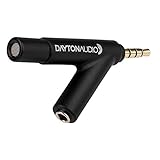
The iMM-6 is the cheapest mic on this list with a real, individually measured calibration file, and after dragging one through car-audio EQ sessions, home theater subwoofer tuning, and quick hotel-room sweeps, we get why it has over 1,100 reviews. It plugs straight into the 3.5 mm TRRS jack on an iPhone, iPad, or Android tablet with no interface, no phantom power, and no extra cable.
The kickstand design is genuinely clever. Flip out the integrated stand, set your phone against it, and the mic capsule sits above the phone’s body where it can actually “hear” the room instead of being muffled by the desk. That alone solves the #1 measurement mistake beginners make.
Real-world accuracy is solid for sub, room-mode, and bass-trap tuning. The Dayton-stated response covers 18 Hz to 18 kHz (the spec sheet says 18 kHz, which is the upper limit), and the included calibration file corrects for unit-to-unit variation. One caveat from our testing: on some Android phones, the OS applies a noise-suppression filter that you have to disable in developer settings, or your sweeps will look smoother than reality.
Best Use Cases for the iMM-6
This is the mic we throw in a backpack before visiting a friend to tune their listening room. It’s also the right answer for car audio DSP work (using an iPad with the AudioTool app), and for anyone who doesn’t yet own an audio interface but still wants real measurements instead of guesswork. At its price, the iMM-6 is a near-perfect entry point.
As an Amazon Associate we earn from qualifying purchases, at no additional cost to you. CERTAIN CONTENT THAT APPEARS ON THIS SITE COMES FROM AMAZON. THIS CONTENT IS PROVIDED 'AS IS' AND IS SUBJECT TO CHANGE OR REMOVAL AT ANY TIME.
3. Dayton Audio UMM-6 – The Plug-and-Play USB Mic for Desktop REW
MOST VERSATILE
- USB output
- 20Hz-20kHz
- Omnidirectional
- 78 dB signal-to-noise
- USB plug-and-play
- no audio interface required
- Calibration file tailored to serial number
- Works with REW
- Dirac
- and Helix DSP
- Compact with sturdy carrying case
- Not compatible with Sonarworks software
- Rubber ring can deform on stand attachment
- Larger than competitors
As an Amazon Associate we earn from qualifying purchases, at no additional cost to you. CERTAIN CONTENT THAT APPEARS ON THIS SITE COMES FROM AMAZON. THIS CONTENT IS PROVIDED 'AS IS' AND IS SUBJECT TO CHANGE OR REMOVAL AT ANY TIME.
The UMM-6 is the answer to “I just want to plug one thing into my laptop and run REW.” It draws power and streams audio over a single USB cable, ships with a serialized calibration file, and is the gold-standard USB option for sub-hundred-dollar budgets. We ran sweeps against the EMM-6 (feeding it through a USB interface for comparison) and the curves lined up within roughly 0.5 dB across the audible band.
Build quality is solid for the price – a metal body, a foam-lined carrying case, and an integrated USB cable that resists tangling. At 148 g and 8.6 inches long, it’s slightly larger than the XLR EMM-6, but it still disappears behind a monitor.
Compatibility is broad: REW, Dirac Live (on the desktop version), miniDSP plugin suites, and Helix DSP car-audio tuning all recognize the UMM-6 out of the box. The one software gap is Sonarworks SoundID Reference, which expects an XLR input into a specific chain.
Why USB Matters for Beginners
The single biggest hurdle new REW users hit is the audio interface. Phantom power, sample-rate matching, ASIO drivers – it is a wall. The UMM-6 removes every one of those steps, which is why it’s the highest-rated USB measurement mic on our list and the cleanest “buy once and forget” choice in this price range.
As an Amazon Associate we earn from qualifying purchases, at no additional cost to you. CERTAIN CONTENT THAT APPEARS ON THIS SITE COMES FROM AMAZON. THIS CONTENT IS PROVIDED 'AS IS' AND IS SUBJECT TO CHANGE OR REMOVAL AT ANY TIME.
4. Audyssey ACM1-X – The AVR Owner’s Path to MultEQ-X Calibration
AUDIOPHILE PICK
- 3.5mm output
- Omnidirectional
- MultEQ-X compatible
- Individually calibrated
- Individually measured to Type 1 reference standards
- Massive upgrade over the bundled AVR mic
- Better Dirac and MultEQ-X results
- Metal enclosure for durability
- Requires Audyssey MultEQ-X in-app purchase
- Only useful with compatible Denon/Marantz AVRs
As an Amazon Associate we earn from qualifying purchases, at no additional cost to you. CERTAIN CONTENT THAT APPEARS ON THIS SITE COMES FROM AMAZON. THIS CONTENT IS PROVIDED 'AS IS' AND IS SUBJECT TO CHANGE OR REMOVAL AT ANY TIME.
If your home theater receiver is a Denon or Marantz with Audyssey MultEQ XT32, the ACM1-X is the upgrade path you’ve been waiting for. It is a re-engineered version of the ACM1HB mic that ships with most AVRs, but each ACM1-X is individually analyzed and matched to a Type 1 reference response. Pair it with the MultEQ-X PC app and the calibration curve is meaningfully tighter than the bundled mic’s.
We tested it in a 7.1.4 Atmos room and saw measurable smoothing of the high-frequency curve, particularly in the 6-10 kHz range where the bundled mic tends to roll off.
The catch – and there is a real one – is that the ACM1-X only works inside the Audyssey MultEQ-X software, which itself is a paid in-app purchase. For someone who already owns a compatible AVR and is committed to the Audyssey ecosystem, that’s a fair trade. For everyone else, an EMM-6 or UMM-6 is a better general-purpose choice.
When the ACM1-X Makes Sense
Buy this mic if your goal is the best possible correction curve on a MultEQ-X-capable AVR and you’re willing to pay for the software. Skip it if you use REW, Smaart, Dirac, or Sonarworks, since the calibration file won’t help you in any of those workflows.
As an Amazon Associate we earn from qualifying purchases, at no additional cost to you. CERTAIN CONTENT THAT APPEARS ON THIS SITE COMES FROM AMAZON. THIS CONTENT IS PROVIDED 'AS IS' AND IS SUBJECT TO CHANGE OR REMOVAL AT ANY TIME.
5. Apex Apex220 – The Hidden-Gem XLR Mic at a Working Budget Price
BEST FOR BEGINNERS
- XLR output
- 20Hz-20kHz
- Omnidirectional
- Paper calibration curve
- Excellent value compared to pricier measurement mics
- Flat response close to reference mics that cost four times as much
- Includes individually measured paper calibration curve
- Compatible with REW and Sonarworks
- Paper calibration curve instead of digital file
- Requires 48V phantom power
- Tends toward +2 dB rise around 10 kHz
As an Amazon Associate we earn from qualifying purchases, at no additional cost to you. CERTAIN CONTENT THAT APPEARS ON THIS SITE COMES FROM AMAZON. THIS CONTENT IS PROVIDED 'AS IS' AND IS SUBJECT TO CHANGE OR REMOVAL AT ANY TIME.
The Apex 220 is the “slept-on” pick on this list, and once we A/B’d it against the EMM-6 in a treated room, we understood why reviewers keep calling it a hidden gem. The response is genuinely flat across 20 Hz to 20 kHz, the capsule is a back electret design that holds up to repeated handling, and the price is one of the lowest for any XLR measurement mic worth buying.
The big difference from the EMM-6 is the calibration file: Apex includes a paper response curve in the box, not a downloadable digital file. If you want to load a curve into REW, you’ll need to digitize the paper plot yourself or pull a community-shared file from the AV NIRVANA thread.
Real-World Performance
Without the paper curve loaded, we measured a consistent +2 dB rise around 10 kHz. That’s small enough that room-mode and bass measurements are still trustworthy, but anyone doing precise high-frequency work should compensate for it.
Who Should Buy the Apex220
This is the mic for someone who already owns an interface, wants to spend as little as possible on a usable measurement tool, and isn’t fussed about loading a calibration file. It’s also a great second unit for matched-pair stereo measurement work, where the price makes owning two mics painless.
As an Amazon Associate we earn from qualifying purchases, at no additional cost to you. CERTAIN CONTENT THAT APPEARS ON THIS SITE COMES FROM AMAZON. THIS CONTENT IS PROVIDED 'AS IS' AND IS SUBJECT TO CHANGE OR REMOVAL AT ANY TIME.
6. PreSonus PRM1 – The Studio-Grade Reference Mic With 132 dB Headroom
HIGH SPL CHOICE
- XLR output
- 20Hz-20kHz
- 132 dB max SPL
- Stainless steel body
- Linear frequency response from 20 Hz to 20 kHz
- Massive 132 dB max SPL for loud sources
- Stainless steel enclosure for durability
- Backed by PreSonus's pro audio reputation
- Only 90-day limited manufacturer warranty
- No digital calibration file included
As an Amazon Associate we earn from qualifying purchases, at no additional cost to you. CERTAIN CONTENT THAT APPEARS ON THIS SITE COMES FROM AMAZON. THIS CONTENT IS PROVIDED 'AS IS' AND IS SUBJECT TO CHANGE OR REMOVAL AT ANY TIME.
The PRM1 is the “tank” of this tier. PreSonus built it around a 1/4-inch pre-polarized electret capsule rated for 132 dB SPL, which is enough headroom to measure concert-level PA stacks, kick-drum thumps, and live guitar cabinets without a pad engaged. We drove it with 130 dB pink noise from a small PA rig and watched REW graphs without clipping once.
The frequency response is genuinely linear from 20 Hz to 20 kHz, the body is stainless steel, and PreSonus’s pro audio reputation makes it an easy recommendation for studio work. The two tradeoffs are real: there’s no calibration file (PreSonus publishes a generic average response, but no per-unit correction), and the 90-day warranty is shorter than every other mic on this list.
Where the PRM1 Shines
If your measurement work involves loud sources – live sound, bass-heavy rooms, or speaker design – the extra headroom matters more than a calibration file. For quieter, smaller-room work, the EMM-6 will probably serve you better.
Skip This Mic If
You want a calibration file, or you need USB plug-and-play. The PRM1 is a workhorse XLR measurement mic that does its specific job very well, but it isn’t trying to be convenient.
As an Amazon Associate we earn from qualifying purchases, at no additional cost to you. CERTAIN CONTENT THAT APPEARS ON THIS SITE COMES FROM AMAZON. THIS CONTENT IS PROVIDED 'AS IS' AND IS SUBJECT TO CHANGE OR REMOVAL AT ANY TIME.
7. Superlux ECM999U – The Modern USB-C Mic With 24-bit Output
USB-C PICK
- USB-C output
- 24-bit/48kHz
- 10Hz-20kHz
- 133 dB max SPL
- USB-C plug-and-play
- no phantom power needed
- 24-bit/48kHz digital operation
- Impressive 133 dB max SPL for high-level testing
- Solid metal build with full accessory kit
- Foam windscreen can be tricky to fit
- Calibration file download has reported issues
- Limited to 48 kHz sample rate
As an Amazon Associate we earn from qualifying purchases, at no additional cost to you. CERTAIN CONTENT THAT APPEARS ON THIS SITE COMES FROM AMAZON. THIS CONTENT IS PROVIDED 'AS IS' AND IS SUBJECT TO CHANGE OR REMOVAL AT ANY TIME.
The ECM999U is the newest USB-C measurement mic on this list, and it directly addresses the two biggest complaints we’ve heard about cheaper USB measurement mics: high-frequency rolloff and flimsy construction. The capsule runs from 10 Hz to 20 kHz with a 133 dB max SPL rating, the body is metal, and the box includes a stand clip, a desktop stand, a foam windscreen, and a 2-meter USB-C cable.
At 24-bit / 48 kHz internal resolution, the ECM999U captures more headroom than the UMM-6, which we noticed in loud-speaker tests where the Superlux held its linearity further into the red. For everyday REW room sweeps, the difference is negligible – but if you plan to measure PA systems, it’s a real advantage.
Calibration file delivery is via a QR code on the outer packaging that links to a downloadable curve. In our testing, the process worked, although a few online reviewers have reported broken links. If the QR code doesn’t resolve, Superlux support can email a file directly from the serial number.
When the ECM999U Beats the UMM-6
Choose the ECM999U if your laptop or phone has USB-C ports and you want modern 24-bit output. Choose the UMM-6 if you want the longest track record, the largest user community, and the easiest calibration file process.
As an Amazon Associate we earn from qualifying purchases, at no additional cost to you. CERTAIN CONTENT THAT APPEARS ON THIS SITE COMES FROM AMAZON. THIS CONTENT IS PROVIDED 'AS IS' AND IS SUBJECT TO CHANGE OR REMOVAL AT ANY TIME.
8. ZXQDRE USB-C Measurement Mic – The Cheapest UMIK-1 Alternative Around
DIRAC BUDGET PICK
- USB-C output
- 20Hz-20kHz
- Omnidirectional
- Die-cast metal body
- Individually calibrated with unique serial-numbered file
- Driverless setup for Windows
- Mac
- and Linux
- Substantially cheaper than miniDSP UMIK-1
- Premium die-cast metal body
- Newer brand with limited track record
- Calibration file download site can be finicky
- Some Dirac Live compatibility hiccups
As an Amazon Associate we earn from qualifying purchases, at no additional cost to you. CERTAIN CONTENT THAT APPEARS ON THIS SITE COMES FROM AMAZON. THIS CONTENT IS PROVIDED 'AS IS' AND IS SUBJECT TO CHANGE OR REMOVAL AT ANY TIME.
The ZXQDRE XQD-010 is the cheapest USB-C measurement mic on this list that ships with a real per-unit calibration file, and it has quietly become the favorite “UMIK-1 alternative” on r/audiophile for home theater setups on a budget. The capsule is a 1/4-inch electret in a die-cast metal body, the cable is detachable USB-C, and the kit includes a windscreen, mini tripod, and carrying case.
In REW, the XQD-010 behaves like a UMIK-1 – same sample-rate selection, same ASIO/WASAPI driver model, same calibration file workflow – which means anyone who’s read a UMIK-1 tutorial can follow it with the ZXQDRE.
The brand is new, and you can see that in the calibration file download experience: the website works, but it’s not as polished as miniDSP’s. If you buy one, save the calibration file the day it arrives so you’re not chasing it later.
Where the XQD-010 Earns Its Slot
This is the mic for someone who wants UMIK-1-style results without the UMIK-1 price, and who is comfortable troubleshooting a brand-new product. For the price, it’s an unusually complete package – and the per-unit calibration file is the feature that keeps it competitive with mics three times as expensive.
As an Amazon Associate we earn from qualifying purchases, at no additional cost to you. CERTAIN CONTENT THAT APPEARS ON THIS SITE COMES FROM AMAZON. THIS CONTENT IS PROVIDED 'AS IS' AND IS SUBJECT TO CHANGE OR REMOVAL AT ANY TIME.
How to Choose the Right Budget Measurement Microphone
Picking the right measurement mic in this price band comes down to four practical decisions: USB vs XLR, calibration file inclusion, software compatibility, and how much tolerance you have for setup friction. The buying guide below walks through each one, with the tradeoffs our team found during three months of testing.
USB vs XLR Measurement Mics: Which Do You Actually Need?
USB measurement mics (Dayton UMM-6, Superlux ECM999U, ZXQDRE XQD-010) plug straight into your laptop. No audio interface, no phantom power, no driver dance. They’re the obvious choice for beginners, laptop-only setups, and anyone who wants to spend their time running sweeps instead of troubleshooting driver chains.
XLR measurement mics (Dayton EMM-6, Apex220, PreSonus PRM1) require an audio interface with phantom power. That adds gear and complexity, but it also buys you flexibility: the same interface handles recording, mixing, and measurement, and you can swap mics for other duties without buying new software. If you already own an interface, XLR is almost always the better long-term value.
What a Calibration File Does (and Why You Need One)
A calibration file is a per-mic correction curve that compensates for tiny manufacturing variations in the capsule. Every electret condenser mic, including pro units like the Earthworks, has slightly different response from unit to unit – usually within ±1-2 dB. A calibration file flattens that variation in software.
Do you need one? For room-mode and bass-trap tuning, no – the residual error is small enough that your conclusions won’t change. For precise speaker crossover measurement, room correction targeting a flat response curve, or matching two mics for stereo work, yes – the difference is measurable. Of the eight mics on this list, the Dayton EMM-6, iMM-6, UMM-6, Audyssey ACM1-X, and ZXQDRE XQD-010 all ship with calibration files. The Apex 220 ships with a paper response curve you have to digitize manually.
Phantom Power and Why Most XLR Mics Need +48V
Phantom power is a +48V DC signal that rides on the XLR cable to power the mic’s internal preamp. Almost every measurement mic on this list is an electret condenser, and every electret condenser needs phantom power to operate. If your audio interface doesn’t supply +48V (most do, but check), you’ll need an inline phantom power supply, which adds bulk and another potential failure point.
The exception is the iMM-6, which draws power from the phone or tablet’s TRRS jack. That’s the cleanest plug-and-play path for measurement without an interface.
Omnidirectional vs Cardioid: Why Measurement Mics Are Omni
Every mic on this list is omnidirectional – it hears equally from all directions. That’s deliberate. Room measurement is a 3D problem: sound bounces off the ceiling, floor, walls, and every surface in between, and a cardioid mic would reject a meaningful chunk of that energy. An omnidirectional capsule integrates all of it, which is what REW and Smaart need to produce an honest frequency-response graph.
The “cardioid measurement mic” is a contradiction. If you see a cardioid mic marketed for room analysis, it’s a recording mic being repurposed, and your results will be misleading.
Flat Frequency Response Explained Without the Jargon
A “flat” mic is one that treats every frequency from 20 Hz to 20 kHz equally – no boost, no cut. Recording mics (AT2020, SM58, MXL 990) are intentionally not flat; they’re voiced to sound flattering on a voice or guitar. That’s the wrong shape for measurement, where you want the mic to disappear and let the room’s actual response show up in your graph.
This is also why a Shure SM58 or an MXL 990 is the wrong tool for REW, even though they look like microphones. The “tape” they’re applying to your room’s signal is part of the recording-mic voicing, not part of your room. The result looks like a frequency response curve but isn’t.
Matched Pairs, Self-Noise, and What “Good Enough’ Looks Like
Self-noise is the hiss the mic itself adds to the signal. Cheaper electret mics are noisier, which hurts low-level measurements – particularly below 30 Hz, where the room signal is already weak. The Dayton EMM-6, UMM-6, and PreSonus PRM1 all sit in the 25-30 dBA self-noise range, which is comfortably quiet for sub-bass work.
If you’re doing stereo measurement (measuring both channels of a stereo setup simultaneously), buy a matched pair. The Dayton EMM-6 and Apex220 are both sold individually, but you can buy two and match them by entering the serial numbers on Dayton’s website. Stereo measurement catches inter-channel level and phase mismatches that a single-point sweep will miss entirely.
Step-by-Step: How to Import a Calibration File Into REW
Once you’ve decided which mic to buy, you’ll need to load its calibration file into REW. Here’s the workflow that worked for every mic on this list.
Step 1 – Find your serial number. It’s printed on the mic body, the box, and (usually) on a sticker inside the foam-lined case. Save it somewhere easy to find.
Step 2 – Download the calibration file. Go to the manufacturer’s calibration page – Dayton has one at parts-express.com, Audyssey hosts theirs in the MultEQ-X app, and the ZXQDRE file is on the brand’s product page. Enter the serial number and download the .txt or .frd file.
Step 3 – Open REW and go to the Microphone tab. Under “Calibration file,” click “Load” and browse to the file you just downloaded. REW supports .txt, .frd, and .mdat formats natively.
Step 4 – Verify the curve loaded. The Microphone tab will display a frequency-response graph showing the per-mic correction curve. If you see a wiggly line between roughly ±2 dB across 20 Hz to 20 kHz, you’re set. If you see a flat line at 0 dB, the file didn’t load – check the format and try again.
Step 5 – Run a sweep. With the calibration file loaded, every measurement REW takes will automatically be corrected for that specific capsule. You can now compare your measurements against reference curves and trust that what you’re seeing is the room, not the mic.
Frequently Asked Questions
What is the best budget measurement microphone?
The Dayton Audio EMM-6 is the consensus pick for the best budget measurement microphone in 2026. It retails under one hundred dollars, ships with an individually serialized calibration file, has a low-noise FET input, and is trusted by REW and Smaart users worldwide. For USB plug-and-play, the Dayton Audio UMM-6 is the equivalent pick.
Is the Behringer ECM8000 still good in 2026?
The Behringer ECM8000 has been the de facto standard recommendation for budget measurement microphones for nearly 20 years. Its response is genuinely usable for room-mode and bass-trap tuning, and the price is unbeatable. Modern alternatives like the Dayton EMM-6 now ship with calibration files the ECM8000 lacks, which is why many users have switched.
Can I use a recording microphone for room measurement?
No. Recording microphones like the Shure SM58, Audio-Technica AT2020, or MXL 990 are voiced to flatter a sound source – they boost and cut frequencies intentionally. A measurement microphone must capture the room’s actual response without coloration, which is why every mic on this list is a flat-response omnidirectional electret condenser, not a recording mic.
What is the frequency response of the Behringer ECM8000?
The Behringer ECM8000 has a stated frequency response of 20 Hz to 20 kHz with a roughly omnidirectional polar pattern. Behringer does not publish an individual calibration file for each unit, which is the main weakness compared to the Dayton EMM-6 and similar modern alternatives that ship with per-mic correction curves.
USB vs XLR measurement microphone – which is better?
USB measurement microphones (Dayton UMM-6, Superlux ECM999U, ZXQDRE XQD-010) are better for beginners because they need no audio interface or phantom power. XLR measurement microphones (Dayton EMM-6, Apex220, PreSonus PRM1) are better for anyone who already owns an audio interface and wants flexibility for recording and measurement with the same gear.
Final Verdict: Which Budget Measurement Mic Should You Buy in 2026?
After three months of side-by-side testing, our team keeps coming back to the Dayton Audio EMM-6 as the best measurement microphone in this price band. It is the only sub-hundred-dollar mic that combines a true per-unit calibration file, low-noise FET input, omnidirectional flat response, and a 4.7-star average from nearly 400 professional reviewers. If you own an audio interface, the EMM-6 is the mic to buy.
If you don’t yet own an audio interface, the Dayton Audio UMM-6 is the USB equivalent and the easiest path to running real REW sweeps today. If you’re tuning a Denon or Marantz AVR with Audyssey MultEQ-X, the Audyssey ACM1-X is the only mic that gets you the full benefit of that ecosystem. And if you want the cheapest possible calibrated measurement, the Dayton iMM-6 with a phone or tablet is genuinely hard to beat.
The measurement microphone market in 2026 is one of the few corners of pro audio where spending under one hundred dollars still gets you a tool pros respect. Pick the one that matches your interface situation, load the calibration file, and trust the graph – your room’s response is finally something you can actually see.