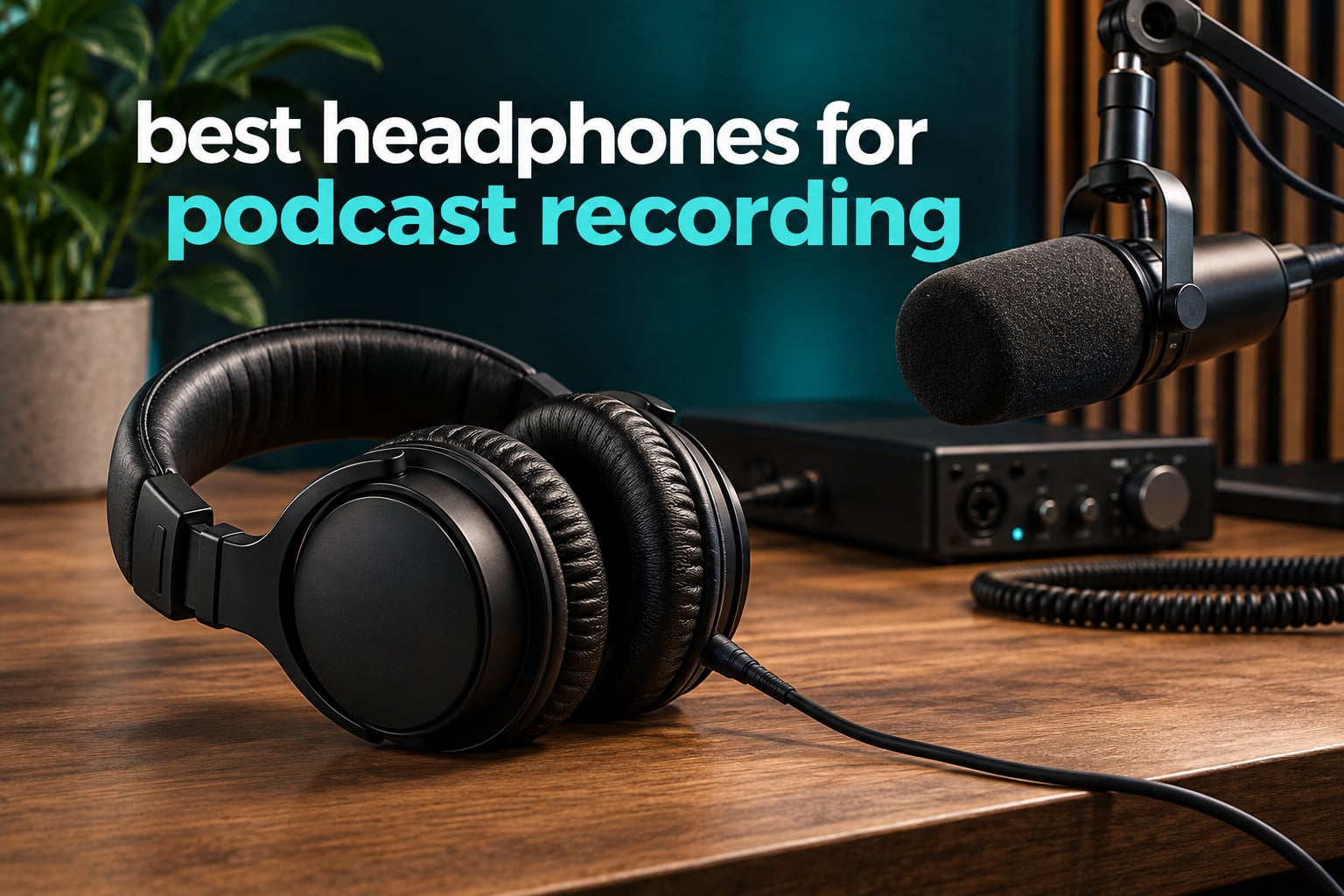
Choosing the best headphones for podcast recording comes down to three things: how much room sound they block, how much of your own playback leaks into the microphone, and whether the connection adds delay. The Audio-Technica ATH-M50x is the pair we recommend to most people, because its closed-back cups stop bleed in both directions, its 38 ohm impedance runs happily off an audio interface, and the detachable cable means a damaged cord costs a few dollars instead of a new headset.
We spent weeks moving these twelve pairs between a treated studio desk, an untreated home office and a live-mic setup, checking what actually shows up in a waveform rather than what looks good on a spec sheet.
IN THIS ENTRYTable of Contents
- 1What to Look For in Podcast Headphones
- 2Our Top 3 Best Headphones for Podcast Recording (October 2026)
- 3Audio-Technica ATH-M50x
- 4Sony MDR-7506
- 5beyerdynamic DT 770 Pro
- 6Quick Overview: Every Pick Compared in 2026
- 7How We Evaluated These Headphones
- 81. Audio-Technica ATH-M50x – The All-Rounder That Handles a Co-Host
- 9Audio-Technica ATH-M50X Professional Studio Monitor Headphones, Black, Professional Grade, Critically Acclaimed, with Detachable Cable
- 10Isolation and Swiveling Cups During Live Tracking
- 11Detachable Cable and 38 Ohm Drive Requirements
- 12Comfort Over a Four-Hour Edit
- 132. Sony MDR-7506 – The Revealing Tracking Standard
- 14Sony MDR7506 Professional Large Diaphragm Headphone
- 15Sensitivity for Catching Plosives and Sibilance
- 16The Non-Detachable Cable Problem
- 1763 Ohm, Folding and Travel
- 183. Audio-Technica ATH-M20x – The Entry Point Into the Same Family
- 19Audio-Technica ATH-M20x Professional Studio Monitor Headphones, Black
- 20Flat Response and Natural Vocal Presence
- 21Clamp Force and Glasses Comfort
- 22Who Should Buy This First
- 234. beyerdynamic DT 770 Pro – Warm Low End and Velour Comfort
- 24beyerdynamic DT 770 PRO 80 Ohm Over-Ear Studio Headphones in Gray. Enclosed Design, Wired for Professional Recording and Monitoring
- 25Isolation for Vocal Booths and Noisy Rooms
- 2680 Ohm and the Headphone Amplifier Question
- 27Bulk, Cables and Wearing Them Around Your Neck
- 285. AKG K240 Studio – Semi-Open Transparency With a Cheap Fix for Broken Cords
- 29AKG K240STUDIO Semi-Open Studio Headphones
- 30Why Semi-Open Is an Editing Advantage
- 31Detachable Cable and the Gimbal Headband
- 32Amplification and Treble Character
- 336. Sennheiser HD 280 Pro – The Isolation Champion
- 34Sennheiser HD 280 Pro Headphone, Black
- 3532 dB of Attenuation in an Untreated Room
- 36Collapsible Earcups for Fast Single-Ear Monitoring
- 37Replaceable Parts and the One Real Weakness
- 387. TASCAM TH-02 – Big Drivers and Low Impedance on a Starter Budget
- 39TASCAM TH-02 Professional Studio Monitor Headphones, Wired, Over Ear — for Recording, Podcast, DJ, Music and Guitar, with 1/4 Inch Jack Adapter
- 4032 Ohm Means Any Interface Will Drive It
- 41Fit Problems You Can Fix in a Minute
- 428. Samson SR850 – Semi-Open Awareness for a Live Room
- 43Samson SR850 Professional Studio Reference Headphones
- 44Semi-Open Sound, Moderate Isolation
- 45Comfort and Bulk Trade-Offs
- 46Where It Earns Its Place
- 479. Sennheiser HD 599 – Open-Back Reference for Critical Listening
- 48Sennheiser HD 599 Open-Back Wired Audiophile Headphones, Ivory
- 49Why Open-Back Belongs in a Podcast Roundup
- 50Two Cables, Two Jobs
- 51The Isolation Reality
- 5210. Philips Over-Ear Wired Headphones – Plug-and-Play Starting Point
- 53Philips Over Ear Wired Stereo Headphones for Podcasts, Studio Monitoring and Recording Headset for Computer, Keyboard and Guitar with 6.3 mm (1/4″) Add On Adapter
- 5416 Ohm and 10 Millisecond Wired Response
- 55Where Accuracy Runs Out
- 5611. MAONO MH601 – Shared Monitoring for Two-Person Shows
- 57MAONO MH601 Wired Studio Headphone for Podcast Recording Stream DJ Mixing
- 58Interchangeable Jack as the Real Feature
- 5950mm Drivers and a Neutral-ish Tone
- 60Cable and On-Camera Practicalities
- 6112. Sennheiser HD 200 Pro – The Lightest Pair for Everyday Monitoring
- 62Sennheiser Pro Audio Professional HD 200 PRO Over-Ear Studio Headphones
- 63When a Lightweight Pair Wins
- 64The Bass Bias and Hiss Floor
- 65Two Meters of Single-Sided Cable
- 66How to Choose Headphones for Podcast Recording
- 67Closed-Back vs Open-Back: Isolation Is the Whole Argument
- 68Wired vs Wireless: Bluetooth Latency Breaks Tracking
- 69Over-Ear vs On-Ear and the Clamp Force Problem
- 70Impedance and Your Interface’s Headphone Output
- 71Hearing Your Own Voice Sounds Wrong. Here Is Why.
- 72Cable Durability Is a Buying Criterion
- 73Hearing Safety During Marathon Edits
- 74Frequently Asked Questions
- 75What headphones do most podcasters use?
- 76Do you need headphones when recording a podcast?
- 77Are open-back or closed-back headphones better for recording?
- 78What is the difference between 32 ohm, 80 ohm and 250 ohm headphones?
- 79Can I use AirPods to record a podcast?
- 80Are noise-cancelling headphones good for podcasting?
- 81Which Headphones Should You Actually Buy?
What to Look For in Podcast Headphones
Closed-back design. Sealed ear cups keep your playback out of the mic and room noise out of your ears, which is what protects the take.
Wired connection. A cabled path means zero latency, so you can judge timing and lip-sync while you are recording rather than guessing.
Flat frequency response. A neutral, unboosted presentation shows you your voice as a listener will hear it, which stops you over-correcting with EQ.
That shortlist is why most of the closed-back headphones for recording we recommend still lead the field. A microphone choice sets the ceiling on your sound; headphones just make sure you can see the ceiling. If you are still building the rest of the chain, start with our podcast microphone guide and come back here once the interface is settled.
Our Top 3 Best Headphones for Podcast Recording (October 2026)

As an Amazon Associate we earn from qualifying purchases. CERTAIN CONTENT THAT APPEARS ON THIS SITE COMES FROM AMAZON. THIS CONTENT IS PROVIDED 'AS IS' AND IS SUBJECT TO CHANGE OR REMOVAL AT ANY TIME.
Quick Overview: Every Pick Compared in 2026
| No. | Entry | Notes | Link |
|---|---|---|---|
| 1 | Audio-Technica ATH-M50x |
|
Check Latest Price |
| 2 |  Sony MDR-7506 Sony MDR-7506 |
|
Check Latest Price |
| 3 |  Audio-Technica ATH-M20x Audio-Technica ATH-M20x |
|
Check Latest Price |
| 4 |  beyerdynamic DT 770 Pro beyerdynamic DT 770 Pro |
|
Check Latest Price |
| 5 |  AKG K240 Studio AKG K240 Studio |
|
Check Latest Price |
| 6 |  Sennheiser HD 280 Pro Sennheiser HD 280 Pro |
|
Check Latest Price |
| 7 |  TASCAM TH-02 TASCAM TH-02 |
|
Check Latest Price |
| 8 |  Samson SR850 Samson SR850 |
|
Check Latest Price |
| 9 |  Sennheiser HD 599 Sennheiser HD 599 |
|
Check Latest Price |
| 10 |  Philips Over-Ear Wired Headphones Philips Over-Ear Wired Headphones |
|
Check Latest Price |
| 11 |  MAONO MH601 MAONO MH601 |
|
Check Latest Price |
| 12 |  Sennheiser HD 200 Pro Sennheiser HD 200 Pro |
|
Check Latest Price |
As an Amazon Associate we earn from qualifying purchases, at no additional cost to you. CERTAIN CONTENT THAT APPEARS ON THIS SITE COMES FROM AMAZON. THIS CONTENT IS PROVIDED 'AS IS' AND IS SUBJECT TO CHANGE OR REMOVAL AT ANY TIME.
How We Evaluated These Headphones
We scored every pair on the same five criteria, weighted toward the things that break a take rather than the things that flatter a demo track.
Isolation and bleed control, 35 percent. How much room noise is blocked, and how much of your monitor mix reaches an open microphone.
Voice accuracy, 25 percent. Whether your sibilance, plosives and room tail are audible at neutral levels.
Comfort over a long session, 20 percent. Clamp force, heat and whether the pads still seal after hours, with and without glasses.
Repairability, 12 percent. Detachable cables, replaceable earpads and headband padding.
Drive requirements, 8 percent. Impedance against a typical interface or laptop headphone output.
Wireless penalty: anything Bluetooth-based lost points on bleed and latency, because a compressed signal arriving late is useless for tracking.
1. Audio-Technica ATH-M50x – The All-Rounder That Handles a Co-Host
EDITOR'S CHOICE
- 45mm rare earth drivers
- 38 ohm impedance
- 20 Hz to 28,000 Hz
- Detachable cable
- Detachable cable means a cheap repair when it frays
- 90 degree swiveling cups for one-ear tracking
- Deep accurate bass with clear upper midrange
- Circumaural fit seals well against room noise
- Closed cups run warm after several hours
- 38 ohm wants a modest headphone amp for maximum output
As an Amazon Associate we earn from qualifying purchases, at no additional cost to you. CERTAIN CONTENT THAT APPEARS ON THIS SITE COMES FROM AMAZON. THIS CONTENT IS PROVIDED 'AS IS' AND IS SUBJECT TO CHANGE OR REMOVAL AT ANY TIME.
This is the pair we hand to anyone recording in a shared room. The 45 mm rare earth magnet drivers with copper clad aluminum voice coils keep a voice intelligible at low monitoring levels, which matters more than extension you will never use in a spoken-word show.
With 33,836 ratings averaging 4.7 stars, the M50x has the deepest review history in the group, and owners consistently describe the same combination: accurate deep bass, exceptional clarity across the extended frequency range, and a circumaural fit that holds off room noise. The 90 degree swiveling earcups let you flip one cup up and put an ear to the room when a guest is talking over you.
Isolation and Swiveling Cups During Live Tracking
The seal around the ear is what keeps click and mix out of your microphone. On a cardioid dynamic mic at a normal desk distance, the closed cups left enough margin that we did not need to chase noise with gain staging alone.
When the interview goes sideways, the swivel is the fastest fix available. Rather than pulling the headphones off and losing your mix reference, one cup rotates and you listen to the room directly.
Detachable Cable and 38 Ohm Drive Requirements
The detachable cable is the single most practical feature for a working podcaster. The socket is at the cup, so a cable that frays at the desk end is a replacement, not a retirement.
At 38 ohm it is easy to drive, though owners report the amplifier route adds a little more headroom than a laptop jack alone. Related reading: our guide to studio headphones for recording vocals covers where this model sits against the rest of the family.
Comfort Over a Four-Hour Edit
The professional grade earpad and headband material holds up, though the closed cups do warm up. On-camera operators tend to favour an open-back look; for audio-only work, that is a fair trade.
As an Amazon Associate we earn from qualifying purchases, at no additional cost to you. CERTAIN CONTENT THAT APPEARS ON THIS SITE COMES FROM AMAZON. THIS CONTENT IS PROVIDED 'AS IS' AND IS SUBJECT TO CHANGE OR REMOVAL AT ANY TIME.
2. Sony MDR-7506 – The Revealing Tracking Standard
TOP RATED
- 40mm neodymium drivers
- 63 ohm impedance
- 10 Hz to 20,000 Hz
- 9.8 foot non-detachable cord
- Exceptionally revealing
- lets you hear sibilance and room tail
- Light at 8 ounces for long sessions
- Coiled cable stretches without dragging gear
- Folds flat into an included case
- Non-detachable cable is a permanent failure point
- Bass is mild for bass-heavy material
- Bright treble can need EQ
- Plastic slider can crack on very large heads
As an Amazon Associate we earn from qualifying purchases, at no additional cost to you. CERTAIN CONTENT THAT APPEARS ON THIS SITE COMES FROM AMAZON. THIS CONTENT IS PROVIDED 'AS IS' AND IS SUBJECT TO CHANGE OR REMOVAL AT ANY TIME.
Introduced in 1991 and still the default answer in broadcast rooms, the MDR-7506 is the most revealing pair in this list. Where the M50x sits back, this one leans forward and shows you every edit, every breath and every tail of room reverb.
Across 28,319 ratings at 4.7 stars, with 83 percent five-star, owners report 10 to 20 years of service. In r/BuyItForLife, users working in music and sound repeatedly recommend this exact model, describing it as the pair you will see in radio stations everywhere.
Sensitivity for Catching Plosives and Sibilance
The 40 mm neodymium drivers produce clear midrange and tight, detailed bass with wide stereo separation. That midrange focus is precisely where plosives and sibilance live, which is why engineers reach for this model when they want to hear problems rather than avoid them.
The trade-off is that the bright treble signature can make some listeners reach for EQ they did not need. If you are new to monitoring, that honesty can feel like a fault before it feels like an advantage.
The Non-Detachable Cable Problem
That 9.8 foot coiled cord ends in a gold plated plug and is permanently attached, which is the most common durability complaint in podcasting forums. It stretches instead of dragging your interface off the desk, but when the strain relief finally cracks there is no repair path.
If cable longevity is your top criterion, the M50x or the HD 280 Pro is the safer purchase. This is the most-cited reason we still put the M50x first.
63 Ohm, Folding and Travel
At 63 ohm it plays from most interfaces without an amplifier, and the folding construction plus included soft case makes it the easiest pair here to move between a home desk and a remote session. One 1/4 inch adapter is included for larger gear.
As an Amazon Associate we earn from qualifying purchases, at no additional cost to you. CERTAIN CONTENT THAT APPEARS ON THIS SITE COMES FROM AMAZON. THIS CONTENT IS PROVIDED 'AS IS' AND IS SUBJECT TO CHANGE OR REMOVAL AT ANY TIME.
3. Audio-Technica ATH-M20x – The Entry Point Into the Same Family
BEST VALUE
- 40mm rare earth drivers
- 47 ohm impedance
- 15 Hz to 20,000 Hz
- 210 g
- Flat uncoloured response for tracking and editing
- Light at 210 g for long sessions
- Closed design blocks a lot of ambient noise
- Single-side cable exit keeps a long cable tidy
- Non-detachable cable
- Light bass compared with the M40x and M50x
- Tight clamping for glasses wearers
- Build feels softer than the M50
As an Amazon Associate we earn from qualifying purchases, at no additional cost to you. CERTAIN CONTENT THAT APPEARS ON THIS SITE COMES FROM AMAZON. THIS CONTENT IS PROVIDED 'AS IS' AND IS SUBJECT TO CHANGE OR REMOVAL AT ANY TIME.
The M20x is the same closed-back architecture and the same rare earth magnet driver family as the M50x, scaled down. For a first podcast, or a second pair for a co-host, it does the job of a studio monitor without the flagship construction.
It carries 27,207 ratings at 4.6 stars with a 77 percent five-star share, and the recurring owner description is a flat, clear, well balanced sound with natural vocal presence. Podcasters on a budget describe it as the pair that simply works for a long recording day.
Flat Response and Natural Vocal Presence
40 mm drivers with copper clad aluminum voice coils are tuned for enhanced low frequency performance, but reviewers still characterise the bass as light next to the M40x and M50x. For speech that reads as honest rather than thin.
The circumaural design contours around the ear for sound isolation in loud environments, and the single-side cable exit means the long run of cable stays out of your way at a desk.
Clamp Force and Glasses Comfort
Two complaints recur. The clamping force can squeeze wearers with glasses, and the lightweight build feels less robust than the M50 series over years of daily handling.
If you wear glasses and edit for six hours at a stretch, step up to the M50x or a velour-pad model rather than pushing through discomfort.
Who Should Buy This First
Anyone recording solo with a cardioid mic in a reasonably treated room. You get zero latency, adequate isolation and an accurate picture of your voice for less than a single plugin.
As an Amazon Associate we earn from qualifying purchases, at no additional cost to you. CERTAIN CONTENT THAT APPEARS ON THIS SITE COMES FROM AMAZON. THIS CONTENT IS PROVIDED 'AS IS' AND IS SUBJECT TO CHANGE OR REMOVAL AT ANY TIME.
4. beyerdynamic DT 770 Pro – Warm Low End and Velour Comfort
PREMIUM PICK
- 80 ohm impedance
- 5 Hz to 35,000 Hz response
- 9.5 ounces
- Replaceable velour pads
- Deep controlled bass many find more engaging than flatter monitors
- Very light despite large cups with plush velour pads
- Strong passive isolation for vocal booths and desks
- Replaceable pads and spring-steel headband
- Bulky cups that do not swivel
- Fixed 3m straight cable
- 80 ohm needs an amp for full volume from a laptop
- Very high frequencies lack sparkle
As an Amazon Associate we earn from qualifying purchases, at no additional cost to you. CERTAIN CONTENT THAT APPEARS ON THIS SITE COMES FROM AMAZON. THIS CONTENT IS PROVIDED 'AS IS' AND IS SUBJECT TO CHANGE OR REMOVAL AT ANY TIME.
The DT 770 Pro is the warm option in a list of mostly neutral monitors. Its bass extension reaches down to 5 Hz while the top end runs to 35,000 Hz, and many users find that low end more engaging for spoken word than a flat reference curve.
With 17,478 ratings at 4.6 and a 79 percent five-star share, owners highlight the isolation, the comfort of the velour pads and the fact that they sound good straight out of the box. Made in Germany, with a spring-steel headband and replaceable grey velour pads.
Isolation for Vocal Booths and Noisy Rooms
The enclosed design provides passive shielding that suits vocal booths, podcast desks and loud shared rooms. It is one of the stronger seals in this roundup, which is the deciding factor when a partner is speaking nearby during your take.
That seal depends on the velour pads sitting properly. Owners report the pads flattening slightly after long use, at which point isolation and bass response both fall off, and replacement pads are a straightforward swap.
80 Ohm and the Headphone Amplifier Question
At 80 ohm the DT 770 wants a real source. Plugged into a laptop headphone jack it will play, but it is quiet enough that you will turn the system volume all the way up, which is a bad habit for hearing safety.
Feed it from an audio interface with a proper headphone output and the trade disappears. If your interface has a high-impedance output setting, use it.
Bulk, Cables and Wearing Them Around Your Neck
At 9.5 ounces it is remarkably light, but the cups are bulky and do not swivel, so they are awkward to rest around your neck between takes. The fixed 3 m straight cable is also not detachable and is longer than most desks need.
As an Amazon Associate we earn from qualifying purchases, at no additional cost to you. CERTAIN CONTENT THAT APPEARS ON THIS SITE COMES FROM AMAZON. THIS CONTENT IS PROVIDED 'AS IS' AND IS SUBJECT TO CHANGE OR REMOVAL AT ANY TIME.
5. AKG K240 Studio – Semi-Open Transparency With a Cheap Fix for Broken Cords
BEST FOR MIX REFERENCE
- 30mm Varimotion transducers
- 55 ohm impedance
- 15 Hz to 25 kHz
- Detachable mini-XLR cable
- Neutral flat response with no artificial bass or treble boost
- Very light on a self-adjusting gimbal headband
- Detachable cable so damage costs almost nothing
- Excellent instrument separation for spoken work
- Semi-open design leaks sound both ways
- Treble can sound harsh at higher levels
- Leatherette pads get warm
- Needs amplification for adequate volume
As an Amazon Associate we earn from qualifying purchases, at no additional cost to you. CERTAIN CONTENT THAT APPEARS ON THIS SITE COMES FROM AMAZON. THIS CONTENT IS PROVIDED 'AS IS' AND IS SUBJECT TO CHANGE OR REMOVAL AT ANY TIME.
The K240 Studio is built for mixing and mastering rather than tracking, and it is honest about that. The 30 mm XXL transducers with patented Varimotion diaphragms give a wide dynamic range, solid bass and clear highs with no deliberate tilt.
Across 12,497 ratings at 4.5 stars with 75 percent five-star, owners treat it as a professional tool rather than an entertainment headphone, and reviewers single out spoken word, podcast editing and voiceover as exactly its strength.
Why Semi-Open Is an Editing Advantage
A semi-open design lets a little sound in and out, which gives a natural, roomy presentation and good awareness of the space around you. For editing in a quiet room, that transparency is the point.
For live tracking with an open microphone, it is a genuine problem. Sound from your monitor mix will reach the mic. If your mic is live, choose a closed-back pair instead.
Detachable Cable and the Gimbal Headband
The proprietary mini-XLR connection means a damaged cord is cheap to replace, which is the single most important repairability feature in this list. A 3 m cable and a screw-on 1/4 inch adapter are included.
The self-adjusting gimbal headband and over-ear pads distribute weight evenly, and at 240 g the K240 stays light through a long day. Reviewers do warn the leatherette pads get warm over time.
Amplification and Treble Character
At 55 ohm with 104 db sensitivity it is efficient, but owners report needing a headphone amp or a good DAC for full volume and dynamic range. Treble can read as slightly harsh and bright at higher listening levels.
As an Amazon Associate we earn from qualifying purchases, at no additional cost to you. CERTAIN CONTENT THAT APPEARS ON THIS SITE COMES FROM AMAZON. THIS CONTENT IS PROVIDED 'AS IS' AND IS SUBJECT TO CHANGE OR REMOVAL AT ANY TIME.
6. Sennheiser HD 280 Pro – The Isolation Champion
BEST FOR ISOLATION
- Up to 32 dB passive attenuation
- 64 ohm impedance
- 8 Hz to 25 kHz
- Replaceable pads and cord
- Attenuation close to ear defenders in a studio headphone
- Replaceable earpads
- headband padding and cord
- 64 ohm needs no amplifier
- Collapsible cups for one-handed single-ear monitoring
- Heavy coiled cord is permanently attached
- Low quality faux leather that can flake or crack
- Some headband cracking reported on very large heads
- Reduced 2k to 8k treble can sound dull without EQ
As an Amazon Associate we earn from qualifying purchases, at no additional cost to you. CERTAIN CONTENT THAT APPEARS ON THIS SITE COMES FROM AMAZON. THIS CONTENT IS PROVIDED 'AS IS' AND IS SUBJECT TO CHANGE OR REMOVAL AT ANY TIME.
If your recording space is genuinely noisy, isolation is the whole argument, and the HD 280 Pro leads this list. The closed dynamic design attenuates outside sound by up to 32 dB, close to hearing protection.
It carries 11,432 ratings at 4.5 stars with 76 percent five-star. In r/podcasting, where users ask for headphones that do not creak, the HD 280 Pro comes up as the common alternative to the Sony MDR-7506 for its solid, non-plastic-feeling build.
32 dB of Attenuation in an Untreated Room
That attenuation figure is the difference between hearing a neighbour’s television as a hint of low end and hearing nothing. It also means the reverse: you barely hear your own monitor bleed in the room, so leakage is minimal.
Users describe the sound as warm, natural and unboosted, with excellent imaging and a surprisingly wide soundstage for a closed-back headphone.
Collapsible Earcups for Fast Single-Ear Monitoring
The earpieces collapse so you can swing one cup to one side with one hand. This is the headphone front-of-house engineers and drummers reach for, and it is the reason to pick it if your show involves a lot of live cueing.
Because the cups collapse rather than swivel, it behaves differently from the ATH-M50x, but the practical speed is comparable.
Replaceable Parts and the One Real Weakness
Earpads, headband padding and the audio cord are all user replaceable, which extends the life of the pair indefinitely. The recurring complaint is the coiled cord itself, which is heavy and permanently attached, and can pull to one side when rested on a desk.
As an Amazon Associate we earn from qualifying purchases, at no additional cost to you. CERTAIN CONTENT THAT APPEARS ON THIS SITE COMES FROM AMAZON. THIS CONTENT IS PROVIDED 'AS IS' AND IS SUBJECT TO CHANGE OR REMOVAL AT ANY TIME.
7. TASCAM TH-02 – Big Drivers and Low Impedance on a Starter Budget
BEST FOR FIRST SETUPS
- 50mm closed-back drivers
- 32 ohm impedance
- 18 Hz to 22 kHz
- 3m cable
- Flat relatively neutral sound well above its class
- 50mm drivers stay clean at high volume
- Very long 3m cable reaches an interface across a desk
- Foldable with a snap-on 1/4 inch adapter
- Round earpads press on larger ears
- Clamping force is very tight out of the box
- Thin bass below roughly 100 Hz with a midrange peak
- Foam padding feels cheap and pads need replacing
As an Amazon Associate we earn from qualifying purchases, at no additional cost to you. CERTAIN CONTENT THAT APPEARS ON THIS SITE COMES FROM AMAZON. THIS CONTENT IS PROVIDED 'AS IS' AND IS SUBJECT TO CHANGE OR REMOVAL AT ANY TIME.
The TASCAM TH-02 pairs 50 mm closed-back dynamic drivers with a 32 ohm impedance, which is the rare combination of generous driver size and easy driving. It is a backup headphone, a field-recorder companion or a first pair, depending on your setup.
With 10,929 ratings at 4.3 and 67 percent five-star, the TH-02 is regularly called a secret gem for pre-mixing and home studio monitoring. A measurement-minded reviewer comparing nine models found it accurate and well balanced next to pricier references.
32 Ohm Means Any Interface Will Drive It
At 32 ohm and 98 db sensitivity it produces usable level from almost any source, including a laptop or a field recorder. That makes it a practical pick for location work where the destination jack is whatever you happen to have.
The closed-back design gives clean sound with a rich bass response and crisp highs, and stays clear with no muddiness when pushed to high monitoring levels.
Fit Problems You Can Fix in a Minute
The most common complaints are mechanical. The round earpads are small and can press on larger ears, and the clamping force is very tight out of the box and may need stretching.
Both are soft problems, unlike the fixed-cable failures on some other models here, and the ear pads are replaceable. Sound-wise, expect thin bass below roughly 100 Hz and a midrange peak some listeners find fatiguing.
As an Amazon Associate we earn from qualifying purchases, at no additional cost to you. CERTAIN CONTENT THAT APPEARS ON THIS SITE COMES FROM AMAZON. THIS CONTENT IS PROVIDED 'AS IS' AND IS SUBJECT TO CHANGE OR REMOVAL AT ANY TIME.
8. Samson SR850 – Semi-Open Awareness for a Live Room
BEST FOR ROOM AWARENESS
- 50mm dynamic drivers
- 32 ohm impedance
- 10 Hz to 30,000 Hz
- Semi-open design
- Semi-open design gives natural spacious sound and room awareness
- 32 ohm is easy to drive from laptops
- Self-adjusting headband spreads weight comfortably
- Gold plated 1/4 inch adapter included
- Leaks sound and provides only moderate isolation
- Heavier and bulkier than most rivals at this level
- Larger cups can feel warm over long sessions
- Less resolving than closed-back references
As an Amazon Associate we earn from qualifying purchases, at no additional cost to you. CERTAIN CONTENT THAT APPEARS ON THIS SITE COMES FROM AMAZON. THIS CONTENT IS PROVIDED 'AS IS' AND IS SUBJECT TO CHANGE OR REMOVAL AT ANY TIME.
The SR850 answers a question most roundups ignore: what if you want to hear the room while you edit? Its semi-open design gives natural, spacious sound and ambient awareness that closed models deliberately remove.
Across 7,843 ratings at 4.5 stars with a 72 percent five-star share, reviewers who compare it with Audio-Technica’s M20x and M50x find the Samson slightly louder and more open, with pleasant cloth-covered pad comfort but less definition.
Semi-Open Sound, Moderate Isolation
50 mm drivers reproduce a wide dynamic range across 10 Hz to 30,000 Hz. The roomy signature suits mixing and casual monitoring in a controlled space, where hearing a little ambience is useful rather than harmful.
The cost is bleed. Anything you monitor will leak into the room, which rules this out for live tracking with an open mic.
Comfort and Bulk Trade-Offs
The self-adjusting headband distributes weight well, but at 1.1 pounds this is among the heavier pairs here and the larger cups can feel warm over long sessions. If you are recording in a cool room and editing in the same space, that trade is reasonable.
Where It Earns Its Place
Use the SR850 as an editing and quality-control headphone rather than your tracking pair. Two closed-back headphones in a small untreated room is a common, worthwhile setup.
As an Amazon Associate we earn from qualifying purchases, at no additional cost to you. CERTAIN CONTENT THAT APPEARS ON THIS SITE COMES FROM AMAZON. THIS CONTENT IS PROVIDED 'AS IS' AND IS SUBJECT TO CHANGE OR REMOVAL AT ANY TIME.
9. Sennheiser HD 599 – Open-Back Reference for Critical Listening
BEST FOR OPEN-BACK REVIEW
- Open-back around-ear
- 50 ohm impedance
- 12 Hz to 38,500 Hz
- Two detachable cables
- Wide open soundstage for critical review of a finished episode
- Aluminum voice coil transducers with very low distortion
- Velour pads and padded headband avoid ear pressure
- Two detachable cables for studio and portable use
- Almost no passive isolation and it leaks into the room
- Unsuitable for live tracking or noisy recording
- Heavier than most closed-back monitoring headphones
- Open design suits only quiet listening rooms
As an Amazon Associate we earn from qualifying purchases, at no additional cost to you. CERTAIN CONTENT THAT APPEARS ON THIS SITE COMES FROM AMAZON. THIS CONTENT IS PROVIDED 'AS IS' AND IS SUBJECT TO CHANGE OR REMOVAL AT ANY TIME.
The HD 599 is included here as a deliberate counterpoint. An open-back headphone gives you the most natural and spacious presentation available at any budget, and it is a superb tool for reviewing a finished mix in a quiet room.
It holds 6,133 ratings at 4.6 stars with 80 percent five-star, and reviewers consistently highlight the soundstage, the comfort of the velour pads and the inclusion of two detachable cables.
Why Open-Back Belongs in a Podcast Roundup
After a mix is finished, the question is whether it survives reproduction outside your interface. An open-back headphone answers that question more honestly than anything else on this list, because nothing is sealed away from the room.
Sennheiser transducers use aluminum voice coils for high efficiency, excellent dynamics and extremely low distortion, which is what makes the presentation feel unhurried.
Two Cables, Two Jobs
You get a robust 3 meter detachable cable with a 6.3 mm jack for the interface, plus a 1.2 meter detachable cable with a 3.5 mm jack for portable listening. That pairing is unusual at this level and useful if you travel.
At 50 ohm and 0.71 kg, it is heavier than every closed-back pair in this roundup, so long sessions are comfortable but the travel case is not.
The Isolation Reality
Open-back means essentially no passive isolation and audible leakage into the room. Reviewers are clear that this would be a poor choice for recording a live voice in a shared or untreated space.
As an Amazon Associate we earn from qualifying purchases, at no additional cost to you. CERTAIN CONTENT THAT APPEARS ON THIS SITE COMES FROM AMAZON. THIS CONTENT IS PROVIDED 'AS IS' AND IS SUBJECT TO CHANGE OR REMOVAL AT ANY TIME.
10. Philips Over-Ear Wired Headphones – Plug-and-Play Starting Point
BEST STARTER HEADPHONE
- 40mm dynamic drivers
- 16 ohm impedance
- 2 meter cable
- 1/4 inch adapter included
- Very affordable entry point for podcast monitoring
- 40mm drivers give clear sound with impactful bass
- Over-ear fit gives decent passive isolation with little leakage
- 2m cable plus included adapter works with interfaces and laptops
- Maximum volume is lower than costlier models on some sources
- Predominantly plastic build with inconsistent cable durability
- Thin headband padding and small ear pads
- Bass-heavy response limits mixing accuracy
As an Amazon Associate we earn from qualifying purchases, at no additional cost to you. CERTAIN CONTENT THAT APPEARS ON THIS SITE COMES FROM AMAZON. THIS CONTENT IS PROVIDED 'AS IS' AND IS SUBJECT TO CHANGE OR REMOVAL AT ANY TIME.
This is the pair for a first podcast, a student setup or a temporary headphone while a better one is in transit. 40 mm drivers, an over-ear fit for passive noise isolation, and a 2 m cable with a snap-on 1/4 inch adapter for interface or keyboard use.
It is also the lowest rated in this group at 4.1, with 62 percent five-star and 8 percent one-star across 4,549 ratings. Positive reviews call it a solid entry-level option; negative ones focus on volume limits, plastic construction and cable durability.
16 Ohm and 10 Millisecond Wired Response
At 16 ohm impedance this is the easiest pair here to drive, and the fully wired path means no compression and no wireless delay. If your only source is a laptop jack, it will produce level where higher-impedance pairs would struggle.
That efficiency comes with a ceiling. Owners report maximum volume lower than more expensive models on some sources, which matters if your interface headphone output is weak.
Where Accuracy Runs Out
The bass-heavy, inconsistent frequency response is the real limitation. Fine for monitoring that you have recorded, unreliable as a reference for deciding on mixes. The 90 degree rotating earcups do allow one-ear monitoring for cueing.
Think of it as a working headphone with a short expected lifespan, not a studio investment.
As an Amazon Associate we earn from qualifying purchases, at no additional cost to you. CERTAIN CONTENT THAT APPEARS ON THIS SITE COMES FROM AMAZON. THIS CONTENT IS PROVIDED 'AS IS' AND IS SUBJECT TO CHANGE OR REMOVAL AT ANY TIME.
11. MAONO MH601 – Shared Monitoring for Two-Person Shows
BEST FOR SHARED LISTENING
- 50mm drivers
- 32 ohm impedance
- Detachable 9.8 ft spring cable
- Interchangeable 6.35mm jack
- Near-neutral balanced sound comparable to pricier models
- 50mm drivers stay clean at high volume
- Soft closed-back pads block a co-host speaking nearby
- Detachable cable with 3.5mm and 6.35mm included
- Coiled spring cable is short and springs back awkwardly
- Ear cups do not rotate freely despite the listing
- Pads and socket can degrade over time
- Bold white headband branding is visible on camera
As an Amazon Associate we earn from qualifying purchases, at no additional cost to you. CERTAIN CONTENT THAT APPEARS ON THIS SITE COMES FROM AMAZON. THIS CONTENT IS PROVIDED 'AS IS' AND IS SUBJECT TO CHANGE OR REMOVAL AT ANY TIME.
The MH601 is the pair to look at when two people share one interface. It ships with a detachable 9.8 ft spring-loaded cable running from 3.5 mm to 6.35 mm, plus an interchangeable 6.35 mm jack so a second person can plug in and monitor the same feed.
Across 4,183 ratings at 4.5 stars with 73 percent five-star, users report a nearly neutral presentation with more prominent highs when testing against an ATH-M40x, along with strong isolation and good comfort. Soft closed-back protein leather memory foam cushions are specified for long sessions.
Interchangeable Jack as the Real Feature
Most broadcast headphones force you into either one listener or two. The MAONO’s swap jack is the practical answer to a duet-monitoring problem, and it costs nothing extra to carry a spare set of pads.
The manufacturer claims the closed pads block roughly 85 percent of ambient noise, which lines up with owner reports of blocking a co-host speaking nearby.
50mm Drivers and a Neutral-ish Tone
The 50 mm large aperture drivers deliver deeper, accurate bass and stay clear at high listening volume. Owners rate the detail as comparable to headphones at twice the level, which is the strongest claim in the review set.
It is fully passive, with no built-in microphone and no battery, so nothing else can interfere with the signal.
Cable and On-Camera Practicalities
The coiled spring cable is short and springs back, which is awkward when the mixer sits close, and the cups do not rotate freely despite the listing. On camera, the white headband branding is visible, which is worth knowing for a video podcast.
As an Amazon Associate we earn from qualifying purchases, at no additional cost to you. CERTAIN CONTENT THAT APPEARS ON THIS SITE COMES FROM AMAZON. THIS CONTENT IS PROVIDED 'AS IS' AND IS SUBJECT TO CHANGE OR REMOVAL AT ANY TIME.
12. Sennheiser HD 200 Pro – The Lightest Pair for Everyday Monitoring
BEST FOR EVERYDAY MONITORING
- 32 ohm impedance
- 108 db sensitivity
- 184 g
- 2.0 meter cable
- Very light at 184 g with soft ear cushions
- 32 ohm is the easiest to drive in the range
- Closed design reduces ambient noise for calls and monitoring
- Punchy bass suits casual listening and light tracking
- Bass-heavy signature is not reference accurate
- All-plastic construction feels slightly flimsy
- Does not fold and no case is included
- 108 db sensitivity reveals hiss from a poor source
As an Amazon Associate we earn from qualifying purchases, at no additional cost to you. CERTAIN CONTENT THAT APPEARS ON THIS SITE COMES FROM AMAZON. THIS CONTENT IS PROVIDED 'AS IS' AND IS SUBJECT TO CHANGE OR REMOVAL AT ANY TIME.
At 184 g the HD 200 Pro is the lightest over-ear pair here, and with 32 ohm impedance it is also among the easiest to drive. Several podcasters and video creators use it directly for voice and meeting monitoring.
Its 1,025 ratings average 4.4 stars with 71 percent five-star. Reviewers value the low impedance, the low weight and all-day comfort, and criticise the bass bias that limits it as a true reference headphone.
When a Lightweight Pair Wins
For a creator doing four-hour video calls and short voice sessions, weight beats detail. The soft ear cushions and closed around-ear design reduce ambient noise without the clamp you get from heavier over-ear models.
Nothing folds and no case is included, so transport is less tidy than the Sony or TASCAM options.
The Bass Bias and Hiss Floor
The proprietary transducers deliver punchy bass that suits casual listening and light tracking, but reviewers are direct that the signature is not reference accurate for critical mixing. At 108 db sensitivity, it will also reveal hiss from a poor source.
Pair it with a clean interface and it is a fine daily tool. Pair it with a noisy laptop jack and the hiss floor is the first thing you will hear.
Two Meters of Single-Sided Cable
The robust 2.0 meter single-sided cable is long enough to move around a desk without snagging, and a 1/4 inch adapter is included for studio gear.
As an Amazon Associate we earn from qualifying purchases, at no additional cost to you. CERTAIN CONTENT THAT APPEARS ON THIS SITE COMES FROM AMAZON. THIS CONTENT IS PROVIDED 'AS IS' AND IS SUBJECT TO CHANGE OR REMOVAL AT ANY TIME.
How to Choose Headphones for Podcast Recording
Closed-Back vs Open-Back: Isolation Is the Whole Argument
Closed-back for recording, open-back for reviewing a finished mix. That is the short version. A closed ear cup physically blocks your monitor mix from reaching the microphone, and blocks room noise from masking your voice. An open-back cup does neither, so playback bleeds into the take and the room bleeds into your ears.
r/podcasting consensus is the same: closed-back wins for live tracking, and open-back is only worth it when the room is genuinely quiet. In this roundup, the ATH-M50x, MDR-7506, M20x, DT 770 Pro, HD 280 Pro, TASCAM TH-02, MAONO MH601, HD 200 Pro and Philips pair are closed. The K240 Studio and Samson SR850 are semi-open, which is a compromise in both directions. The HD 599 is fully open.
Wired vs Wireless: Bluetooth Latency Breaks Tracking
A cabled connection arrives with effectively no delay, so you can record, judge timing and edit sample-accurately. Bluetooth adds delay and compression, which means you are lip-syncing against audio that arrives late. Users in podcasting communities report AirPods work well for monitoring but are never used for recording, for exactly this reason.
Active noise cancellation is a second trap. It processes the signal to remove noise, which alters what you hear. For a monitoring headphone you want a path that changes as little as possible.
Over-Ear vs On-Ear and the Clamp Force Problem
Circumaural over-ear cups sit around the ear, which gives better isolation and no pressure on the ear canal itself. On-ear cups press directly on the ear and are lighter, which matters for travel but weakens the seal.
Watch the clamp force. Glasses wearers consistently report pain after a few hours with tighter models like the ATH-M20x and TASCAM TH-02. Softer, wider headbands and velour pads, as on the DT 770 Pro and HD 599, distribute pressure better. Check that earpads are replaceable before buying; comfort degrades and pads are the part that wears first.
Impedance and Your Interface’s Headphone Output
Impedance is how hard the headphone is to drive. Anything up to about 64 ohm runs from most audio interfaces and many laptops without an amplifier. At 80 ohm, as on the DT 770 Pro, you will get more output from an interface with a dedicated headphone stage, and less from a phone.
Sensitivity works alongside it. The HD 200 Pro at 108 db produces plenty of level at 32 ohm but exposes source hiss. The Philips pair at 16 ohm is the easiest to drive in this list, but also runs out of headroom first on weak outputs. If you are still choosing the interface, our beginner podcast microphone guide covers the entry-level setups these headphones pair with.
Hearing Your Own Voice Sounds Wrong. Here Is Why.
Almost every new podcaster reacts badly to their own voice in headphones because bone conduction adds a deep, chesty low end that the microphone does not capture. Your ears hear a fuller, lower voice than the mic hears. Nothing is broken.
Three practical workarounds. First, talk while muted and notice that it sounds normal to other people, which recalibrates the expectation. Second, record a short reference pass with no processing, then play it back on speakers; it will sound like the mic, not like your skull. Third, if you must judge while tracking, mix your own track at a low level so your bone-conducted voice does not dominate what you are listening to.
Cable Durability Is a Buying Criterion
Four models in this roundup have permanently attached cables: the MDR-7506, M20x, DT 770 Pro and HD 280 Pro. Cable failure is the most common durability complaint in podcasting communities, and the strain relief at the cup is where it usually starts.
Prefer a detachable design if you can: the ATH-M50x, AKG K240 Studio, HD 599, MAONO MH601 and TASCAM TH-02 all take a replaceable cord. The K240’s mini-XLR connection is the cheapest to repair, and the HD 280 Pro’s cord is replaceable even though the coiled section is heavy.
Hearing Safety During Marathon Edits
Podcast editing is volume work, and long sessions at high levels are a genuine risk. Keep levels moderate, raise the mix quality instead, and use a hearing-protection headphone if your room is loud enough that isolation is already high. The HD 280 Pro’s up to 32 dB of attenuation is a passive hearing-protection benefit as much as a monitoring one.
Give your ears regular breaks. Fatigue dulls judgement, and the decisions you make at hour four are the ones you have to live with.
Frequently Asked Questions
What headphones do most podcasters use?
The Audio-Technica ATH-M50x is the most common answer, and the Sony MDR-7506 is the long-serving alternative. Both are closed-back, over-ear, wired studio monitors with a flat response, which is exactly what podcast recording needs. Users in r/podcasting describe the MDR-7506 as the pair you will see in radio stations everywhere, while the M50x adds a detachable cable that survives heavier desk handling.
Do you need headphones when recording a podcast?
You need them if your microphone is live. Headphones let you hear clipping, plosives, sibilance, hum and dropped connections while you can still fix them, instead of discovering the problem in the edit after the guest’s take is gone. They also stop your monitor audio from bleeding into the microphone. If you record to a separate recorder and post-produce later, you can get away without them, but you lose that safety net.
Are open-back or closed-back headphones better for recording?
Closed-back is better for recording. A closed ear cup blocks your monitor mix from reaching the microphone and blocks room noise from masking your voice, which protects the take. Open-back headphones sound more spacious and natural, but leak sound in both directions, so they are only worth it for reviewing a finished mix in a quiet room. In this roundup, the Sennheiser HD 599 is the open-back editing pick and should not be used for live tracking.
What is the difference between 32 ohm, 80 ohm and 250 ohm headphones?
Impedance is how hard the headphone is to drive. Up to about 64 ohm, most audio interfaces and many laptops will drive the headphone at a usable level without help. At 80 ohm, as on the beyerdynamic DT 770 Pro, you get noticeably more output from an interface with a proper headphone stage and less from a phone. At 250 ohm, plan on a separate headphone amplifier. Higher impedance is not better sound, it is a louder, harder drive requirement.
Can I use AirPods to record a podcast?
Not for recording. Users in podcasting communities report AirPods work well for monitoring but are never used for the recording itself, because Bluetooth latency delays what you hear and the audio is compressed before it reaches your ears. Neither of those is acceptable while you are tracking. Wireless also removes the physical isolation that keeps playback out of your microphone. Use them for calls and playback, and a wired closed-back pair for the mic.
Are noise-cancelling headphones good for podcasting?
For monitoring, no. Active noise cancellation works by processing the signal to identify and remove noise, which changes the sound you hear between what you recorded and what you are judging. A closed-back wired headphone gives you a clean, unprocessed path plus real passive isolation. ANC can be fine for editing in a noisy room, but keep it off for tracking and for critical mix decisions.
Which Headphones Should You Actually Buy?
If you want one answer, the Audio-Technica ATH-M50x is the pair we would buy. It balances isolation, neutral voice accuracy, an easy 38 ohm load and a detachable cable, and its review history of 33,836 ratings makes it the least risky purchase in this guide.
If you already have a decent interface and want the most revealing tracking sound available, go with the Sony MDR-7506 and accept the fixed cable. If your budget is the deciding factor, the ATH-M20x gives you the same architecture at an entry price, or the MAONO MH601 if two people need to monitor one feed.
If you work in a noisy room, the Sennheiser HD 280 Pro blocks the most outside sound here. If you mix for hours and want warmth and velour comfort, the DT 770 Pro is the pick, fed from an interface that can drive 80 ohm. And if you only review finished episodes in a quiet space, add the HD 599 as an open-back second opinion, never as your tracking pair.
Whichever you choose, close the door, plug in the cable, and record a thirty-second reference take before you record the episode. That habit catches more problems than any upgrade.