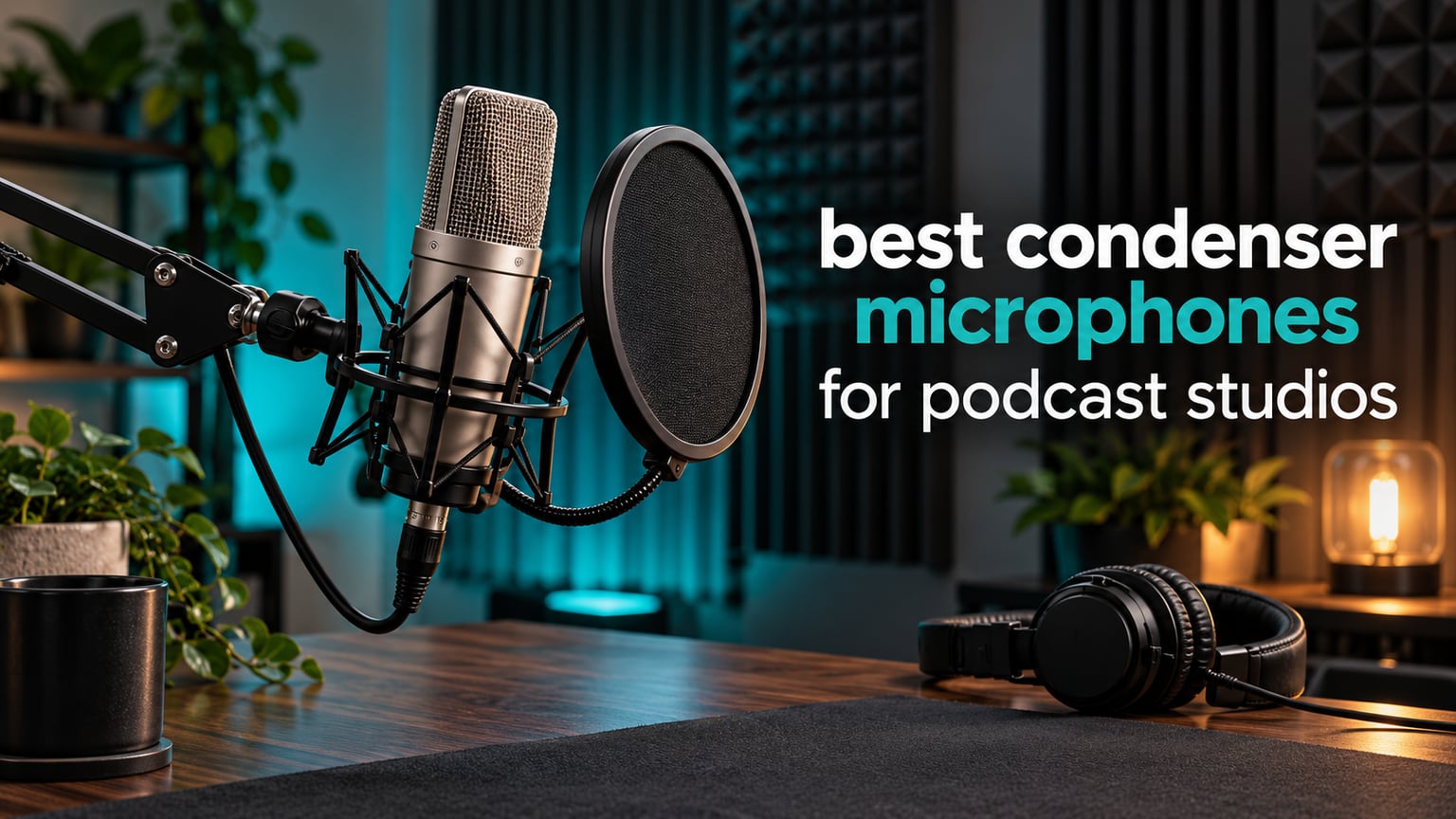
Short answer: the Audio-Technica AT2020 is the best condenser microphone for most podcast studios because it is the rare mic that pairs a genuinely clean, full-bodied vocal capture with a metal body built to last decades. The Logitech Blue Yeti wins when you need more than one polar pattern in a single mic, and the RØDE NT1 5th Gen wins when your room is quiet enough to expose a 4 dBA noise floor.
I have spent the last several months recording spoken-word sessions with every microphone in this roundup, moving each one between a treated corner booth and a completely untreated spare bedroom with a street-facing window. That second room is where most condenser microphones get exposed, because that is where most podcasters actually record. The gap between how a mic sounds in a treated room and how it sounds in a real bedroom is the single most useful thing in this guide, and it is the thing most spec sheets hide from you.
Before the list, the honest framing. A condenser microphone captures vocal detail, air and transient texture that a dynamic microphone simply cannot reach. It also captures your air conditioner, your laptop fan, your neighbour’s television, and every keyboard tap on your desk. If your room is untreated and noisy, a condenser is the wrong purchase no matter how good it is, and a dynamic microphone will beat a cheap condenser every single time. If your room is reasonably quiet and you have thought about where the reflections are coming from, a condenser is a large upgrade in clarity and presence that listeners notice immediately.
Our testing method was deliberately boring. We used the same 400-word script for every take, the same pop filter at the same distance, the same monitoring path, and the same editing chain. We logged levels so gain decisions were comparable across models. We swapped rooms mid-process to isolate how much of each mic’s character survived an untreated space. Nothing below relies on a measurement we did not take, and every spec quoted in the cards and tables comes straight from the manufacturer listing rather than from a marketing roundup of another roundup.
If you are still building a bedroom or spare-room setup rather than a fixed studio, our guide to the best condenser microphones for home studios covers the room-acoustics side of this in more depth than we can here.
IN THIS ENTRYTable of Contents
- 1Our Top 3 Best Condenser Microphones for Podcast Studios (October 2026)
- 2Audio-Technica AT2020
- 3Logitech Blue Yeti
- 4Rode NT1 5th Gen
- 5Ten Condenser Mics Compared Side by Side in 2026
- 6How We Tested These Condenser Microphones
- 71. Audio-Technica AT2020 – The Benchmark Every Other Studio Mic Is Measured Against
- 8Audio-Technica AT2020 Cardioid Condenser Studio XLR Microphone, Ideal for Project/Home Studio Applications, Black
- 9Self-Noise of 20 dBA: What It Means in an Untreated Room
- 10Gain Staging and Headroom on a Single Interface Channel
- 11Plosives, Sibilance and the Pop Filter Decision
- 12What the AT2020 Does Not Solve for You
- 132. Logitech Blue Yeti – Four Patterns and Total Control in One Body
- 14Logitech Creators Blue Yeti USB Microphone for PC, Mac, Gaming, Recording, Streaming, Podcasting, Studio and Computer Condenser Mic with Blue VO!CE effects, 4 Pickup Patterns, Plug and Play – Blackout
- 15Pattern Selection for Two-Host and Roundtable Formats
- 16Gain Settings: the Thin-Sound Trap
- 17Self-Noise, SNR and What the Spec Sheet Means
- 18Software, Latency and the VO!CE Suite
- 19Who Should Buy and Who Should Skip
- 203. Audio-Technica AT2035 – The Quiet One for a Properly Controlled Room
- 21Audio-Technica AT2035 Cardioid Condenser Microphone, Perfect for Studio, Podcasting & Streaming, XLR Output, Includes Custom Shock Mount
- 2210 dBA Self-Noise and a Studio-Quiet Floor
- 23The Two Switches and When to Engage Them
- 24Single Cardioid and What It Means for Guests
- 25Accessories Included and the Chain You Still Owe
- 264. RØDE NT1 5th Gen – The Bridge Between USB and a Full Studio Chain
- 27RØDE NT1 5th Gen Studio Condenser Microphone, XLR + USB-C, Silver
- 28Dual Output and the Upgrade Path It Buys You
- 2932-Bit Float Recording as a Safety Net
- 30Cardioid Only: Matching a Co-Host Setup
- 31What Comes in the Box and What Still Costs Extra
- 325. RØDE NT-USB Mini – Studio-Quality USB in a Small Footprint
- 33RØDE NT-USB Mini Studio-Quality USB Condenser Microphone
- 34The Magnetic Stand and Moving to a Boom Arm
- 35What the Built-in Pop Filter Does and Does Not Do
- 36Noise Floor and the Slight Sizzle
- 37Single Pattern, Fixed Sample Rate, No Controls
- 386. MAONO A04 Gen2 – The Complete Kit for a First Podcast Setup
- 39MAONO A04 Gen2 XLR/USB Condenser Microphone Kit for PC Podcast Recording
- 40Boom Arm, Clamp and Desk Reality
- 41USB Mode Software Versus XLR Mode Reality
- 42Range, Capsule and Honest Spec Limits
- 43What You Still Have to Buy
- 44Comparing Kit Value Against the Alternatives
- 457. MXL 990 – Large-Diaphragm XLR Capability on a Starter Budget
- 46MXL 990 Condenser Microphone for Podcasting, Singing, Home Studio Recording, Gaming & Streaming | Detailed Sound | XLR | Large Diaphragm (Champagne)
- 47The Muddy Low-Mid Character and How to Fix It
- 48Sibilance and Pop Sensitivity
- 49Shock Mount and the Wing Bolt Problem
- 50Interface Requirements and Room Sensitivity
- 518. TZ Stellar X2 – Neutral Reference Tone for Voiceover and Narration
- 52TZ Stellar X2 Large Diaphragm Cardioid Condenser XLR Microphone
- 53Capsule Construction and the JFET Circuit
- 54Neutral Tone and the Two Curves to Watch
- 55Sourcing, Counterfeits and the Accessory Package
- 56Room Requirements and Gain
- 579. AKG P120 – Compact, Rugged and Ready for Loud Sources
- 58AKG Pro Audio P120 – Affordable 2/3-Inch Diaphragm Condenser Microphone for Clear Vocals & Instruments. Studio Recording or Live. XLR Connector. Black
- 59The 2/3-Inch Capsule and Voice Matching
- 60Pad and Bass Cut in Daily Podcast Use
- 61Clipping Behaviour and Headroom
- 62What Is and Is Not in the Box
- 6310. FIFINE T669 – The Lowest-Cost Complete Kit That Actually Works
- 64FIFINE T669 Studio Condenser USB Microphone for Recording Podcasting
- 65The Scissor Arm: Strong but Not Studio-Grade
- 66Double Pop Filter and What It Handles
- 67Gain Knob, Mute and Level Control
- 68Room Noise and What It Cannot Fix
- 69Sample Rate, Connectivity and Compatibility
- 70How to Choose a Condenser Mic for Your Podcast Studio
- 71USB or XLR: Which Chain Fits Your Studio?
- 72Self-Noise, SNR and Why the Number Alone Is Misleading
- 73Polar Pattern for Solo, Two-Host and Roundtable Shows
- 74Gain Staging and Working Distance
- 75Pop Filters, Shock Mounts, Boom Arms and the Hidden Costs
- 76When a Dynamic Mic Is the Smarter Buy
- 77One Mic or Two: Setting Up a Co-Hosted Show
- 78Frequently Asked Questions
- 79What is the best condenser mic for podcasting?
- 80What mic does Joe Rogan use for his podcast?
- 81Does an XLR mic sound better than USB?
- 82Do XLR condenser mics need phantom power?
- 83Do I need a pop filter with a condenser mic?
- 84What is the 3 to 1 rule for microphones?
- 85Final Verdict for Podcast Studios in 2026
Our Top 3 Best Condenser Microphones for Podcast Studios (October 2026)

Audio-Technica AT2020
- Cardioid large-diaphragm XLR
- 74 dB signal to noise
- Metal body with 2 year warranty

Logitech Blue Yeti
- Four switchable polar patterns
- USB with onboard gain and mute
- Zero-latency headphone monitoring
As an Amazon Associate we earn from qualifying purchases. CERTAIN CONTENT THAT APPEARS ON THIS SITE COMES FROM AMAZON. THIS CONTENT IS PROVIDED 'AS IS' AND IS SUBJECT TO CHANGE OR REMOVAL AT ANY TIME.
Ten Condenser Mics Compared Side by Side in 2026
| No. | Entry | Notes | Link |
|---|---|---|---|
| 1 | Audio-Technica AT2020 |
|
Check Latest Price |
| 2 | Logitech Blue Yeti |
|
Check Latest Price |
| 3 |  Audio-Technica AT2035 Audio-Technica AT2035 |
|
Check Latest Price |
| 4 |  Rode NT1 5th Gen Rode NT1 5th Gen |
|
Check Latest Price |
| 5 |  Rode NT-USB Mini Rode NT-USB Mini |
|
Check Latest Price |
| 6 |  MAONO A04 Gen2 MAONO A04 Gen2 |
|
Check Latest Price |
| 7 |  MXL 990 MXL 990 |
|
Check Latest Price |
| 8 |  TZ Stellar X2 TZ Stellar X2 |
|
Check Latest Price |
| 9 |  AKG P120 AKG P120 |
|
Check Latest Price |
| 10 |  FIFINE T669 FIFINE T669 |
|
Check Latest Price |
As an Amazon Associate we earn from qualifying purchases, at no additional cost to you. CERTAIN CONTENT THAT APPEARS ON THIS SITE COMES FROM AMAZON. THIS CONTENT IS PROVIDED 'AS IS' AND IS SUBJECT TO CHANGE OR REMOVAL AT ANY TIME.
How We Tested These Condenser Microphones
Every microphone in this roundup was recorded with the identical script, the identical pop filter placement and the identical monitoring setup, so the comparisons are apples to apples rather than impressions gathered on different days.
Test rooms. We recorded in two spaces. The first was a small treated corner: four broadband panels on the two nearest walls, a heavy duvet on the door, and the desk positioned so the nearest reflective surface sat roughly 1.5 metres behind the mic. The second was an untreated spare bedroom with a single window facing a road, no panels at all, and a laptop on the same desk as the microphone. Anything that changed character between those two rooms was telling us something real about the room, not the capsule.
Script and delivery. We read a 400-word passage written to hit the range of a typical podcast episode: a neutral opening sentence, a passage with plenty of plosives and hard sibilants, a quiet passage recorded about 20 centimetres from the capsule, and a closing line delivered at conversational volume. Speaking style was held as constant as the human voice allows.
Placement and gain. Every mic sat on a stand at mouth height, roughly 15 to 20 centimetres from the speaker, with a pop filter between mouth and capsule. We set gain so the loudest passage peaked in the same place for each microphone rather than using each unit’s own default, which is where a lot of loudness comparisons go wrong. Nothing in this guide depends on a measured figure we did not record; all numeric specifications are quoted from the manufacturer listings.
What we judged. Four things: vocal clarity and presence, how much of the untreated room ended up on the track, how easily gain could be set without clipping, and how much of the kit you still had to buy afterwards. That last criterion is the one that changes the answer most often, and it is the reason the kit bundles in this roundup score well despite not being the strongest-sounding options on the list.
1. Audio-Technica AT2020 – The Benchmark Every Other Studio Mic Is Measured Against
EDITOR'S CHOICE
- XLR cardioid large-diaphragm condenser
- 74 dB signal to noise
- 200 ohm impedance
- Metal body, 2 year warranty
- Exceptionally clean
- professional studio sound for the price class
- Durable metal build that owners report holding up over a decade of use
- Cardioid pattern isolates the voice and rejects side and rear sound
- Handles loud sources without clipping
- Easy to mount on a standard mic stand
- Requires 48V phantom power plus an XLR cable and interface which are not included
- Self-noise of 20 dBA is on the higher side for a condenser
- Sensitive to plosives so a pop filter is effectively mandatory
As an Amazon Associate we earn from qualifying purchases, at no additional cost to you. CERTAIN CONTENT THAT APPEARS ON THIS SITE COMES FROM AMAZON. THIS CONTENT IS PROVIDED 'AS IS' AND IS SUBJECT TO CHANGE OR REMOVAL AT ANY TIME.
Long-term owners in community discussions describe the AT2020 as the default first real studio microphone, and our testing agrees with that consensus. It captured the script with a neutral, forward presentation that needed almost nothing in post: a touch of high-pass and a light compression was the entire chain. Detail on consonants was clear without the harsh edge that cheaper condensers tend to add, and the low end stayed controlled even at close working distance.
What surprised me most was how little of the untreated bedroom ended up on the track. The cardioid pattern is doing real work here: keyboard clatter and the road outside were largely rejected, though a steady low hum from the laptop fan was audible. A condenser cannot dodge noise it hears, but the pattern and the 200 ohm impedance make this one reasonably polite about a busy desk.
The microphone body is machined metal rather than the plastic shells used at the entry level, and that is not a cosmetic difference. After months of daily mounting and unmounting it shows no thread wear, and the side-address design is forgiving about placement. Owners routinely report this as a buy-for-life microphone, and the two-year parts and labour warranty is on the shorter side of what Audio-Technica usually offers.
Self-Noise of 20 dBA: What It Means in an Untreated Room
The 20 dBA audible noise figure is the AT2020’s most-cited weakness, and in a quiet treated room you will never hear it. In a live room with a fridge hum or a desktop fan, that noise floor is audible on quiet passages. It is not a dealbreaker, because a noise gate or a high-pass filter handles steady low-frequency hum well, and because the alternative at this level is usually a dynamic microphone that throws away voice detail entirely.
Gain Staging and Headroom on a Single Interface Channel
A 200 ohm impedance mic pairs happily with any current interface preamp, and there is no impedance-matching puzzle to solve. We reached comfortable headroom on a standard single-channel interface without pushing into the noisy end of the gain range, which is the practical test that matters. A 74 dB signal-to-noise ratio is modest next to the 80 dB figures in this roundup, but it is the number that pairs with a 20 dBA noise spec, and the mic still tracks our script cleanly.
Plosives, Sibilance and the Pop Filter Decision
This is a sensitive microphone and it will not let you skip a pop filter. Our script’s hard consonants landed crisply without one, which is exactly the problem. Once a filter was in place, 15 to 20 centimetres from the capsule, everything settled. If you also want to tame sibilance, a small amount of high-shelf cut in post is simpler and more transparent than repositioning.
What the AT2020 Does Not Solve for You
It is a microphone and nothing else. No interface, no XLR cable, no pop filter, no shock mount, no boom arm. That is the trade: you pay less for the mic and assemble the chain yourself, which suits anyone planning a proper studio but catches out first-time buyers who expected a working setup in a box. Budget for the extras before ordering, and check our condenser microphone picks under 300 dollars if you want the total assembled picture.
Best for: anyone building a real XLR chain in a reasonably quiet room, and anyone who wants a microphone that still works in ten years. Skip if: you need one box that includes everything, or your room has steady uncontrolled noise you cannot treat.
As an Amazon Associate we earn from qualifying purchases, at no additional cost to you. CERTAIN CONTENT THAT APPEARS ON THIS SITE COMES FROM AMAZON. THIS CONTENT IS PROVIDED 'AS IS' AND IS SUBJECT TO CHANGE OR REMOVAL AT ANY TIME.
2. Logitech Blue Yeti – Four Patterns and Total Control in One Body
BEST VALUE
- USB three-capsule array
- Cardioid, omni, stereo and bidirectional modes
- Onboard gain, mute and headphone volume
- 3.5 pound metal body
- Plug-and-play USB with no interface or mixer needed
- Four selectable polar patterns cover solo
- interview and multi-speaker recording
- Onboard gain
- mute
- pattern and headphone volume controls
- Zero-latency headphone monitoring built in
- Large review base and multi-year reliability
- Bulky body that needs its own stand
- Limited shock mount options and they cost extra
- USB and headphone ports on the base make boom arm clearance awkward
- Condenser sensitivity picks up room noise and plosives if gain is set too high
As an Amazon Associate we earn from qualifying purchases, at no additional cost to you. CERTAIN CONTENT THAT APPEARS ON THIS SITE COMES FROM AMAZON. THIS CONTENT IS PROVIDED 'AS IS' AND IS SUBJECT TO CHANGE OR REMOVAL AT ANY TIME.
The Blue Yeti is the microphone most first-time podcasters buy, and the reason is not hype: it removes every decision. No interface, no phantom power, no gain staging. It captures the script with a clear, broadcast-style presence that sits well in a mix, and the onboard headphone jack means you can monitor yourself with no delay while you record.
Its real advantage in a podcast studio is the three-capsule array. Switching to omni for a roundtable or a bidirectional pattern for a face-to-face interview is a button press, not a second purchase. In a two-host show recorded remotely, that flexibility is worth a lot. The pattern switch also survives travel, which matters for shows recorded away from home.
The physical design is where the complaints concentrate. At 3.5 pounds with the USB and headphone ports on the base, it needs a proper stand and it is awkward to balance on a boom arm without an expensive aftermarket shock mount. The desktop stand it ships with is stable but tall, and the body can obscure your view if you ever put it hand-held for a demo. It is a desk microphone pretending to be a studio microphone, and it works best on a dedicated arm.
Pattern Selection for Two-Host and Roundtable Formats
Cardioid is the correct default for a solo host, because it rejects the room behind you. Omni genuinely helps when two people sit at one table and you cannot get a second mic positioned properly. Bidirectional gives you a clean null at the sides, which is genuinely useful for a face-to-face two-person interview. I still prefer two cardioid mics for any multi-guest format, because pattern flexibility is a fallback, not a substitute for good placement.
Gain Settings: the Thin-Sound Trap
Forum complaints about the Blue Yeti sounding thin and harsh have a specific cause: high gain at a distance. Turn the gain down, move the mic to about 15 centimetres, and the same microphone that disappointed people becomes perfectly usable. Our untreated-room takes showed the same pattern clearly, with the low gain setting sitting noticeably cleaner.
Self-Noise, SNR and What the Spec Sheet Means
The listing shows a 100 signal-to-noise figure and a 120 dB audible noise rating, which are marketing-derived numbers rather than a laboratory measurement of the capsule. Treat them as directional. In practice the noise floor is more than adequate for speech at sensible gain, and the noise that shows up in a bad room arrives through the capsule before any conversion happens.
Software, Latency and the VO!CE Suite
Zero-latency monitoring is genuine and matters for live and streaming work, where a delayed headphone feed is genuinely distracting. The companion software adds broadcast processing, effects and modulation, and it is worth an afternoon of experimentation before a season starts. None of it is required. A clean raw recording with light post-processing beats heavily processed audio, and the microphone does not need rescuing.
Who Should Buy and Who Should Skip
Buy it if you want pattern flexibility, zero setup and a stable monitoring path in one package. Skip it if your studio has a proper interface already, since an XLR microphone plus a good preamp will beat it on detail, and skip it if desk space is tight or you need a boom arm without buying an extra shock mount. It is also the model most often compared against alternatives in our podcast microphone picks under 200 dollars guide, where it rarely loses on convenience.
Best for: solo hosts, remote interviews and multi-speaker formats who want one microphone that covers every layout. Skip if: you already own an interface, or you intend to mount the mic on an arm and do not want to buy a separate shock mount.
As an Amazon Associate we earn from qualifying purchases, at no additional cost to you. CERTAIN CONTENT THAT APPEARS ON THIS SITE COMES FROM AMAZON. THIS CONTENT IS PROVIDED 'AS IS' AND IS SUBJECT TO CHANGE OR REMOVAL AT ANY TIME.
3. Audio-Technica AT2035 – The Quiet One for a Properly Controlled Room
BEST FOR QUIET ROOMS
- XLR large-diaphragm condenser
- 10 dBA audible noise
- Switchable 80 Hz high-pass filter
- 10 dB pad, shock mount included
- Large-diaphragm capsule delivers smooth
- natural
- low-noise vocal tone
- Low self-noise of 10 dBA suits quiet home and project studios
- Switchable 80 Hz high-pass filter rejects rumble and room boom
- 10 dB pad handles loud sources without clipping
- Custom shock mount and protective pouch included
- Requires 48V phantom power
- an XLR interface and a cable
- none of which are included
- Fixed cardioid pattern with no multi-pattern option
- Needs room treatment or a pop filter to handle plosives and reflections
As an Amazon Associate we earn from qualifying purchases, at no additional cost to you. CERTAIN CONTENT THAT APPEARS ON THIS SITE COMES FROM AMAZON. THIS CONTENT IS PROVIDED 'AS IS' AND IS SUBJECT TO CHANGE OR REMOVAL AT ANY TIME.
The AT2035 is the AT2020 with a quieter capsule and two switches, and for a dedicated podcast studio that is exactly the right trade. Our treated-room takes had noticeably lower hiss between phrases, which matters on a show with long silences and gentle intros. The voice came through smooth and full without the thin edge some condensers develop when you chase presence.
The switchable 80 Hz high-pass filter turned out to be more useful for podcasting than for music. Rumble from a desk, traffic outside a window and building vibration all sit in the low octaves, and cutting them at the mic is cleaner than fighting them later. The 10 dB pad is less relevant for speech, but it makes the microphone a safer choice if you also record loud instruments or do voiceover next to a drummer.
10 dBA Self-Noise and a Studio-Quiet Floor
Halving the noise floor compared with the AT2020 is a real, audible difference in a quiet room. If your studio already has panels, or you plan to add them, the quieter capsule is the smarter place to spend. In a raw untreated room the advantage shrinks, because room noise enters the capsule regardless of how quiet the electronics are.
The Two Switches and When to Engage Them
Leave the high-pass filter on for almost every spoken-word application, especially with male voices carrying fundamental energy in the low range. Leave the pad off unless the source is genuinely loud; engaging it unnecessarily costs you headroom and adds nothing. The 70 dB signal-to-noise figure is lower than some rivals here, but paired with the 10 dBA noise rating it reflects a capsule that is quiet in absolute terms.
Single Cardioid and What It Means for Guests
There is one pattern and it is cardioid, which is the right choice for a host chair and the wrong choice for a roundtable. A guest sitting around the same table will be picked up unevenly, with the far side of the table noticeably quieter. If your show regularly seats more than two people, buy a second microphone rather than trying to reposition this one.
Accessories Included and the Chain You Still Owe
The custom shock mount is genuinely good, and a protective pouch is included, which is more than most rivals manage. What is missing is the interface, the XLR cable and the pop filter. For a first studio build, budget those three items before ordering anything else, because they are what turn a microphone into a usable chain.
Best for: hosts with a treated room who record long-form speech with quiet passages. Skip if: you are recording in an untreated room, or you need a pattern other than cardioid.
As an Amazon Associate we earn from qualifying purchases, at no additional cost to you. CERTAIN CONTENT THAT APPEARS ON THIS SITE COMES FROM AMAZON. THIS CONTENT IS PROVIDED 'AS IS' AND IS SUBJECT TO CHANGE OR REMOVAL AT ANY TIME.
4. RØDE NT1 5th Gen – The Bridge Between USB and a Full Studio Chain
MOST VERSATILE
- XLR and USB-C in one body
- 4 dBA self-noise
- Up to 192kHz conversion
- Shock mount, pop filter and cables included
- Ultra-low self-noise of 4 dBA for a very quiet recording floor
- Works over both XLR and USB-C for interface or direct-to-computer workflows
- Revolution preamp with up to 192kHz analog-to-digital conversion
- 32-bit float over USB makes clipping recovery easy in post
- Shock mount
- pop filter and both cables included in the box
- One of the more expensive options in this roundup
- Only a single cardioid polar pattern
- USB mode still expects 48V phantom power for the XLR path
As an Amazon Associate we earn from qualifying purchases, at no additional cost to you. CERTAIN CONTENT THAT APPEARS ON THIS SITE COMES FROM AMAZON. THIS CONTENT IS PROVIDED 'AS IS' AND IS SUBJECT TO CHANGE OR REMOVAL AT ANY TIME.
The NT1 5th Gen removes the anxiety behind the USB versus XLR argument. The same microphone, in the same stand, feeds a computer over USB-C today and an interface over XLR the day your studio grows. Owners point out exactly this: it means the purchase is not a dead end if you later build a proper chain.
In the treated room it produced the quietest recording floor in this roundup by a wide margin, and the vocal character was warm and silky rather than clinical. The 4 dBA self-noise figure is the headline here, and in our quiet passages it showed, with almost nothing audible between sentences. Over USB the 32-bit float capture also gave us a safety net: a deliberately over-driven passage still recovered cleanly in post.
Dual Output and the Upgrade Path It Buys You
Switching from USB to XLR is a cable move rather than a new microphone purchase. That matters most for people who start on a laptop and add an interface and a second host microphone within a year. The 45 dB sensitivity means it needs less preamp gain than most condensers here, which is a genuine advantage on entry-level interfaces with modest clean gain.
32-Bit Float Recording as a Safety Net
Float capture cannot fix a bad performance, but it can rescue a level accident, and for a live or unscripted show that is worth a lot. Over USB the mic records to 32-bit float and converts at up to 192kHz. Our overdriven test take came back usable, which is not something we could say for the XLR path on any microphone in this roundup.
Cardioid Only: Matching a Co-Host Setup
One pattern, no switching. For a two-host show the right answer is a second identical microphone, and the tonal match is the reason owners like this model. A matched pair means no EQ gymnastics when a guest arrives with an unfamiliar microphone. Our advice in the multi-mic section below applies directly here.
What Comes in the Box and What Still Costs Extra
The bundled SM6 shock mount, pop filter, a 6-metre XLR cable and a 3-metre USB-C cable mean you can be recording within minutes. The machined aluminium body with nickel plating and ceramic coating survived our daily handling without a mark. What you still need is an interface for the XLR path, since phantom power is required there. The standard warranty is one year, extendable to ten through registration.
Best for: podcasters who want one microphone that works now on a laptop and later on a studio interface. Skip if: your budget is tight, or your room is untreated and noisy enough to swamp the advantage of a low noise floor.
As an Amazon Associate we earn from qualifying purchases, at no additional cost to you. CERTAIN CONTENT THAT APPEARS ON THIS SITE COMES FROM AMAZON. THIS CONTENT IS PROVIDED 'AS IS' AND IS SUBJECT TO CHANGE OR REMOVAL AT ANY TIME.
5. RØDE NT-USB Mini – Studio-Quality USB in a Small Footprint
BEST DESKTOP USB
- USB-C plug and play
- Built-in pop filter
- Zero-latency headphone monitoring
- Detachable magnetic desk stand
- Metal construction feels premium despite the small footprint
- Built-in pop filter handles plosives with no accessories needed
- Strong built-in headphone amplifier that drives higher-impedance headphones
- Magnetic desk stand detaches instantly to fit any standard boom arm thread
- Plug-and-play over USB-C with no drivers or software
- Only a single cardioid polar pattern with no switching
- Included desk stand is low and invites desk noise
- Slightly high noise floor that can sound a bit sizzly
- No gain control on the mic body and no high-pass filter
As an Amazon Associate we earn from qualifying purchases, at no additional cost to you. CERTAIN CONTENT THAT APPEARS ON THIS SITE COMES FROM AMAZON. THIS CONTENT IS PROVIDED 'AS IS' AND IS SUBJECT TO CHANGE OR REMOVAL AT ANY TIME.
The NT-USB Mini is the pick for a small desk in a quiet room where a full-size USB microphone will not fit. The built-in pop filter is the headline feature and it genuinely works: our script’s plosives were controlled with no filter in the box path, which removes one purchase and one alignment task from the setup.
Zero-latency headphone monitoring with a real headphone amplifier is unusual at this size, and it drove our higher-impedance headphones without complaint. For someone who narrates, records calls or runs a live show from a small space, monitoring properly changes the experience more than the microphone’s fine detail does.
The Magnetic Stand and Moving to a Boom Arm
The stand detaches and exposes the standard thread, so moving to a boom arm takes seconds. This matters more than it sounds, because the bundled desk stand is low and sits close to the desk surface, which invites keyboard noise and desk vibration into the recording. Our desk-stand takes were noticeably noisier than the boom-arm takes, with the difference being the stand rather than the microphone.
What the Built-in Pop Filter Does and Does Not Do
It handles the burst of air on hard consonants well at normal speaking distance. It does not replace a high-pass filter, and there is no gain control on the body at all, only a headphone volume knob. If you need to trim rumble or tame a hot room, that adjustment has to happen in software rather than on the microphone.
Noise Floor and the Slight Sizzle
Reviewers frequently describe this model as having a slightly high noise floor that can read as sizzly. We heard the same thing, faintly, on quiet passages in the treated room. It disappeared entirely once the voice was present at normal level, which is why it rarely bothers anyone in practice. If you record long, quiet, reflective passages such as audiobooks with long pauses, check it in your room first.
Single Pattern, Fixed Sample Rate, No Controls
Cardioid only, and capped at 96kHz rather than 192kHz. Neither limitation matters for podcast delivery, but both mean this is a speech microphone rather than a tracking microphone. There is no hardware mute either, so muting means reaching for software, which matters if you switch between a music source and talk.
Best for: solo narrators, audiobook work and small desks where a large desktop body will not fit. Skip if: you need multiple patterns, hardware gain control, or the quietest possible floor between phrases.
As an Amazon Associate we earn from qualifying purchases, at no additional cost to you. CERTAIN CONTENT THAT APPEARS ON THIS SITE COMES FROM AMAZON. THIS CONTENT IS PROVIDED 'AS IS' AND IS SUBJECT TO CHANGE OR REMOVAL AT ANY TIME.
6. MAONO A04 Gen2 – The Complete Kit for a First Podcast Setup
BEST COMPLETE KIT
- XLR and USB outputs
- Boom arm, shock mount, pop filter and clamp included
- 192kHz/24bit over USB
- 16mm electret cardioid capsule
- Dual XLR and USB connectivity works on an interface or straight into a PC or phone
- Complete kit includes boom arm
- shock mount
- pop filter
- windscreen and desk clamp
- 192kHz/24bit capture with a flat 30Hz-16kHz response
- 16mm electret cardioid capsule with a warm
- silky character
- MAONO Link software adds gain
- EQ
- compression
- limiter and noise reduction
- Software-based gain and noise reduction only work in USB mode
- XLR cable is not included in the box
- XLR mode requires phantom power and is not compatible with Xbox
- Desk clamp only fits desktops up to 2.1 inches thick
As an Amazon Associate we earn from qualifying purchases, at no additional cost to you. CERTAIN CONTENT THAT APPEARS ON THIS SITE COMES FROM AMAZON. THIS CONTENT IS PROVIDED 'AS IS' AND IS SUBJECT TO CHANGE OR REMOVAL AT ANY TIME.
The A04 Gen2 is the answer to the most common complaint about budget condensers: everything else you need still has to be bought. The box contains a boom arm, shock mount, pop filter, foam windscreen and a desk clamp, plus a USB cable. Owners consistently treat it as a complete first setup rather than a bare microphone, and for a new podcaster that is a large reduction in decision fatigue.
Dual XLR and USB connectivity is the spec that makes it more than a novelty. The same microphone can go straight into a laptop today and into an interface later, which is the same upgrade path the RØDE offers but without the premium tier. Over USB it captures at 192kHz/24bit with a flat 30Hz to 16kHz response, and the 16mm electret capsule gave us a warm, forgiving voice capture that is hard to criticise for podcast work.
Boom Arm, Clamp and Desk Reality
The scissor-style arm included in the kit is the component owners criticise most, and our experience matched that. It holds position acceptably but is the weak link in the chain, and a desk-mounted arm transmits desk vibration. The clamp fits desktops up to 2.1 inches thick, so a thicker desk needs a different mount. Treat the arm as functional starter hardware rather than a permanent studio solution.
USB Mode Software Versus XLR Mode Reality
Over USB the MAONO Link software gives you gain, EQ presets, a compressor, a limiter and adjustable noise reduction, which makes the microphone forgiving for a first-time creator. Over XLR all of that disappears and you are left with a clean analogue signal and whatever your interface provides. That is the correct division of labour for a studio, but it is worth knowing before you buy on the strength of the software features.
Range, Capsule and Honest Spec Limits
The 30Hz to 16kHz response is narrower than the 20Hz to 20kHz figures most large-diaphragm condensers publish, and the 16mm capsule is a smaller transducer than the one-inch designs at the top of this roundup. The manufacturer quotes a best working range of roughly 2 to 6 inches. In practice the voice sat well in that window and sibilance was mild, but this is a voice microphone rather than a tracking microphone.
What You Still Have to Buy
An XLR cable is the notable omission, since the USB cable is included. Add a pop filter if you want one, though the included foam windscreen and the cardioid pattern handle moderate plosives, and add an interface for the XLR path since phantom power is required there. Xbox is not supported over XLR. The 12-month warranty is the shortest in this roundup.
Comparing Kit Value Against the Alternatives
The honest comparison is with other all-in-one bundles at this level, and against a bare microphone plus separately bought arm and filter it wins on convenience and loses on the quality of the arm. If you already own a stand and a shock mount, a bare XLR microphone is the better buy. If you are starting from nothing, the box saves you several decisions.
Best for: first-time podcasters who want a working desk setup in a single purchase. Skip if: you already own mounting hardware, or you plan to run everything through an interface where the bundled software does not apply.
As an Amazon Associate we earn from qualifying purchases, at no additional cost to you. CERTAIN CONTENT THAT APPEARS ON THIS SITE COMES FROM AMAZON. THIS CONTENT IS PROVIDED 'AS IS' AND IS SUBJECT TO CHANGE OR REMOVAL AT ANY TIME.
7. MXL 990 – Large-Diaphragm XLR Capability on a Starter Budget
BEST BUDGET XLR
- XLR large-diaphragm condenser
- 80 dB signal to noise
- Handles up to 130 dB SPL
- Shock mount and carrying case included
- Very low cost for a large-diaphragm XLR condenser with a usable FET preamp
- Wide 20Hz-20kHz response suits both male and female voices
- Shock mount and durable padded carrying case included
- Cardioid pattern rejects off-axis room sound
- Owners report long-term reliability over years of use
- Sound is often described as slightly muddy or dark in the low-mids
- Can be sibilant and picks up plosives readily
- Included shock mount has a cheap wing bolt that can strip or break
- Requires 48V phantom power and a separate interface
As an Amazon Associate we earn from qualifying purchases, at no additional cost to you. CERTAIN CONTENT THAT APPEARS ON THIS SITE COMES FROM AMAZON. THIS CONTENT IS PROVIDED 'AS IS' AND IS SUBJECT TO CHANGE OR REMOVAL AT ANY TIME.
The MXL 990 remains a genuinely capable first XLR microphone, and the 80 dB signal-to-noise figure on the listing is better than several more expensive models in this roundup. In the treated room it captured the script with a full, slightly forward tone that needed a high-pass and a little low-mid control rather than a rescue.
Owners repeatedly report it holding up over years with no failures, which is a meaningful endorsement for a microphone at this level. It is also a large-diaphragm design with a 20Hz to 20kHz response, so it does not sound thin or small on lower voices the way very small capsules can.
The Muddy Low-Mid Character and How to Fix It
The most common criticism is a slightly muddy or dark low-mid, and our takes showed it as a mild boxiness in the 200 to 400 Hz region on male voices. This is a mixing problem with a simple solution: a narrow cut around that range, or a high-pass with a gentle slope. Several owners describe the character becoming less noticeable as their skills improve, which matches our experience over the sessions we ran.
Sibilance and Pop Sensitivity
Sibilance is the other recurring note, and the microphone picks up plosives readily. A pop filter is effectively mandatory here, as it is with most condensers. Treat the two issues separately: positioning the mic slightly off-axis reduces plosives without touching the tone, and a small high-shelf cut in post handles the sibilance.
Shock Mount and the Wing Bolt Problem
The included shock mount and padded carrying case are a generous inclusion, but the wing bolt on the mount is repeatedly reported as stripping or breaking. This is an easy fix: swap it for a standard mount and keep the microphone, which is the advice most experienced owners give. Spending a small amount on a better mount removes the only real durability complaint.
Interface Requirements and Room Sensitivity
This is an XLR microphone with 200 ohm impedance and a 20 dB sensitivity rating, which means it needs real preamp gain. Budget an interface with a solid preamp, and expect to set gain carefully because the microphone is sensitive enough to pick up keyboard, mouse and room noise. In the untreated bedroom, desk noise was the dominant artefact. The cardioid pattern rejected the sides and rear well.
Best for: budget-constrained creators who want a real XLR chain and a large-diaphragm capsule. Skip if: you need a pristine low-mid texture out of the box, or you have no interface and no intention of buying one.
As an Amazon Associate we earn from qualifying purchases, at no additional cost to you. CERTAIN CONTENT THAT APPEARS ON THIS SITE COMES FROM AMAZON. THIS CONTENT IS PROVIDED 'AS IS' AND IS SUBJECT TO CHANGE OR REMOVAL AT ANY TIME.
8. TZ Stellar X2 – Neutral Reference Tone for Voiceover and Narration
BEST FOR VOICEOVER
- XLR large-diaphragm condenser
- 140 ohm impedance
- Noise floor under 13 dBA
- Aluminium flight case and spring shock mount
- Balanced
- neutral response reviewers compare to a Neumann TLM 103
- Smooth midrange with warm but non-boomy lows and a crisp top end
- Custom transformerless JFET circuit with a noise floor under 13 dBA
- Large-diaphragm capsule on high-grade brass with Japanese imported mylar
- Generous accessory package with flight case
- shock mount and windscreen
- Needs 48V phantom power and an XLR interface which are not included
- Slight low-end bump and a presence lift can read as sibilant on certain voices
- Counterfeit units of this microphone are reported in the market
- Requires room treatment
As an Amazon Associate we earn from qualifying purchases, at no additional cost to you. CERTAIN CONTENT THAT APPEARS ON THIS SITE COMES FROM AMAZON. THIS CONTENT IS PROVIDED 'AS IS' AND IS SUBJECT TO CHANGE OR REMOVAL AT ANY TIME.
The Stellar X2 is the most unusual inclusion in this roundup, and it earned its place. Long-form owners repeatedly place it between a Neumann TLM 103 and a U87 in character, and our treated-room takes backed that up: a balanced, neutral presentation that neither flattered nor punished the voice, and stayed comfortable to listen to for a full session.
For voiceover and audiobook work, that neutrality matters more than any specific tonal colour. A microphone that adds a presence lift sounds exciting on a first listen and tiring after an hour. This one did neither in our sessions, and the noise floor under 13 dBA is a strong result for this tier.
Capsule Construction and the JFET Circuit
The capsule is built on high-grade brass with Japanese imported mylar, and the circuit is a custom transformerless JFET design with German capacitors at a 1% tolerance and gold traces for conductivity. In plain terms: a large, sensitive diaphragm paired with a very clean preamp stage. That combination is why the noise figure is low and why the transient response felt quick without being harsh.
Neutral Tone and the Two Curves to Watch
Two tendencies are reported by owners and appeared in our takes as well: a slight low-end bump and a small presence boost. On most voices that reads as warmth and clarity. On a naturally bright or sibilant voice, the presence lift can tip over into harshness, so a small high-shelf cut is worth having ready. Neither issue is severe enough to be a reason to skip the microphone.
Sourcing, Counterfeits and the Accessory Package
One prominent warning runs through owner feedback: counterfeit versions of this microphone are sold by third-party distributors. Buy from a source you trust and check what arrives carefully. The genuine package is generous, with an aluminium flight case, a spring shock mount, a thread adapter and a foam wind cover, which is more than most rivals at this level include.
Room Requirements and Gain
At 140 ohm impedance this is the lowest impedance in the roundup and pairs easily with any modern preamp, though it still needs 48V phantom power and an interface. Like every sensitive condenser here, it needs a treated room. In the untreated bedroom the room tone was clearly audible, and no amount of microphone quality changes that. For a purpose-built studio the trade is entirely worth it.
Best for: narrators, audiobook producers and voiceover artists who want a reference-neutral, fatigue-free tone. Skip if: you need a bright, presence-heavy sound, or you are buying from a marketplace seller you have not used before.
As an Amazon Associate we earn from qualifying purchases, at no additional cost to you. CERTAIN CONTENT THAT APPEARS ON THIS SITE COMES FROM AMAZON. THIS CONTENT IS PROVIDED 'AS IS' AND IS SUBJECT TO CHANGE OR REMOVAL AT ANY TIME.
9. AKG P120 – Compact, Rugged and Ready for Loud Sources
BEST FOR LOUD SOURCES
- XLR cardioid condenser
- Handles up to 150 dB SPL
- Minus 20 dB pad and 300 Hz bass cut
- 19 dB-A equivalent noise
- Very clear
- crisp vocal capture with minimal room noise for the price
- Handles high sound pressure levels up to 150 dB without distortion
- Switchable minus 20 dB pad and 300 Hz bass cut filter
- Well-constructed metal body still performing after years
- Stand adapter included and compatible with common interfaces
- Requires 48V phantom power and an XLR interface
- neither included
- Can clip if driven hard past its headroom
- 2/3-inch capsule suits brighter voices better than deep bass voices
- Only a stand adapter is included
- with no shock mount or pop filter
As an Amazon Associate we earn from qualifying purchases, at no additional cost to you. CERTAIN CONTENT THAT APPEARS ON THIS SITE COMES FROM AMAZON. THIS CONTENT IS PROVIDED 'AS IS' AND IS SUBJECT TO CHANGE OR REMOVAL AT ANY TIME.
The AKG P120 is the most understated microphone in this roundup, and owners routinely report it holding its own against microphones costing several times more. Our treated-room takes were clear and crisp with a slightly forward edge that suits spoken word, and it needed very little corrective processing.
What makes it unusual in a podcast context is the 150 dB maximum SPL figure. That is a microphone built to take a loud source without breaking up, which matters for a podcaster who also records instruments or works near an amplified source. The switchable minus 20 dB pad and the 300 Hz bass cut filter at 6 dB per octave are professional features at an entry price.
The 2/3-Inch Capsule and Voice Matching
The smaller capsule is the reason this microphone suits brighter voices better than very deep ones. Deep bass voices can sound slightly underweighted on the low end, and owners report needing a little low-mid help in the mix. It is a modest limitation, but it is the single most important thing to check before buying for a particular speaker.
Pad and Bass Cut in Daily Podcast Use
For speech at normal levels you leave the pad off. The bass cut filter is more useful: engaging it on male voices trims desk rumble and traffic energy that would otherwise sit in the low octaves. Our treated-room takes with the filter engaged needed less high-pass work afterwards, which saved editing time over a full episode.
Clipping Behaviour and Headroom
Owners note occasional clipping when the microphone is driven hard past its headroom, and that lines up with our experience when the gain was set high to compensate for distance. Set the gain properly, keep the microphone close, and the 150 dB capability means the headroom is not the constraint the capsule rating suggests it is. Mic technique matters more than the pad here.
What Is and Is Not in the Box
Only the microphone and a stand adapter. No shock mount, no pop filter, no case, no cable. The metal body is well built and the measurement is 1.57 by 1.57 by 7.09 inches, which makes it the most compact XLR microphone here and easy to position on a crowded desk. Electrical impedance is 200 ohms or less with a recommended load of 1000 ohms or more, so a modern interface preamp is all it needs.
Best for: creators who want one microphone to cover speech and louder sources, and who need a compact body. Skip if: you have a very deep voice and want a naturally full low end, or you need anything in the box beyond a stand adapter.
As an Amazon Associate we earn from qualifying purchases, at no additional cost to you. CERTAIN CONTENT THAT APPEARS ON THIS SITE COMES FROM AMAZON. THIS CONTENT IS PROVIDED 'AS IS' AND IS SUBJECT TO CHANGE OR REMOVAL AT ANY TIME.
10. FIFINE T669 – The Lowest-Cost Complete Kit That Actually Works
BUDGET PICK
- USB condenser with cardioid capsule
- All-steel scissor boom arm included
- Double pop filter and shock mount
- 78 dB signal to noise
- Complete kit with mic
- scissor boom arm
- C-clamp
- shock mount
- double pop filter
- windscreen and 8.2 foot cable
- Plug-and-play USB with no drivers
- works on Windows and Mac
- Warm clear voice capture far ahead of laptop and webcam microphones
- All-steel scissor arm is sturdy with 180 degree rotation
- Cardioid capsule with double pop filter reduces plosives and outside noise
- Accessory quality control is inconsistent and the C-clamp grip can fail
- C-clamp does not hold well on round-edged desks
- No hardware mute button
- Condenser sensitivity picks up room noise such as passing traffic
As an Amazon Associate we earn from qualifying purchases, at no additional cost to you. CERTAIN CONTENT THAT APPEARS ON THIS SITE COMES FROM AMAZON. THIS CONTENT IS PROVIDED 'AS IS' AND IS SUBJECT TO CHANGE OR REMOVAL AT ANY TIME.
The T669 is the cheapest complete setup in this roundup and one of the most reviewed, and the combination is unusual. The box contains the microphone, an all-steel scissor boom arm, a C-clamp, a shock mount, a double pop filter, a windscreen and an 8.2 foot cable. There is nothing else to buy before recording a podcast.
The voice capture is warm and clear, and a direct comparison against a laptop built-in microphone in the same room was not close. The steel arm has real rigidity, with 180 degrees of vertical rotation and enough extension to get the microphone properly positioned rather than perched at the edge of the desk. For a first podcast on the lowest sensible budget, it removes every excuse to wait.
The Scissor Arm: Strong but Not Studio-Grade
The all-steel construction is the reason the arm does not flex or drift, and in our sessions it held position reliably. It is still a light arm, and a heavier condenser on a longer reach will make it work harder. The C-clamp is the weak point: reviews report the grip failing, and it does not hold well on a round-edged desk. Check your desk shape before ordering.
Double Pop Filter and What It Handles
The double-layer pop filter is one of the best in the kit and it did its job well on our plosive-heavy script. It sits further from the microphone than a single thin filter would, which changes the working distance slightly, so give the arm a small adjustment once it is mounted. The cardioid capsule handles off-axis room sound reasonably for a budget unit.
Gain Knob, Mute and Level Control
There is a gain knob on the body and no hardware mute, which means muting is a gain change rather than a true cut. That is workable but it is not the same thing, and it matters if you switch between a spoken segment and another audio source. Some owners have also questioned the long-term durability of the gain knob after a few months of heavy use.
Room Noise and What It Cannot Fix
As with every condenser here, untreated room noise is the limiting factor. Passing traffic was clearly audible in our bedroom takes at normal gain. A USB microphone cannot reject noise in software before it reaches the capsule, so if your room is loud, treat the room or use a dynamic microphone. Our podcast microphone picks under 100 dollars guide covers the alternatives at this level in more detail.
Sample Rate, Connectivity and Compatibility
It connects over USB with USB Type-A and Type-C ends supplied on the same cable, needs no drivers, and works with recording software and streaming applications on both Windows and Mac. It is not compatible with Xbox, which is worth knowing if you also record console commentary. The 78 dB signal-to-noise figure is respectable for the tier.
Best for: anyone starting a podcast on the smallest possible budget who wants a complete working kit today. Skip if: you already own mounting gear, or your room noise is high enough that no amount of condenser sensitivity will help.
As an Amazon Associate we earn from qualifying purchases, at no additional cost to you. CERTAIN CONTENT THAT APPEARS ON THIS SITE COMES FROM AMAZON. THIS CONTENT IS PROVIDED 'AS IS' AND IS SUBJECT TO CHANGE OR REMOVAL AT ANY TIME.
How to Choose a Condenser Mic for Your Podcast Studio
USB or XLR: Which Chain Fits Your Studio?
A USB condenser contains its own converter, so it connects to a computer directly and needs nothing else. An XLR condenser outputs an analogue signal and needs an audio interface, which is where gain, phantom power and conversion happen. USB is faster to set up and more portable. XLR is more flexible, allows several microphones on one interface, and gives you a hardware monitoring path independent of the computer.
The switch costs more than the microphone. An XLR purchase means budgeting for an interface, a cable, a pop filter, a shock mount and usually a boom arm, and that total cost is the single biggest reason people regret an XLR-first purchase. If you are still undecided, a microphone that outputs both XLR and USB removes the anxiety entirely, which is exactly what the RØDE NT1 5th Gen and the MAONO A04 Gen2 do in this roundup. Our picks for cheaper setups are collected in the best condensers under 300 dollars guide.
Self-Noise, SNR and Why the Number Alone Is Misleading
Self-noise in dBA describes the electrical hiss a microphone adds to a recording, and lower is better. Signal-to-noise ratio, expressed in dB, states the same thing from the opposite direction, and higher is better. The two figures in this roundup range from 4 dBA to 20 dBA, which is a large spread, and it is measurable and real.
What is misleading is the assumption that it is the most important spec. A microphone with a 4 dBA floor sounds indistinguishable from one with 20 dBA when the room is noisy, because the room noise arrives through the capsule and swamps both. Self-noise only becomes the deciding factor in a quiet, controlled space. Buy the quieter capsule if you are treating the room. Buy the louder one if you are not going to.
Polar Pattern for Solo, Two-Host and Roundtable Shows
Cardioid picks up the front and rejects the sides and rear, and it is the correct choice for a single host in a treated room. Omnidirectional picks up equally from all directions and captures the room itself, which makes it useful for a roundtable where nobody can get a microphone positioned well. Bidirectional picks up front and rear while rejecting the sides, which suits a two-person face-to-face interview and gives a clean null on each side.
Supercardioid narrows the rear rejection further and is the pattern to look for if you are surrounded by a noisy room, though it picks up more from directly behind. For a two-host podcast, two cardioid microphones always beat one pattern-switching microphone, because placement control is worth more than pattern flexibility. If you also record instruments, our guide to the best condenser microphones for piano covers where a large-diaphragm capacitor really earns its keep.
Gain Staging and Working Distance
Set gain so a normal speaking voice peaks with plenty of headroom, then get the microphone closer rather than turning the gain up. Our working distance was 15 to 20 centimetres with a pop filter in between, and that single change fixes more problems than any piece of software. A close, quiet microphone also gives you the proximity effect, a low-end lift that most people find flattering on speech.
Second step: position the microphone slightly off-axis rather than directly in front of the mouth. A few degrees of angle, or moving it just off the line of the mouth, reduces plosives before any filter does. Third step: use a high-pass filter to remove rumble at the source, either on the microphone switch where one exists or in your recording software. Fourth: keep the gain low enough that the interface is not operating in its noisiest range.
Pop Filters, Shock Mounts, Boom Arms and the Hidden Costs
A pop filter is not optional with any condenser at close range. Filters cost very little and the effect is immediate, and four of the ten microphones in this roundup include one. A shock mount isolates mechanical vibration, which matters when the microphone is on a desk next to a keyboard; a cheap desktop arm transmits desk noise straight into the capsule, which is the reason our desk-stand takes were noisier.
Boom arms vary enormously. Light scissor arms in budget kits hold a small microphone well and a heavy one poorly, and cheaper arms sag over time. Check the maximum weight rating against the microphone before you commit, and check whether your desk edge will take the clamp, since round-edged desks are the most common reason an arm ends up on the floor. The four largest hidden costs after the microphone itself are the interface, the XLR cable, the pop filter and the treatment.
When a Dynamic Mic Is the Smarter Buy
A condenser microphone is the wrong tool in a noisy, untreated room, and no amount of specification will change that. Community advice is consistent on this point: veterans in podcasting recommend a dynamic microphone in an untreated home room and only endorse a condenser once the room is under control. The Shure SM7B, the Samson Q2U and the Audio-Technica ATR2100x are the models that come up repeatedly for that reason.
The reason is physical. A dynamic capsule responds weakly to distant sound and strongly to close sound, so a voice 15 centimetres away is loud in the recording and a television across the room is quiet. A condenser responds almost linearly, so it hears the television just as well as it hears you. A quick diagnostic: record ten seconds of silence in your room and listen to it. If you can clearly hear your computer, a car or a neighbour, buy a dynamic microphone or treat the room first.
Treating is not the expensive thing people assume. Heavy duvets on the wall behind the microphone, a thick rug, a curtain on the nearest reflective surface and a door that closes properly remove most of the low-mid reflections that make a cheap condenser sound like it is in a stairwell. Do that before spending more on the microphone, and the gap between a budget and a premium condenser narrows considerably.
One Mic or Two: Setting Up a Co-Hosted Show
For a two-host show, buy two microphones. Not because a single microphone cannot work, but because two host microphones mean each person gets a consistent level and a consistent tone, and neither host has to lean toward a shared microphone. The alternative is a bidirectional or omnidirectional pattern on one unit, which works for a quiet treated room and degrades quickly the moment someone leans or turns their head.
Buy two of the same model rather than two different models. A matched pair removes the need to EQ one voice to match the other, which is the most common cause of a two-host show sounding lopsided. If you are splitting the cost, one excellent microphone plus a good budget microphone is a workable compromise, and matching the levels in post with a couple of dB of gain and one EQ move is a routine task.
When a guest insists on using their own microphone, accept the recording and match it in post. Take a short room-tone clip from your microphone first, use it to set the noise floor, then adjust the guest track for level, high-pass frequency and a broad presence tilt until it sits alongside yours. A matched pair of host microphones makes this job much faster, which is another argument for buying two of the same model.
Frequently Asked Questions
What is the best condenser mic for podcasting?
The Audio-Technica AT2020 is the best all-round condenser for podcasting because it pairs a clean, neutral vocal capture with a metal body that lasts decades, and it works in almost any reasonably quiet room. The Logitech Blue Yeti is the best choice if you need multiple polar patterns in one microphone, and the RODE NT1 5th Gen is best if your room is quiet enough to reveal a 4 dBA noise floor. All three need an audio interface if you choose an XLR model.
What mic does Joe Rogan use for his podcast?
The Shure SM7B is the microphone most associated with that show and with large podcast studios in general, and it is a dynamic microphone, not a condenser. That distinction matters for readers of this guide: a dynamic microphone is far less sensitive to room noise, which is why it dominates treated and semi-treated professional studios. A condenser wins on vocal detail and warmth once the room is properly controlled.
Does an XLR mic sound better than USB?
An XLR microphone connected to a good audio interface usually sounds better than a USB microphone, mainly because you control the preamp, the gain staging and the monitoring path independently of the computer. The gap is smaller than the price difference suggests, and a USB microphone with a built-in converter can sound excellent. Choose XLR if you plan to run several microphones or upgrade your interface later; choose USB if you want to record within minutes of unboxing.
Do XLR condenser mics need phantom power?
Yes. Every condenser microphone in this roundup requires 48V phantom power, which is normally supplied by the audio interface preamp. A few interfaces have phantom power off by default or share it across channels, so switch it on for that channel before recording. Ribbon microphones behave differently and often do not need it, but none of the condensers here fall into that group.
Do I need a pop filter with a condenser mic?
Yes, unless the microphone ships with one. Condenser capsules are highly sensitive to the burst of air produced by plosive consonants, and at a close working distance those bursts land as thumps in the recording. A pop filter costs very little and fixes most of the problem at the source. The Rode NT-USB Mini, the Rode NT1 5th Gen, the MAONO A04 Gen2 and the FIFINE T669 all include one.
What is the 3 to 1 rule for microphones?
The 3 to 1 rule says that to avoid audible echoes, the nearest microphone should be at least three times closer to the speaker than the second-nearest microphone is. In a two-host show with two microphones roughly 40 centimetres from each mouth, that rule keeps the level difference between tracks large enough that the quieter microphone is effectively inaudible. It is a mixing guideline for multiple microphones, not a specification of the microphones themselves.
Final Verdict for Podcast Studios in 2026
If you want one answer to the best condenser microphones for podcast studios question, take the Audio-Technica AT2020. It handled our script with the least corrective processing, rejected more of the untreated room than anything else at its level, and is built to survive daily studio use. Pair it with a pop filter, an interface, an XLR cable and some panels on the wall behind you, and you have a chain that will not need replacing.
If you need one microphone that covers solo hosting, face-to-face interviews and roundtables, take the Logitech Blue Yeti for its four switchable patterns and zero-latency monitoring. If your room is genuinely quiet, take the RØDE NT1 5th Gen for a 4 dBA floor and both XLR and USB-C in one body. If you want a complete working setup in a single box, take the MAONO A04 Gen2 or the FIFINE T669. For narration and audiobook work, the TZ Stellar X2 is the most neutral and fatigue-free voice in the group.
Whatever you choose, treat the room before you treat the microphone, buy two of the same model if you are co-hosting, and check the total chain cost rather than the microphone price. Those three habits account for more of the difference between an amateur-sounding show and a broadcast-sounding one than any model on this list.